Veteran comedian and Nollywood actor Okechukwu Anthony Onyegbule, popularly known as Okey Bakassi, has dismissed a viral social-media claim that his 25-year marriage has collapsed, describing the report as false, disturbing and deeply disrespectful to his family.
The controversy erupted after an old video of the entertainer discussing his preferred candidate in Nigeria’s 2023 presidential election was repurposed and given an entirely different narrative. The accompanying caption falsely suggested that Bakassi had spent 15 years financing his wife and children abroad, only for her to request a divorce after more than a decade of separation.




The fabricated account also claimed that his wife had relocated to the United States to study nursing.
Okey Bakassi responded through his social-media platforms, explaining that he was on a film set when calls began arriving from concerned relatives, friends and fans around the world. He said the report had caused needless anxiety and intruded on a part of his life that he considers especially important.
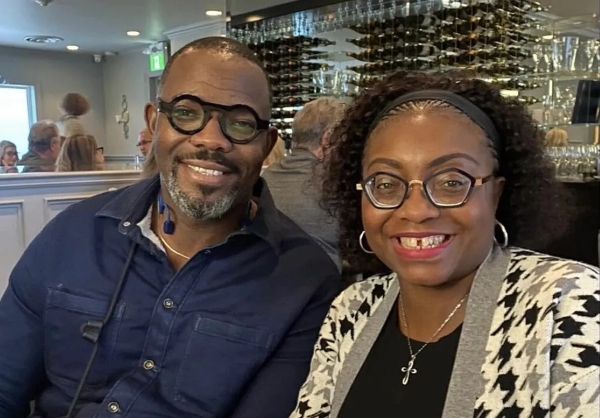
“My wife and I are still together,” he said, assuring supporters that his family remained intact.
The comedian clarified that his wife, Ezinne, lives in Canada—not the United States—and is not a nurse. He added that the couple had recently celebrated their 25th wedding anniversary in Canada, directly contradicting the suggestion that their marriage had broken down.
Bakassi and Ezinne marked the milestone on September 1, 2026. The marriage has produced three children—two daughters and a son.
He urged members of the public to disregard the story and report the account that originated it for violating the rules of X, formerly Twitter. He also criticised people who circulated the claim without first attempting to verify it with him or members of his family.
When Virality Becomes a Business Model
The episode is not merely another celebrity rumour. It exposes the increasingly dangerous commercial machinery behind fabricated digital content.
In the attention economy, emotional stories—particularly those involving marriage, betrayal, death or financial distress—can generate rapid traffic. That traffic may translate into advertising impressions, followers and platform visibility. The incentive structure consequently rewards speed and outrage, sometimes at the expense of truth.
Artificial intelligence and inexpensive editing tools are making the problem harder to contain. A genuine video can be detached from its original context, supported by a fabricated caption and redistributed as apparently authentic content. The image may be real, and the voice may be genuine, while the meaning presented to audiences is entirely false.
For public figures, the consequences can extend beyond embarrassment. Celebrity brands are commercial assets built around reputation, familiarity and trust. False claims about marital instability, financial problems or misconduct can affect endorsement negotiations, event bookings, film partnerships and audience relationships.
Brands working with entertainers must therefore strengthen their reputation-monitoring systems. A viral allegation should not automatically trigger panic or commercial withdrawal; it should trigger verification. Companies that react impulsively to fabricated content risk punishing the victim while rewarding the creator of the falsehood.
A Reputation-Test for Digital Publishers
The incident also challenges online publishers and entertainment platforms to distinguish reporting from amplification. Reproducing a trending claim without contacting the subject, checking the original footage or examining obvious inconsistencies is not journalism. It is distribution without accountability.
The incorrect references to the United States, nursing school and an alleged divorce request could have been tested before publication. Bakassi’s recent anniversary celebration also provided readily available evidence that should, at minimum, have prompted caution.
The entertainer—who combines his comedy and acting career with his position as traditional ruler of the Umuihuocha Autonomous Community in Imo State—has built a public identity extending beyond entertainment. Falsehoods directed at such a personality can affect not only a celebrity brand but also family members, associates and the traditional institution he represents.
Market Implications
Nigeria’s creator economy cannot mature sustainably if fabricated scandal remains an accepted customer-acquisition strategy. Advertisers will increasingly scrutinise the quality of platforms on which their messages appear, while reputable publishers could command greater value by demonstrating stronger verification standards.
Social-media companies also face pressure to improve reporting mechanisms and respond faster when content is demonstrably false. However, responsibility cannot be outsourced entirely to platforms. Audiences, publishers, influencers and advertisers all participate in the market that makes misinformation profitable.
BRANDECONOMY Insight
Okey Bakassi’s rebuttal reveals a central weakness in the digital attention economy: falsehood often travels as entertainment, while correction arrives as damage control.
The lesson for celebrities and corporate brands is clear. Reputation protection can no longer begin after a crisis goes viral. Public figures need active social listening, verified communication channels and rapid-response protocols capable of correcting false narratives before they harden into perceived truth.
For publishers, the standard should be equally uncompromising: virality is not verification, a real video can carry a false story, and traffic obtained by violating trust eventually becomes a reputational liability.
Okey Bakassi has corrected the record about his marriage. The bigger question is whether Nigeria’s digital-content ecosystem will correct the incentives that made the fabrication commercially attractive.