Nigeria’s Sugar Sector Can Create 1 Million Jobs, Reduce Imports and Tackle Insecurity — NSDC
A Rural Industrialisation Opportunity

 The National Sugar Development Council says a fully developed domestic sugar economy could turn more than $1 billion in annual import spending into jobs, power generation and industrial renewal across rural Nigeria.
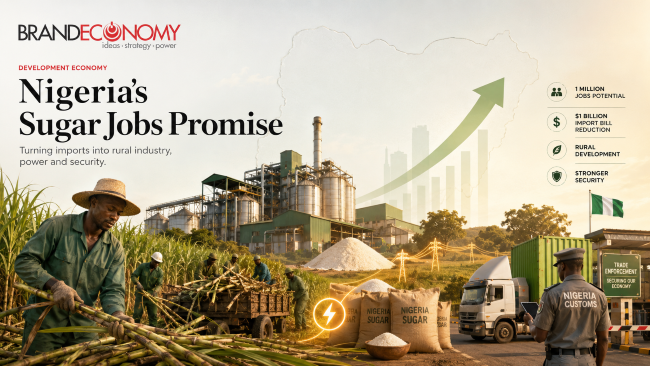 The National Sugar Development Council says a fully developed domestic sugar economy could turn more than $1 billion in annual import spending into jobs, power generation and industrial renewal across rural Nigeria.
Nigeria’s sugar sector has the potential to create as many as one million direct and indirect jobs, stimulate rural industrialisation and help reduce insecurity by providing large-scale employment opportunities for young people, according to the National Sugar Development Council.
The Council’s Executive Secretary, Kamar Bakrin, made the case during a strategic engagement with the Nigeria Customs Service at the Customs Headquarters in Abuja, arguing that sugar development should no longer be viewed merely as an agricultural ambition, but as a wider economic transformation project with implications for jobs, foreign exchange, energy supply and national stability.




Bakrin said Nigeria currently spends more than $1 billion annually on sugar imports, a persistent outflow that could be redirected into domestic investment if the country succeeds in building a competitive local sugar industry.
“If Nigeria succeeds in developing a proper sugar sector, one of the things we would do is convert an annual outflow of over one billion dollars into jobs, security and industrialisation,” he said.
According to him, the sector could generate approximately 250,000 direct jobs and another 750,000 indirect jobs across the value chain, with the bulk of the opportunities concentrated in rural communities across about 12 states.
“The beauty of it is that these are rural jobs, not city jobs,” Bakrin said.
A Rural Industrialisation Opportunity
Bakrin’s intervention places sugar within one of Nigeria’s most urgent development questions: how to create productive livelihoods beyond major urban centres.
For decades, the country’s job-creation debate has been dominated by cities, digital services and public-sector employment. But the sugar value chain — from plantation agriculture to processing, logistics, packaging, transport and energy co-generation — presents a different model: large-scale employment anchored in rural production corridors.
That has strategic importance. Rural unemployment and underemployment have long contributed to economic fragility in many communities. A viable agro-industrial sector with deep local linkages could provide income, reduce migration pressures, broaden household purchasing power and create a more stable economic base in areas often vulnerable to insecurity.
The NSDC’s argument is therefore not merely about replacing imported sugar. It is about converting a commodity deficit into a platform for inclusive regional development.
Turning Import Dependence into Domestic Capacity
Nigeria’s reliance on imported sugar remains a significant drain on foreign exchange and a reminder of the country’s weak progress in agro-industrial self-sufficiency. Bakrin’s point is that the more than $1 billion spent each year on sugar imports represents not only lost foreign currency, but also lost opportunities for domestic capital formation.
If even a meaningful share of that expenditure were domesticated through local cultivation, refining and distribution, the economic effect could spread across multiple sectors. Farmers would gain assured demand. Industrial processors would invest in plant and equipment. Transporters would handle greater domestic freight. Local communities would benefit from service economies around sugar estates.
In practical terms, sugar development aligns with the wider national objective of reducing import dependence by building productive capacity at home. It fits squarely into a development strategy that privileges local value creation over perpetual external sourcing.
Energy Co-Generation: The Overlooked Sugar Dividend
One of the most striking aspects of Bakrin’s presentation was his emphasis on the sector’s energy potential.
He noted that modern sugar estates are capable of generating their own electricity independently of the national grid, often through the use of bagasse — the fibrous residue left after sugarcane is processed. According to him, a typical sugar estate may use only about 50 per cent of the power it generates, leaving the remainder available for supply into the national grid.
“A sugar estate consumes only about 50 per cent of the energy it produces, while the rest can be injected into the national grid,” he said.
This is an important development point. Nigeria’s industrial economy is severely constrained by unreliable power supply and high self-generation costs. A sugar industry that produces both refined output and surplus electricity could contribute to energy security while improving the economics of rural industrialisation.
In effect, the sugar sector could operate as a dual-purpose infrastructure system: producing food inputs on one hand and supporting distributed energy generation on the other.
Why Customs Matters to the Sugar Master Plan
Bakrin described the Nigeria Customs Service as a critical partner in implementing the country’s sugar sector development agenda, particularly through quota enforcement, anti-smuggling operations and regulation of imports.
That emphasis is essential. Industrial policy often fails when market incentives are undermined by weak border management. If cheaper, undeclared or poorly regulated imports flood the market, domestic producers struggle to recover investment costs, factory utilisation falls and policy credibility weakens.
The Nigeria Sugar Master Plan depends not only on private investment and plantation development, but also on disciplined trade administration. Customs enforcement therefore becomes part of industrial strategy, not merely a revenue function.
For the sector to grow, local producers need confidence that the policy environment will be consistent enough to support long-term investments in land, processing plants, irrigation, logistics and workforce development.
Customs Pledges Support
Responding, the Comptroller-General of Customs, Bashir Adeniyi, pledged the Service’s support for the sugar industry’s transformation agenda.
Adeniyi said the sector’s potential contribution to job creation, energy production, rural development and economic diversification aligns strongly with Nigeria’s national priorities. His remarks suggest a willingness to deepen institutional coordination between customs authorities and sector regulators in pursuit of domestic industrial development.
That coordination will matter. Sugar policy requires alignment across agriculture, trade, finance, customs and infrastructure. Without it, progress risks remaining fragmented and slow.
Beyond Sugar: A Test of Nigeria’s Industrial Seriousness
The sugar debate is ultimately a larger test of whether Nigeria can execute a coherent import-substitution strategy in sectors where it already possesses basic comparative advantages.
The country has arable land, market demand and a clear consumption gap. What it has often lacked is consistency in implementation, patient capital, infrastructure support and enforcement discipline. The NSDC’s latest advocacy revives the argument that domestic sugar production can become a genuine lever of economic transformation — but only if policy ambition is matched by coordinated execution.
The opportunity is considerable. The challenge is equally clear.
Nigeria does not need to import dependence when it can cultivate productive capacity.
BRANDECONOMY Insight
Sugar Could Become a Quiet Engine of Jobs, Security and Rural Industrialisation
The National Sugar Development Council’s estimate that the sector could support one million jobs deserves serious policy attention because it reframes sugar from a commodity issue into a national development opportunity.
At a time when Nigeria is under pressure to create employment, conserve foreign exchange and stabilise vulnerable communities, sugar stands out as a sector capable of touching all three objectives at once. Its value chain is broad. Its labour needs are substantial. Its geography is rural. Its energy by-products can support power supply. And its import bill is large enough to justify urgent substitution.
The insecurity angle is particularly important. Economic exclusion rarely explains violence on its own, but it often magnifies frustration and weakens social stability. Productive rural jobs, especially for young people, can help build alternatives to idleness, migration and criminal recruitment.
Yet the promise of sugar will remain rhetorical without hard policy follow-through. Nigeria needs enforceable quotas, disciplined import regulation, stronger anti-smuggling action, access to land, reliable transport links, investor confidence and public-private coordination around the Sugar Master Plan.
The most compelling point in Bakrin’s argument is this: the country is already spending the money. The question is whether that spending will continue to enrich foreign producers or be redirected into Nigerian farms, factories, power, jobs and communities.
That is the development choice before policymakers.