The Federal High Court’s final forfeiture order reaches far beyond Malami, a former minister. It raises hard questions about unexplained wealth, property ownership, banking compliance, corporate reputation and Nigeria’s credibility before investors.
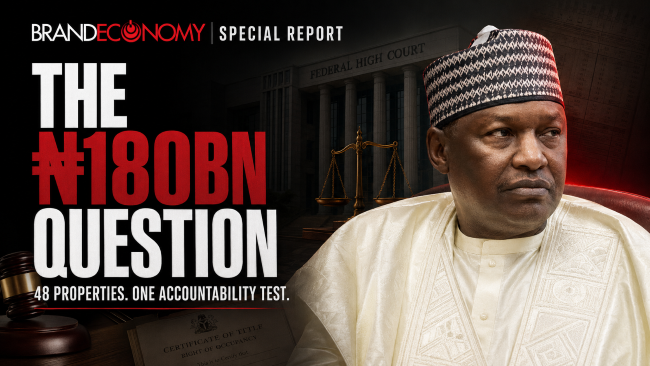 The Federal High Court’s final forfeiture order reaches far beyond Malami, a former minister. It raises hard questions about unexplained wealth, property ownership, banking compliance, corporate reputation and Nigeria’s credibility before investors.
By BRANDECONOMY Editorial Intelligence Desk




Nigeria’s campaign against illicit wealth entered consequential territory on July 15, 2026, when the Federal High Court in Abuja ordered the final forfeiture of 48 properties linked to former Attorney-General of the Federation and Minister of Justice, Abubakar Malami, to the Federal Government.
Justice Joyce Abdulmalik granted the Economic and Financial Crimes Commission’s application after finding that Malami and other claimants had not satisfactorily established lawful sources for the money used to acquire the affected assets.
The decision covered an extensive portfolio of residential, hospitality, educational, agricultural and commercial properties in Abuja, Kano, Kaduna and Kebbi states. They include luxury houses, hotels, warehouses, shopping facilities, university sites, an agro-allied factory and other income-generating assets.
The EFCC initially sought the forfeiture of 57 assets, which it valued at approximately ₦212.8 billion. The court, however, declined to forfeit nine of them, holding that the commission had not established a sufficient connection between those properties and unlawful activities.
That distinction matters.
Based on the individual values attached to the EFCC’s schedule, the 48 properties covered by the final order have been independently estimated at about ₦180.4 billion. The widely reported ₦212.8 billion figure relates to the original 57-asset portfolio—not necessarily the 48 properties ultimately forfeited.
What the court actually decided
The ruling arose from civil asset-forfeiture proceedings rather than the separate criminal prosecution involving Malami, his wife and son.
The former minister and his co-defendants are facing 16 counts relating to alleged money laundering and conspiracy involving about ₦8.7 billion. They have pleaded not guilty, and the criminal charges remain to be determined.
The forfeiture judgment, therefore, is not a declaration that Malami or any other person has been criminally convicted.
Instead, it is an order directed principally at the properties themselves. In legal language, it is an action in rem—a proceeding against assets suspected of representing the proceeds or instruments of unlawful activity.
Justice Abdulmalik relied principally on Section 17 of the Advance Fee Fraud and Other Fraud Related Offences Act, which permits the EFCC to seek forfeiture of property reasonably suspected to be connected with unlawful activity, even without first securing a criminal conviction.
The court framed the central question sharply: not merely who owned the properties, but whether the funds used to acquire them came from legitimate sources.
According to the judgment, the respondents failed to displace the reasonable suspicion raised by the EFCC’s evidence in relation to 48 assets.
When wealth and documented income diverge
One of the most commercially significant aspects of the judgment was the court’s examination of the relationship between declared income and asset acquisition.
The court reportedly considered evidence showing that Malami earned approximately ₦89.7 million in salary during his tenure as minister between 2015 and 2023 and received about ₦12.2 million in severance benefits.
It also reviewed an addendum to an asset declaration in which official earnings of about ₦253.6 million were stated. In a separate 2020 transaction in which Malami acted as guarantor for a company seeking a bank facility, the court noted that he had reportedly declared personal assets of ₦41 million and monthly net income of ₦397,000.
The court additionally examined the incorporation and expansion of companies associated with the disputed portfolio during his years in government.
Where loans were offered as explanations for some acquisitions, the judge found an absence of sufficiently traceable repayment histories tied to documented income, business records or verifiable financial transactions.
This reasoning sends a powerful message to corporate Nigeria: legal title alone may no longer be enough to protect a high-value asset where its acquisition trail cannot withstand forensic scrutiny.
Why the nine released properties matter
The decision was not a wholesale endorsement of everything presented by the EFCC.
Justice Abdulmalik lifted the interim forfeiture order over nine assets after concluding that the commission had not established an adequate connection between them and unlawful activity. Some were said to predate Malami’s ministerial tenure or to have been inherited or independently owned by relatives.
The court held, in effect, that family connection, proximity or association with a politically exposed person could not, without more, justify permanent forfeiture.
That part of the judgment strengthens the due-process value of the decision. It indicates that the court examined the properties individually instead of treating the entire portfolio as one indivisible block.
It also highlights a vital legal balance. Asset-recovery powers must be strong enough to prevent suspicious wealth from being hidden behind companies, relatives or nominees—but disciplined enough to protect genuinely acquired third-party property.
The next legal battlefield
The respondents retain the right to challenge the judgment at the Court of Appeal and, ultimately, the Supreme Court.
Any appeal could test whether the evidence presented by the EFCC established a sufficiently clear connection between each property and an identifiable unlawful activity.
That question has become especially important following the Supreme Court’s 2024 decision in Melrose General Services Limited v. EFCC. In that case, the apex court stressed that an interim forfeiture order does not automatically entitle an enforcement agency to final forfeiture. The agency must first present credible evidence connecting the asset to unlawful conduct before the evidential burden shifts to the claimant.
In the Malami-linked case, the EFCC relied on a 47-paragraph affidavit supported by 46 documentary exhibits. The respondents countered with a 109-paragraph affidavit, arguing that the assets were lawfully acquired, that some predated Malami’s tenure and that the commission’s case rested on suspicion rather than proof.
An appellate court may eventually be asked to decide whether the income comparisons, company records, transaction histories and alleged gaps identified by the trial court satisfied the standard established by the Supreme Court.
Property market: beneficial ownership takes centre stage
The ruling should command the attention of property developers, estate agents, lawyers, valuers, banks and private-equity investors.
Nigeria’s real-estate industry has historically placed enormous emphasis on title documents, physical possession and perfection of interests. The Malami ruling demonstrates that due diligence must go further.
Transactions involving politically exposed persons, their relatives, associates or connected companies require enhanced checks covering:
- Ultimate beneficial ownership;
- Source of funds and source of wealth;
- Corporate incorporation and shareholding histories;
- Payment trails and loan-repayment records;
- Relationships among buyers, guarantors and operating companies;
- Existing preservation, forfeiture or litigation orders;
- The commercial basis for sudden asset expansion.
A properly registered title may establish legal ownership. It does not automatically answer questions about the legitimacy of the money used to obtain that title.
Banking and collateral risk
Financial institutions face an equally important lesson.
Where a property has been pledged as collateral, its apparent market value may become secondary if its acquisition is later linked to unlawful activity. Banks must consequently strengthen politically exposed person screening, beneficial-ownership verification and ongoing monitoring beyond the account-opening stage.
Credit committees should also demand evidence that loan repayments are supported by genuine operating income rather than circular transfers, unexplained cash flows or transactions among related companies.
Existing lenders, mortgagees, tenants and business partners connected to forfeited properties may need to establish their interests through appropriate legal processes. A forfeiture order does not necessarily resolve every third-party claim automatically, particularly where an innocent party can demonstrate a legitimate, documented interest.
The brand cost of legal exposure
For businesses, reputation often travels faster than judgment.
Hotels, universities, factories and retail operations can develop identities distinct from their promoters. But where their financing, ownership or growth becomes entangled in a major forfeiture case, the founder’s legal exposure can quickly contaminate the institutional brand.
Customers begin to worry about service continuity. Employees fear disruption. Suppliers tighten credit. Banks reassess exposure. Regulators intensify scrutiny. Prospective partners reconsider endorsements and collaborations.
The Malami ruling therefore reinforces a central principle of modern brand governance: reputation cannot be separated from ownership transparency.
A strong name, attractive building or visible corporate presence is not a substitute for a credible financial history. Brands connected to politically exposed persons require independent boards, audited accounts, clear ownership structures and verifiable capital sources if they are to survive changes in political power or legal fortune.
What investors will be watching
For domestic and international investors, the ruling presents both an opportunity and a test.
The opportunity lies in demonstrating that Nigeria is capable of investigating politically connected wealth and obtaining judicial remedies against suspicious assets. Consistent enforcement can improve confidence in market integrity, reduce the competitive advantage enjoyed by illicit capital and strengthen the credibility of legitimate businesses.
The test is whether enforcement will be even-handed, evidence-led and protected from political manipulation.
Investors will also monitor what happens to the properties after forfeiture. A court order creates legal control; it does not automatically preserve economic value.
Hotels require management. Universities have students and employees. Factories need maintenance. Commercial buildings may have tenants. Poorly managed assets can deteriorate, accumulate liabilities or become targets for opaque allocation.
The Federal Government and relevant asset-management authorities must therefore publish accurate inventories, protect innocent stakeholders, commission independent valuations and ensure that any leasing, management or disposal is transparent and competitive.
Without that accountability, a dramatic forfeiture victory could become another chapter in Nigeria’s long history of recovered assets that lose value after entering government custody.
BRANDECONOMY Insight
The most important lesson from the Malami ruling is not that a powerful former public officer has suffered a legal setback. It is that Nigeria is moving—however unevenly—towards a system in which wealth must increasingly explain itself.
But unexplained-wealth enforcement will strengthen Nigeria’s investment brand only when three conditions are satisfied: rigorous evidence, consistent application and transparent management of recovered assets.
The court’s decision to release nine properties is therefore as significant as its forfeiture of 48. It demonstrates that asset recovery should not become punishment by association. Government must prove its case; claimants must document legitimate acquisition; and courts must protect both public assets and private-property rights.
For corporate Nigeria, the warning is unmistakable. Beneficial ownership, source-of-funds documentation and reputational governance are no longer back-office compliance matters. They are increasingly central to asset security, access to finance and brand survival.
The real victory will not be measured by the number of buildings forfeited. It will be measured by whether the ruling produces stronger institutions, cleaner capital, more disciplined corporate behaviour and greater confidence in the Nigerian marketplace.