
LOTUS Bank Partners FG on CNG, EV Financing to Advance Nigeria’s Clean Mobility Drive
A New Financing Frontier

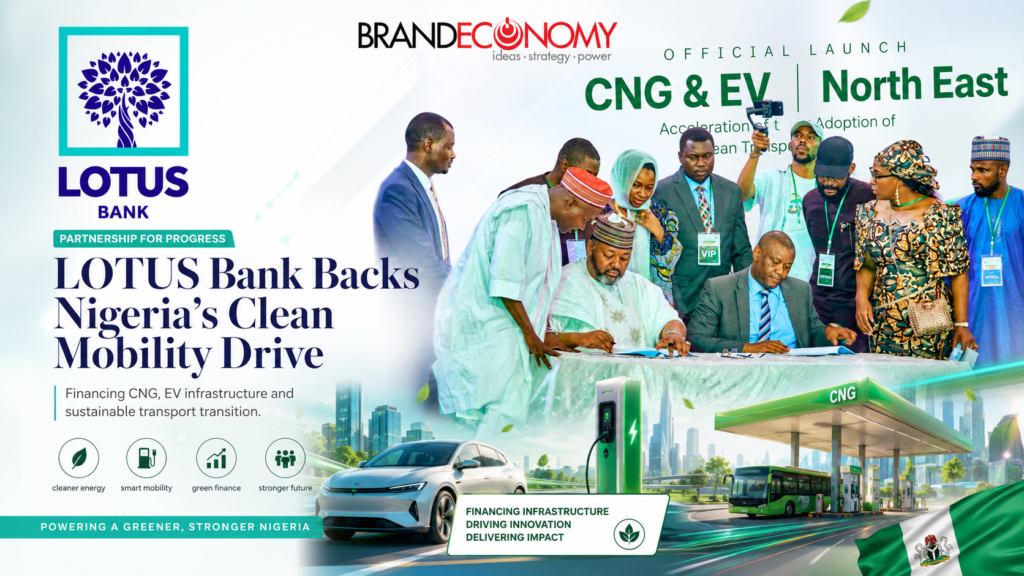 LOTUS Bank has entered into a strategic collaboration with the Federal Government’s Presidential Initiative on Compressed Natural Gas and Electric Vehicles to support the expansion of cleaner, more affordable mobility infrastructure across Nigeria.
The partnership, announced during the inauguration of the Northern Corridor of the CNG and EV Programme in Kano, is aimed at accelerating the deployment of financing solutions for compressed natural gas infrastructure, electric mobility assets, fleet conversion and integrated clean-energy hubs. It also positions LOTUS Bank more firmly within Nigeria’s evolving sustainable-finance architecture at a time when transport costs, energy transition and alternative-fuel investment are moving closer to the centre of national economic policy.




The initiative reflects a notable convergence of public policy and private capital. Following the removal of petrol subsidies and the resulting pressure on transportation costs, the Federal Government has increasingly promoted CNG adoption and alternative mobility systems as part of a strategy to reduce the cost burden on households and businesses while easing dependence on petrol-powered transport. Officials at the Kano launch described the programme as a critical economic intervention intended to lower transport costs, improve energy security and support citizens’ welfare.
Financing the Transition from Petrol Dependence
According to Dr Isiaka Ajani-Lawal, Managing Director of LOTUS Bank, the collaboration with the Pi-CNG and EV initiative is rooted in the bank’s commitment to ethical financing, infrastructure development, energy transition and inclusive economic growth.
He said the bank believes sustainable finance must move beyond traditional banking transactions to support sectors and communities capable of generating long-term economic and social impact. Within the CNG and EV ecosystem, LOTUS Bank is expected to develop financing structures for:
- Integrated energy hubs
- Clean mobility asset acquisition
- Fleet conversion
- Infrastructure financing for businesses and institutions
These focus areas show that the bank is not merely aligning with a government programme for visibility; it is positioning itself within a developing market for green-mobility finance that could grow rapidly if Nigeria succeeds in scaling conversion centres, filling infrastructure and institutional transport solutions.
The commercial logic is clear. Nigeria’s mobility transition will require much more than policy pronouncements. It needs capital, especially for businesses that want to convert vehicle fleets, invest in CNG-supporting infrastructure or participate in the broader clean-transport value chain. Banks willing to design suitable financing products early may gain a strategic foothold in a sector with long-term growth potential.
Why LOTUS Bank’s Role Matters
LOTUS Bank’s entry into the CNG and EV space is particularly noteworthy because of its recent expansion into renewable-energy financing. In February 2026, the bank entered into a ₦100 billion financing partnership with the Rural Electrification Agency to support distributed renewable-energy projects, including mini-grid infrastructure and access expansion for underserved communities. The arrangement was presented as a major effort to address financing bottlenecks affecting renewable-energy developers and to broaden clean-energy access across Nigeria.
The CNG and EV partnership therefore appears to be part of a wider strategic direction rather than an isolated intervention. LOTUS Bank is increasingly building a profile around developmental, asset-backed and sustainability-oriented finance, a space that fits naturally with its non-interest banking model and with growing demand for ethical and impact-conscious financial intermediation.
For the Nigerian financial system, this matters. Green finance in the country has often been discussed at the level of climate commitments and broad sustainability rhetoric. But the next stage must be operational: who finances the vehicles, conversion centres, power systems, charging assets, mini-grids, transport fleets and local manufacturing capacity that make transition real?
LOTUS Bank’s latest collaboration suggests that at least one domestic lender is moving decisively toward that practical end of the market.
CNG, EVs and the Economics of Mobility Relief
The Federal Government’s CNG and EV push is rooted in a broader affordability problem. Transport costs feed into nearly every layer of the economy, from commuting and food prices to logistics and industrial distribution. When fuel costs rise, the effects ripple quickly through consumer prices and business margins.
That is why the CNG strategy has acquired significance beyond environmental considerations. Compressed natural gas is being promoted as a cheaper mobility alternative, particularly for commercial transport, institutional fleets and high-usage vehicles. Electric vehicles, while facing a more complex infrastructure challenge, remain part of the wider future-facing policy conversation around cleaner transportation and reduced exposure to imported fuel vulnerabilities.
The Northern Corridor launch in Kano is therefore symbolically important. It indicates that the government wants cleaner mobility infrastructure to expand beyond Lagos and Abuja into major economic and transport corridors, especially in Northern Nigeria where long-distance logistics, commercial fleet activity and regional trade routes make fuel economics particularly consequential.
A New Financing Frontier for Banks
The deeper business story is that Nigeria’s energy transition will likely create new categories of bankable assets and specialised financing demand.
CNG adoption requires investments in:
- Conversion centres
- Daughter stations and refuelling points
- Gas distribution infrastructure
- Vehicle retrofitting
- Transport-fleet financing
- Public and private institutional procurement
EV adoption, in turn, calls for:
- Charging infrastructure
- Battery and power systems
- Fleet acquisition models
- Renewable-energy integration
- Maintenance ecosystems
These are not merely engineering issues. They are financing issues. Without credit structures that match the asset lives and cash-flow profiles of mobility businesses, adoption will remain slower than policy ambition.
By signalling its willingness to participate in clean-mobility financing, LOTUS Bank is entering a market where early movers may shape product standards, risk models and customer relationships before the sector fully matures.
Sustainable Finance Moves Closer to the Mainstream
Ajani-Lawal’s statement that the collaboration reinforces LOTUS Bank’s place in Nigeria’s sustainability and developmental-finance landscape is not overstated. The bank’s recent partnerships suggest a deliberate effort to finance the physical pillars of the transition economy: energy access, low-carbon infrastructure and transport affordability.
The REA financing programme and the Pi-CNG/EV collaboration are linked by a common thread. Both target parts of the economy where inadequate infrastructure deepens hardship and slows productive activity. One seeks to expand renewable electricity access; the other seeks to support cheaper and cleaner mobility. Both have implications for businesses, households and the government’s broader national-growth agenda.
This is the point at which sustainable finance becomes tangible. It stops being a paragraph in an annual report and starts becoming a loan structure that helps install a mini-grid, finance a transport conversion, or develop an energy hub.
The Policy Challenge: Scaling Beyond Announcements
Still, the success of the CNG and EV programme will depend on execution. Nigeria has seen ambitious infrastructure programmes falter where financing, regulation, logistics and user adoption failed to align. The same risk exists here.
For the partnership to deliver meaningful results, several conditions matter:
First, financing must be accessible and commercially sensible, not merely theoretically available. Businesses and transport operators need products that match their repayment capacity.
Second, infrastructure must scale sufficiently. Vehicle conversion without adequate refuelling access will discourage adoption.
Third, public messaging must be consistent. Consumers, fleet operators and investors need confidence that the policy direction will not change abruptly.
Fourth, technology and standards must be carefully managed so that equipment quality, safety and maintenance do not become weak links in the value chain.
Finally, transition finance must remain inclusive. Cleaner mobility should not be restricted to elite consumers or large corporates; it should reach transport operators, SMEs and institutions that bear a significant share of the country’s mobility burden.
BRANDECONOMY Insight
Nigeria’s Energy Transition Will Be Financed — or It Will Stall
LOTUS Bank’s partnership with the Federal Government on CNG and electric mobility deserves attention because it highlights a central truth of economic transformation: policy ambition is only as powerful as the financing architecture behind it.
Nigeria can announce cleaner mobility targets. It can promote CNG conversion. It can celebrate energy-transition plans. But without credible lenders, accessible capital and investment structures that convert ideas into assets, the transition will remain shallow.
This is why LOTUS Bank’s move matters. It represents the growing entry of domestic financial institutions into sectors once left largely to government intervention, donor support or foreign capital. By supporting CNG infrastructure, fleet conversion and clean-mobility assets, the bank is helping to build the commercial plumbing of a lower-cost transport future.
The alignment with its earlier ₦100 billion renewable-energy partnership with REA further strengthens the picture. LOTUS Bank appears to be shaping a development-finance identity around the practical economics of sustainability: power, transport, infrastructure and inclusion.
The larger lesson for Nigeria’s banking industry is clear. The next generation of growth opportunities will not come only from traditional corporate lending, trade finance and consumer banking. They will increasingly come from financing the country’s transition needs — mobility, energy access, industrial efficiency and resilient infrastructure.
Banks that understand this early will do more than support national development. They may also define the next profitable frontier of Nigerian finance.