Abuja’s Conference Economy Gets Lift as BoI, IFC Sign ACE Arena Agreement

 The proposed ACE Arena conference and exhibition complex is more than a real-estate project. It is a bid to position Nigeria’s capital as a competitive destination for international summits, trade fairs, cultural exchange and the business-event economy.
 The proposed ACE Arena conference and exhibition complex is more than a real-estate project. It is a bid to position Nigeria’s capital as a competitive destination for international summits, trade fairs, cultural exchange and the business-event economy.
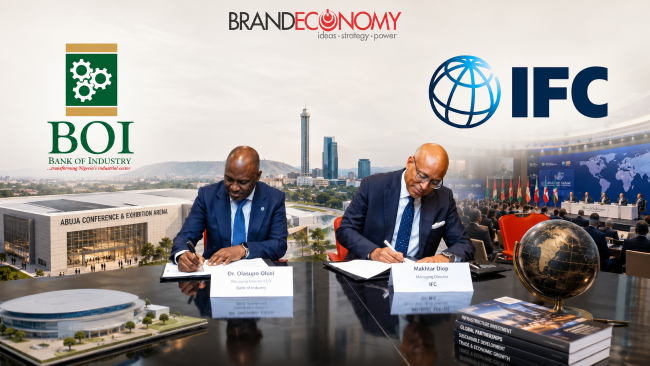
Nigeria’s Bank of Industry and the International Finance Corporation, the private-sector arm of the World Bank Group, have signed a cooperation agreement to advance the development of the Abuja Conference and Exhibition Arena, better known as ACE Arena — a proposed world-class venue designed to elevate Abuja’s standing in Africa’s fast-growing meetings, incentives, conferences and exhibitions economy.
The agreement, signed in Kigali, Rwanda, opens the early-stage preparation phase for a major infrastructure project envisioned under a Public-Private Partnership framework. According to the Bank of Industry, ACE Arena is expected to include large conference and exhibition halls, staging areas, hospitality assets, retail spaces and cultural facilities, creating an integrated venue capable of hosting high-level global gatherings, trade shows, conventions and business events on Nigerian soil.



For Abuja, the project represents a strategic opportunity. Nigeria’s federal capital has long functioned as the country’s political nerve centre and diplomatic headquarters, but it has yet to establish itself fully as a continental hub for major international congresses and exhibitions. ACE Arena is an attempt to close that gap — and, in the process, capture a larger share of the economic value created by conference tourism, international networking, deal-making and hospitality demand.
From Capital City to Conference Capital
The economics of a modern conference and exhibition district extend well beyond the event halls themselves. Large conventions generate demand for hotels, airlines, ground transport, restaurants, logistics providers, security services, event production, advertising, media, retail and tourism. They also place a city on the radar of investors, entrepreneurs, governments and multilateral institutions.
BoI says the ACE Arena is designed to position Abuja as a top-tier destination for global events, bringing home the economic benefits of international gatherings — from ticketed conferences and exhibitions to year-round hospitality spending and broader business activity associated with events hosted in Nigeria.
That ambition is significant. Across Africa, cities such as Kigali, Cape Town, Marrakech and Nairobi have deliberately built infrastructure and city brands around business tourism. These destinations understand that a conference centre is not merely a hall; it is a gateway into a higher-value service economy. Nigeria’s size, diplomatic weight, corporate depth and political relevance suggest that Abuja should be competing more aggressively in that space.
ACE Arena is therefore not only an infrastructure project. It is a city-positioning project.
Why IFC’s Advisory Role Matters
Under the cooperation agreement, IFC will provide advisory services to BoI during the project’s preparatory stage. The work will include market, financial, environmental, legal and regulatory assessments to determine the project’s scope, infrastructure mix and financing structure before subsequent development phases.
This early-stage role is critical. Major infrastructure projects often fail not because the concept is weak, but because preparation is poor: demand forecasts are unrealistic, financing is badly structured, environmental obligations are underestimated, or the operating model is never properly tested. IFC’s advisory mandate is meant to reduce precisely those risks.
The institution describes its advisory work as a tool for helping governments and businesses create the conditions needed to attract private capital. Its broader product suite includes investment, advisory services, blended finance, transaction advisory, loans and capital mobilisation mechanisms tailored to emerging-market development needs.
For ACE Arena, that means the project will not begin with architectural spectacle alone. It will first undergo the kind of due diligence required to establish whether it can be commercially viable, bankable and attractive to long-term private investors.
A PPP Project Built to Attract Private Capital
BoI and IFC are clear that ACE Arena is intended to be delivered through a PPP structure, rather than as a purely government-funded facility. That choice reflects the fiscal realities facing African governments, which continue to fund much of the continent’s infrastructure from domestic resources despite increasingly severe public-finance constraints.
A properly designed PPP can help Nigeria do three things at once:
- reduce the immediate burden on the public purse;
- attract private-sector operating expertise and capital;
- and create stronger incentives for long-term maintenance, commercial performance and service quality.
This does not mean every PPP works automatically. Nigeria has seen infrastructure arrangements weakened by poor risk allocation, opaque procurement, weak enforcement and politically distorted assumptions. But when the framework is properly structured, private participation can turn a project from a government monument into a sustainable economic asset.
ACE Arena’s success will therefore depend heavily on whether the eventual PPP model balances public purpose with commercial discipline.
BoI’s Expanding Development-Finance Role
The project also expands the profile of the Bank of Industry beyond its familiar role in financing manufacturing, SMEs and productive enterprises. By partnering on ACE Arena, BoI is signalling a wider interpretation of industrial development — one that includes enabling infrastructure for trade promotion, investment flows, tourism and cultural exchange.
Dr Olasupo Olusi, Managing Director of BoI, described ACE Arena as an “exciting new frontier” in the institution’s relationship with IFC and said infrastructure of such scale could unlock significant economic opportunity for Nigeria while strengthening the country’s position as a destination for global business and cultural exchange.
That framing is important. Conferences and exhibitions are platforms where economic sectors meet: manufacturers showcase products, investors identify opportunities, governments announce reforms, technology firms find partners and tourism operators gain visibility. A strong event infrastructure ecosystem can therefore complement BoI’s broader mandate to support industrial and enterprise growth.
In that sense, ACE Arena is not a departure from development finance. It is an extension of it.
IFC’s Nigeria Commitment Adds Weight
The partnership lands within a larger IFC relationship with Nigeria’s private sector. Over the past five fiscal years, IFC committed $12.8 billion in investments to Nigerian private-sector activity, including $1.9 billion in long-term financing and $10.9 billion in short-term financing, according to BoI’s statement. The same disclosure noted that IFC’s infrastructure commitments across Africa doubled from $1.5 billion in 2020 to $3 billion in FY2025.
These figures matter because ACE Arena is unlikely to be assessed in isolation. It fits a wider strategy of using private capital, advisory expertise and infrastructure financing to support development goals across African economies. IFC’s involvement may also improve project credibility among investors who would otherwise be cautious about large urban infrastructure developments in emerging markets.
In practical terms, IFC’s name brings comfort to lenders, private equity players, developers and technical partners that the project will be tested against rigorous standards before moving deeper into development.
Economic Spillovers: Tourism, Jobs and the Event Economy
The Bank of Industry expects the project to support tourism, job creation and wider business activity through conferences, exhibitions and related hospitality services.
The job implications could be broad. Construction would generate near-term employment. Operations would require managers, technicians, hospitality staff, logistics workers, security personnel, caterers, interpreters, cleaners, marketers and digital-service providers. Beyond the facility itself, surrounding hotels, restaurants, retail operators and transport businesses could gain from recurring event traffic.
There is also a more strategic benefit: a strong conference and exhibition hub can help Nigeria host more investment forums, trade missions, multilateral gatherings and sector-specific expos domestically rather than allowing that spending and visibility to migrate elsewhere.
Every international event hosted in Abuja has a multiplier effect. Delegates spend, companies promote, local firms network, and Nigeria controls more of the narrative around its investment opportunities.
The Trade and Business Case for ACE Arena
From a trade perspective, ACE Arena could become a physical marketplace for Nigeria’s ambition to deepen regional and global commerce. Exhibition halls are central to product discovery, export promotion and B2B deal-making. Manufacturers, agro-processors, fintech firms, creative companies, tourism operators and infrastructure investors often require visible, organised platforms where partnerships can be formed at scale.
If well executed, ACE Arena could become:
- a home for international trade fairs;
- a launchpad for Nigerian exporters;
- a venue for AfCFTA-linked business forums;
- a location for sector-specific expos in energy, manufacturing, technology and agriculture;
- and a stage for Nigeria’s soft-power diplomacy.
That possibility should not be understated. A country that wants to attract trade and investment must also invest in the infrastructure of presentation, negotiation and convening.
The Project’s Real Test: Execution
The ACE Arena announcement is compelling, but infrastructure ambition in Nigeria must always be accompanied by realism. The country has seen grand projects slowed by procurement disputes, delayed approvals, shifting priorities and financing gaps. The presence of BoI and IFC improves the odds of disciplined preparation, but does not eliminate the need for careful execution.
Several questions will shape the project’s credibility in the years ahead:
Will the demand study demonstrate sustained event traffic at the scale envisioned?
Will private investors find the risk-return profile attractive?
Will transport access, hospitality supply and city services around the facility be adequate?
Will the project be transparently procured and properly governed?
Will it be managed as a commercial asset rather than a prestige structure?
These are the questions that will determine whether ACE Arena becomes a transformational economic platform or a promising idea that loses momentum.
BRANDECONOMY Insight
Abuja Needs More Than Political Relevance — It Needs Economic Convening Power
The proposed Abuja Conference and Exhibition Arena matters because cities now compete not only through airports, office towers and industrial estates, but through their ability to convene power, ideas, capital and markets.
Abuja already has political relevance. It hosts embassies, ministries, development agencies and national decision-makers. Yet much of the high-value conference economy on the continent continues to flow toward cities with more mature exhibition ecosystems. ACE Arena is a deliberate attempt to change that equation.
If developed to international standards, the facility could become a strategic asset for Nigeria’s non-oil economy. It could strengthen tourism receipts, create jobs, support hospitality investment, expand the business-events market and give Nigerian enterprises a more powerful stage for trade and investment engagement.
The partnership with IFC is particularly encouraging because it places project preparation before project hype. Nigeria has often rushed to unveil grand infrastructure visions without first doing the painstaking work of structuring them for viability. Here, the stated focus on market, financial, environmental, legal and regulatory assessment suggests a more disciplined route.
But execution remains the defining issue. Abuja does not merely need a beautiful arena; it needs a facility that works commercially, attracts global events, complements hotels and transport infrastructure, and becomes part of a durable business-tourism economy.
ACE Arena could help reposition the capital from a seat of government into a stronger African centre of convening, commerce and cultural diplomacy. That would be a valuable addition to Nigeria’s growth story.