

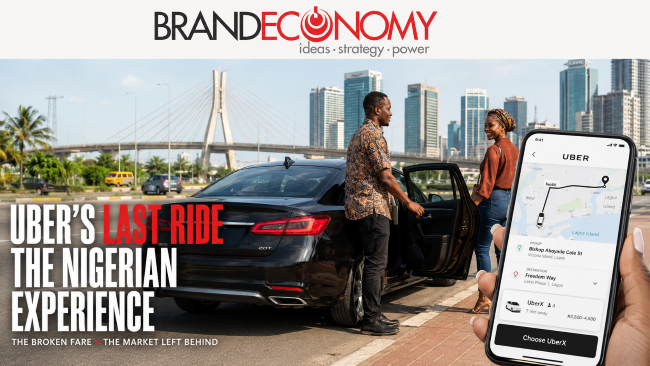
 After 12 years of teaching Nigerians to summon a car with a tap, Uber has switched off its service as Uber exits Nigeria. The app may be leaving, but the need it helped define remains—and so do the punishing economics confronting riders, drivers, rivals and investors.
A Last Ride Through Lagos
At 7.10 on a wet Lagos evening, Amaka refreshes the Uber app outside her Victoria Island office. She has missed the company shuttle and needs to get home to Ogba. The first price makes her blink. The second driver accepts, calls to ask where she is going, then cancels. A third wants an offline payment above the fare displayed on the app. Rain needles the pavement as the estimated arrival time stretches.



Across town, Kunle is behind the wheel of a tired Toyota Corolla. Before accepting Amaka’s request, he runs an improvised calculation: petrol used in traffic; the platform’s deduction; the next oil change; tyres bought at an exchange-rate-inflated price; the daily remittance on the car; and the possibility of returning empty. The fare that looks outrageous to Amaka may still look inadequate to Kunle.
Amaka and Kunle are composite characters, but their dilemma is real. It captures the three-sided squeeze at the heart of Nigerian e-hailing: the passenger thinks the ride is too expensive, the driver thinks it pays too little, and the platform struggles to retain enough from the transaction to justify technology, safety, support, marketing, compliance and profit.
That broken equation is the most useful lens through which to examine Uber’s departure from Nigeria.
Uber Technologies announced that it would cease Nigerian operations from 2 September 2026, ending a 12-year run that began in Lagos in 2014 and expanded to Abuja in 2016. Its support centre will remain available until 23 September for unresolved account matters, while Uber for Business is also being discontinued.
The announcement was definite. The explanation was not. Uber said the decision followed a thorough business review and reflected evolving priorities and investment focus across Africa. It did not publish Nigerian revenue, losses, trip volumes, active-driver numbers or a detailed account of why the market no longer met its investment threshold.
The responsible conclusion is therefore not that one quarrel, levy or cost increase drove Uber out. The evidence points instead to converging pressures: deteriorating driver economics, weak household purchasing power, expensive vehicles and fuel, currency volatility, aggressive competition, regulatory fragmentation and a global company becoming more selective about where it places capital.
| EDITORIAL NOTE The rider and driver scenes in this article are clearly identified composites, constructed from widely reported experiences in Nigeria’s ride-hailing market. They are not presented as verbatim interviews with named individuals. |
The Brand That Changed the Grammar of Movement
Uber did not merely enter Nigeria as another taxi operator. It changed the behaviour of urban consumers. Before its arrival, hiring a taxi often required roadside negotiation, uncertain pricing and little knowledge of the driver or vehicle. Uber introduced app-based matching, driver identification, digital trip records, estimated arrival times, map tracking and cashless payment.
For professionals, visitors and many women moving after dark, the brand offered predictability and greater personal security. “I’ll Uber there” became shorthand for ordering a ride, even when a rival supplied the vehicle. Few brands become verbs.
Yet category creation does not guarantee category control. Bolt expanded into more Nigerian cities and competed heavily on price and driver incentives. inDrive allowed passengers and drivers to negotiate fares, a locally attractive proposition in a price-sensitive economy. Lagos-backed LagRide offered a regulated, fleet-led alternative and a pathway for experiments in vehicle finance, compressed natural gas and electric mobility.
Drivers also became expert “multi-homers”, keeping two or three apps open and selecting whichever request looked most rewarding. Riders learned the same behaviour, comparing fares across screens before every journey. The network Uber pioneered became increasingly rented rather than owned.
That is the first paradox of its exit: Uber leaves behind a consumer habit it helped normalise, but not a market it could sustainably dominate.
When Every Fare Disappoints Somebody
Kunle’s day begins before sunrise. On paper, gross receipts can look respectable. In practice, revenue is not income. Petrol, servicing, insurance, data, platform commission, parking, informal charges, depreciation and vehicle repayment all take their cut. Hours crawling through Lagos traffic add wear without necessarily adding productive trips.
In March 2026, hundreds of app-based drivers protested in Lagos, accusing platforms of setting fares too low while charging commissions of up to 30 per cent. Their claims were not an audit of every driver’s account, but they exposed a widening trust deficit: many drivers believed the algorithm did not reflect the real cost of supplying the vehicle.
The pressure intensified after petrol-subsidy removal in 2023. Vehicles and spare parts are exposed to foreign exchange, while high interest rates make financing harder. Tyres, batteries and maintenance have become painful capital events.
Meanwhile, Amaka’s salary has not risen as quickly as transport, food and housing costs. Nigeria’s headline inflation stood at 15.43 per cent in July 2026 after statistical rebasing, while food inflation was 20.31 per cent. Real GDP expanded by 4.43 per cent year on year in the second quarter, but national growth does not automatically translate into disposable income for an urban household.
When the platform raises fares, passengers travel less, share rides, switch apps or return to informal transport. When it suppresses fares, drivers reject trips, cancel, negotiate offline or abandon the platform. When it reduces commission, the platform’s own margin narrows. A ₦10,000 trip can therefore be simultaneously expensive for the rider, disappointing for the driver and unattractive to the platform.
Big Market, Blurred Numbers
Published estimates vary dramatically. One placed 2024 revenue at about $1.3 billion and projected 42.88 million users by 2028; another put the market at roughly $303 million in 2025. The difference warns against false precision: models may count platform revenue, passenger spending, bookings or broader smart-mobility activity.
Uber’s own 2023 Nigeria Economic Impact Report, prepared by Public First and commissioned by the company, estimated a ₦34 billion contribution to the economy, ₦6.1 billion in additional driver income and nearly ₦500 billion in consumer surplus. It also estimated that riders saved more than 1.8 million hours. Survey respondents strongly associated the service with convenience, comfort and safety.
These figures demonstrate social and economic value, but they do not prove commercial viability. Consumer surplus is a modelled estimate of the value users receive beyond what they pay; it is not cash collected by Uber. A service can generate enormous benefit for a city and still fail to earn an acceptable, currency-adjusted return for its provider.
The most revealing number remains the one Uber did not publish: the profitability of its Nigerian operation.
What the Numbers Say — and What They Do Not
Nigeria’s e-hailing sector suffers from a data problem. Operators rarely publish country-level revenue, completed trips, active drivers, retention, commission income or profitability. Market-research estimates differ dramatically because some measure platform revenue, others gross passenger spending, and others include taxis, motorcycles, rentals or wider “smart mobility” services.
| DATA DISCIPLINE The most responsible conclusion is not that one estimate is definitively correct, but that demand is substantial while transparent unit-economics data remain scarce. |
| Indicator | Reported figure | What it means — and the caveat |
| Uber’s estimated Nigerian economic contribution in 2023 | ₦34 billion | From an Uber-commissioned Public First study; useful but not an official GDP account or proof of profitability. |
| Additional annual driver income attributed to Uber in 2023 | ₦6.1 billion | The same study estimated average Uber earnings at 34% above drivers’ next-best alternative. |
| Rider consumer surplus attributed to Uber in 2023 | Nearly ₦500 billion | A modelled estimate of convenience, time and cost value—not cash revenue received by Uber. |
| Nigeria ride-hailing revenue in 2024 | About $1.3 billion | Reported by the Nigerian Customer Service Index; the market definition is broader than some competing forecasts. |
| Alternative 2025 market estimate | About $303 million | A Statista forecast cited by BusinessDay; demonstrates how scope and methodology change the answer. |
| Nigeria headline inflation, July 2026 | 15.43% | Official NBS figure after CPI rebasing; food inflation was higher at 20.31%. |
| Nigeria real GDP growth, Q2 2026 | 4.43% year on year | Growth accelerated, but does not by itself reveal household purchasing power or ride-hailing profitability. |
Uber’s impact report also said riders saved more than 1.8 million hours in 2023, while the platform supported tourism and the night-time economy. Survey respondents strongly associated the service with convenience, comfort and safety; 78 per cent of women surveyed described Uber as the safest way for them to get home at night.
Those findings capture genuine value, but impact is not the same thing as investability. A service may create large benefits for society and still fail to generate an acceptable return for the company providing
Regulation Was Not the Stated Cause—But It Shaped the Weather
Uber has said its exit was unrelated to the recent Federal Airports Authority of Nigeria dispute. That clarification matters. In July, FAAN directed Uber and Bolt to stop commercial operations at managed airports until licence arrangements were concluded. After ministerial intervention, Bolt reached an operational framework and returned. Uber did not announce a comparable resolution before its withdrawal.
The sequence does not prove causation. It does show how an important customer channel can depend on negotiations with a separate public authority. Lagos already imposes e-hailing requirements covering licensing, insurance, documentation, background checks, trip data and a per-ride road-improvement levy. Many objectives are defensible; cities need safety, accountability and transport intelligence.
The danger is cumulative unpredictability. When state, airport, municipal and federal rules overlap without a harmonised framework, compliance becomes costlier and investment decisions become harder to model. Regulation may not have caused Uber’s exit, but regulatory uncertainty formed part of the commercial climate in which the decision was made.
A Nigerian Exit—and a Global Capital Decision
Nigeria should not read the withdrawal only as a referendum on Nigeria. On the same day, Uber announced plans to cut about 3,300 jobs—roughly 10 per cent of a global workforce of about 34,000—as management layers were reduced and resources redirected towards growth and innovation.
Uber is also preparing for autonomous vehicles to transform its intermediary role. Reuters reported plans to invest more than $10 billion in robotaxi ventures and partnerships. It had already withdrawn from Côte d’Ivoire and Tanzania while remaining elsewhere in Africa.
This context suggests sharper portfolio discipline. A market requiring persistent incentives, local negotiation, regulatory engagement and currency-risk management must compete internally against opportunities promising greater scale, margin or strategic relevance. Nigeria’s pressures and Uber’s changing priorities likely met at the same decision point.
Who Wins, Who Loses—and Who Inherits the Problem?
The immediate effect on drivers will be displacement rather than mass unemployment. Many already work across Bolt, inDrive and other platforms; they can transfer demand histories, redirect vehicles and migrate their time. Riders will also switch quickly because the underlying need for urban transport has not disappeared.
But substitution will not be frictionless. Less competition can weaken drivers’ bargaining power, reduce promotional pressure and create fare spikes or longer waits in some locations. Corporate clients face the loss of Uber for Business, including central billing, travel controls and digital receipts. Women and late-night users will want assurance that rival platforms provide comparable verification, trip sharing, emergency tools and customer support.
Bolt is the clearest short-term beneficiary. inDrive gains from its negotiated-price model. LagRide can present itself as a locally rooted alternative. Yet none should celebrate too quickly. They inherit Uber’s riders and drivers alongside the same expensive fuel, imported vehicles, congested roads, weak purchasing power, security exposure and fragmented regulation.
The market does not merely need another ride button. It needs cheaper vehicle finance, group insurance, credible leasing, more efficient maintenance networks, CNG and hybrid adoption, safer trip systems and fare models that balance affordability with driver viability.
The Signal to Investors: Price Nigeria Honestly
Uber’s departure will inevitably be read in global boardrooms. The lazy conclusion would be that Nigeria is uninvestable. The more useful lesson is that population does not equal purchasing power, and user acquisition does not equal profitable scale.
Nigeria offers enormous demand, urban density, entrepreneurial energy and rapid digital adoption. It also presents currency volatility, costly infrastructure, expensive working capital and regulatory complexity. A company can acquire millions of users who remain too price-sensitive to support healthy margins.
The lesson is not “avoid Nigeria”. It is “price Nigeria honestly”. Investment cases must be built on net revenue, local cost structures, currency-adjusted returns, multiple regulatory scenarios and the economics of suppliers—not merely on the size of the addressable population.
For brands, there is a harder truth. Uber exits with exceptional awareness, but fame is not the same as continuing relevance. Brand strength is the ability to create sustainable value for customers, suppliers, partners, regulators and shareholders at the same time. Once those promises pull apart, even an iconic name loses operational meaning.
What Nigeria Should Do Before the Next Last Ride
Government should resist wounded nationalism. The exit should be treated as diagnostic evidence. Nigeria needs a harmonised national framework that establishes common principles for safety, insurance, data, labour protection and consumer rights while permitting cities to manage local transport conditions.
Levies should be published, predictable and auditable. Platforms should provide anonymised data on trips, fares, active drivers, cancellations and safety incidents so policy is based on evidence rather than market rumours. Accident insurance, transparent deactivation, dispute resolution, verified work histories and portable pension contributions should follow drivers across platforms.
Vehicle costs must also fall. Transparent leasing, local assembly, duty reform, credit tied to verified trip income and investment in CNG, hybrid and electric fleets would help. Transport authorities need a permanent operator forum so disputes are settled before passengers are stranded.
BRANDECONOMY Insight: The App Leaves; the Question Remains
Near midnight, composite rider Amaka finally gets home. Kunle completes one more trip, parks his Corolla and totals the day’s receipts. Both have used the same mobility system; neither is convinced it served them fairly. Somewhere outside Nigeria, a global investment committee has reached a similar conclusion from a different angle.
Uber’s last ride is not proof that Nigerians have stopped needing safe, efficient transport. It is proof that demand, brand fame and digital adoption cannot indefinitely compensate for fragile unit economics.
The company that taught Nigeria to tap for a ride has tapped out. The habit will survive. Drivers will migrate. Competitors will gain. But unless the economics are repaired, the empty space will simply be occupied by another logo carrying the same burden.
Nigeria’s real challenge is therefore larger than retaining one multinational. It is to build a mobility market in which the passenger can afford the fare, the driver can earn a living, the regulator can protect the public and the platform can invest with confidence.
That is the Nigerian experience behind Uber’s last ride—and the test every company arriving next will eventually have to pass.