Dangote Cement, MTN, First HoldCo and Zenith Lead Nigeria’s FTSE Comeback

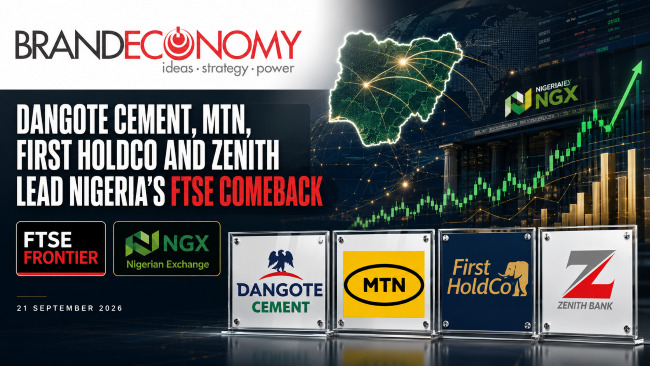 Nigeria is returning to an important global investment map, carrying ten of its biggest listed companies as evidence that Africa’s largest economy is again becoming accessible to international capital through the FTSE.
FTSE Russell’s September index review has classified Aradel Holdings, Dangote Cement, First HoldCo, Guaranty Trust Holding Company, MTN Nigeria Communications, Nestlé Nigeria, Nigerian Breweries, Presco, Stanbic IBTC Holdings and Zenith Bank as newly eligible large-cap stocks in the FTSE Frontier Index Series.




The changes are scheduled to take effect when trading opens on September 21, alongside Nigeria’s reclassification from Unclassified to Frontier Market status.
This is a consequential reversal. Nigeria was removed from FTSE Russell’s frontier universe in September 2023 after persistent foreign-exchange shortages and capital-repatriation delays made it difficult for international institutions to enter the market, receive proceeds and convert naira holdings into foreign currency.
Three years later, the country is being readmitted. The decision reflects improvements in foreign-exchange liquidity, capital mobility and market infrastructure—but it should be understood as conditional recognition, not a declaration that every investability problem has disappeared.
Ten companies, five economic signals
The selected companies provide a compact portrait of the commanding heights of Nigeria’s quoted economy.
First HoldCo, GTCO, Stanbic IBTC and Zenith Bank give financial services the largest representation. Their presence reflects the scale, liquidity and comparatively broad investor following of Nigeria’s leading banking groups.
Dangote Cement represents industrial production and construction; MTN Nigeria anchors telecommunications and digital connectivity; Nestlé Nigeria and Nigerian Breweries represent consumer goods; Aradel Holdings brings indigenous energy; while Presco introduces commercial agriculture and agro-industrial processing.
Together, the ten offer global investors exposure to payments, credit, infrastructure, mobile communications, food, beverages, energy and agriculture. Yet the concentration also reveals the Nigerian Exchange’s structural limitation: too much listed value remains clustered around financial services and a relatively small number of dominant companies.
Nigeria’s next capital-market challenge is therefore not merely to celebrate the returning names, but to broaden the investable universe through new listings in technology, healthcare, logistics, renewable energy, manufacturing and other productive sectors.
Being designated “newly eligible” is also not a medal for corporate popularity. FTSE indices are rules-based. Market capitalisation, investable free float, liquidity, foreign-ownership access and other eligibility screens matter. A large company can be commercially successful yet unsuitable for meaningful index inclusion if very few shares are available to public investors.
The road back—and the T+1 test
Nigeria’s route to reclassification began in October 2025, when FTSE Russell placed the country on a Watch List after observing improvements in foreign-exchange liquidity, repatriation and market access.
In April 2026, the index provider announced that Nigeria would return to Frontier Market status in September. The timetable was later placed under additional review following the market’s June 1 migration from a T+2 to a T+1 settlement cycle.
T+1 means that an equity transaction must be completed one business day after the trade, rather than two. Faster settlement can reduce counterparty exposure and release capital more quickly. For offshore institutions, however, the shorter window may leave less time to secure naira, complete approvals and coordinate custodians across time zones.
The concern was that investors might effectively be required to place money in Nigeria before executing trades—a prefunding arrangement that would increase cost and risk.
That question prompted engagement among NGX Group, the Securities and Exchange Commission, FTSE Russell, global custodians and international institutions. An NGX Group delegation met investors and custodians in July to explain how the settlement framework operated and address concerns about funding and execution.
On August 27, FTSE Russell confirmed that the September 21 return would proceed after its assessment found no material settlement, operational or funding problems since T+1 began.
The episode contains an important lesson. Market reform cannot be judged solely by whether a new system is theoretically faster. It must work for the actual investor moving money through foreign-exchange desks, brokers, custodians, clearing systems and borders.
Market implications
The FTSE Frontier Index Series measures large, mid and small-cap equities across eligible frontier markets. It is used as a performance benchmark and as the foundation for index-tracking investment products.
Nigeria’s return should consequently place eligible stocks back on the screens of active frontier-market managers and rules-based funds. That can increase research attention, trading volumes and demand around the effective date. Better liquidity may narrow bid-offer spreads and, over time, reduce the valuation discount attached to an inaccessible market.
The effect should not be exaggerated. Frontier-market funds command less capital than mainstream emerging-market products, while actual buying will depend on Nigeria’s index weight and each company’s investable free float. Some portfolio managers may also have positioned ahead of implementation.
An initial rally would therefore be sentiment, not proof of durable capital formation. The bigger prize is a sustained reduction in Nigeria’s equity risk premium and a market through which companies can raise long-term capital for factories, networks, farms and infrastructure.
Investor relevance
For international investors, the equation extends beyond company earnings. Total dollar returns depend on the share price, dividends, naira movements, transaction costs and the ability to repatriate proceeds when required. A strong gain in local currency can be eroded by depreciation or delayed conversion.
Investors should assess each selected company on earnings quality, cash generation, dividend resilience, governance, free float, daily liquidity and exposure to regulation or foreign-exchange costs. Index eligibility can create demand, but it cannot transform a weak balance sheet into a sound investment.
Domestic investors should also resist treating September 21 as a guaranteed payday. Index-related flows can raise prices before implementation and reverse after portfolio adjustments are completed. Fundamentals remain the more reliable guide to long-term value.
Brand implications
For the ten companies, FTSE eligibility is a global trust signal—and a higher standard of scrutiny. International investors will expect timely disclosures, accessible investor relations, credible governance and clear explanations of strategy, risk and capital allocation.
Each company now carries more than its corporate identity; it becomes part of Nigeria’s investment brand. Governance failure or poor disclosure at one prominent issuer can reinforce negative perceptions of the wider market.
NGX Group, the SEC, the Central Securities Clearing System and the wider policy establishment face a similar reputational test. Nigeria’s new message is that foreign capital can enter, trade and exit efficiently. That promise must remain true during currency volatility and periods of market stress—not only during an index assessment.
BRANDECONOMY Insight
Nigeria has not yet graduated to investment-market excellence; it has been readmitted to the room.
Frontier status is better than being Unclassified, but it remains below Emerging Market status. The strategic objective should be to make this return irreversible and build the conditions for the next promotion.
Regulators and market operators should publish a monthly Global Investor Access Scorecard tracking foreign-exchange conversion times, repatriation delays, failed settlements, custody and transaction costs, foreign participation, free float and disclosure compliance.
Government must also ensure that renewed foreign interest finances productive expansion rather than merely inflating prices in the secondary market. More public offers, rights issues, corporate bonds and credible new listings would turn visibility into capital formation.
The ten eligible companies have given Nigeria a strong re-entry delegation. What happens after September 21 will determine whether the country has rebuilt a dependable gateway for global capital—or simply enjoyed another ceremonial return.