

 The emerging bargain is not yet a peace deal. It is a delicate attempt to turn a maritime crisis, a nuclear standoff and a sanctions dispute into a sequenced diplomatic framework — with Qatar again positioned as a critical Gulf intermediary.
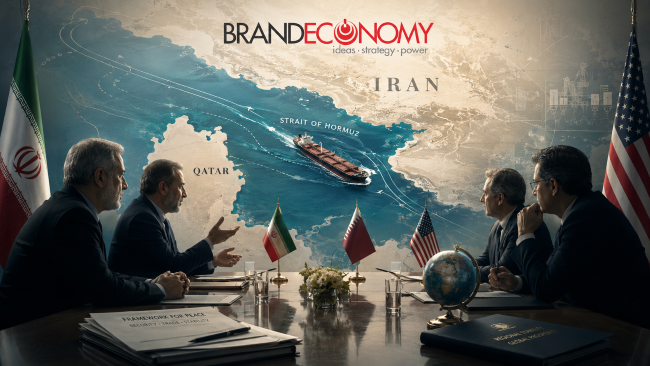 The emerging bargain is not yet a peace deal. It is a delicate attempt to turn a maritime crisis, a nuclear standoff and a sanctions dispute into a sequenced diplomatic framework — with Qatar again positioned as a critical Gulf
Iran’s senior envoys have opened talks in Doha with Qatar’s Prime Minister on a potential framework agreement with the United States to end the three-month-old conflict, even as Washington and Tehran continue to temper expectations of an imminent breakthrough.


Iran’s top negotiator and foreign minister were in the Qatari capital for discussions focused on a possible Peace Deal that would end the war, ease the U.S. naval blockade around the Strait of Hormuz, and create a pathway for time-bound negotiations on Iran’s nuclear programme. The talks are also understood to involve the possible release of frozen Iranian funds, with Iran’s central bank governor reportedly part of the delegation.
The diplomatic push comes as U.S. Secretary of State Marco Rubio said Washington would give diplomacy every reasonable chance before deciding whether to confront Iran “another way.” Rubio suggested that a serious proposal was on the table, including arrangements to reopen the Strait of Hormuz and move into substantive, time-limited nuclear talks.
U.S. President Donald Trump, in a lengthy post on Truth Social, said talks with Iran were progressing “nicely,” but warned that failure would invite renewed military action. His message was characteristically binary: either a “great deal” or no deal at all. He also used the moment to press Arab and Muslim-majority states, including Saudi Arabia and Qatar, to join the Abraham Accords, broadening the diplomatic frame from Iran de-escalation to regional normalisation with Israel.
Iran, however, is keeping its public language cautious. Foreign ministry spokesperson Esmaeil Baghaei said progress had been made on several issues, but stressed that this did not mean both sides were close to signing an agreement on a Peace Deal. According to the Iranian position, the draft memorandum contains 14 points and is primarily focused on ending the war and lifting the U.S. blockade of Hormuz in exchange for Iran taking steps to guarantee safe transit through the strategic waterway.
That distinction matters. Washington appears eager to present the talks as a broad peace and security framework. Tehran is presenting them as a narrower de-escalation mechanism tied first to the maritime blockade and safe passage.
Hormuz as the Bargaining Table
The Strait of Hormuz has become the centre of gravity in the conflict because it is not merely a waterway. It is one of the world’s most consequential energy arteries, normally carrying a large share of global oil and liquefied gas flows.
Since the conflict began, the strait has been effectively closed, with only limited vessel movement compared with the much higher daily traffic that passed before the war. Iranian state television said that 32 vessels and five oil tankers transited in the previous 24 hours with authorisation from Iran’s Revolutionary Guards naval forces, while reiterating that no vessel would be allowed passage without coordination with the IRGC.
This claim strikes at the heart of the legal and strategic dispute. The United States and Gulf partners have resisted any Iranian attempt to assert unilateral control over the waterway. Iran, meanwhile, appears to be using its proximity, military reach and regional leverage to force recognition of a coordination regime.
Baghaei said the proposed accord does not yet contain detailed provisions on managing the strait. He added that Iran would not impose tolls on vessels, although it could charge for services such as navigation and environmental protection under a protocol to be agreed with Oman, which shares the opposite side of the waterway.
For maritime lawyers and trade strategists, this is not a minor clause. The line between legitimate maritime services and a disguised control mechanism could become one of the most contentious issues in the final negotiations.
The Nuclear Question Is Deferred, Not Resolved
The nuclear file remains the most difficult part of the emerging framework.
Trump has repeatedly said his overriding objective is to prevent Iran from obtaining a nuclear weapon. Tehran continues to deny any intention to develop one. Yet Iran’s stockpile of highly enriched uranium remains central to the talks, and any durable peace will require verifiable limits, inspections and a credible structure for compliance.
Baghaei suggested that nuclear issues are not the immediate focus of the current framework, but would be negotiated over a 60-day period if the memorandum is agreed. That sequencing may be diplomatically useful, but it also carries risk. It may enable the parties to first stabilise the war and reopen Hormuz; however, it could also defer the hardest issue until after each side has pocketed early gains.
A maritime truce can reduce energy-market pressure. A nuclear settlement requires political trust, technical verification and sustained enforcement. Those are not the same thing.
Frozen Funds, Sanctions and the Price of De-Escalation
Iran’s inclusion of its central bank governor in the Doha delegation points to another major track: frozen funds and sanctions relief.
Tehran is seeking the release of tens of billions of dollars in oil revenues held in foreign banks. The United States, for its part, will likely want any financial concessions tied to Iranian commitments on maritime transit, nuclear negotiations and regional conduct.
This is where the business dimension of the diplomacy becomes clear. Peace frameworks are not built only with words. They are built with access to money, shipping lanes, insurance markets, sanctions waivers, oil sales and banking channels.
A deal that reopens Hormuz but leaves the sanctions architecture unclear will not fully calm markets. A deal that addresses sanctions without credible security guarantees will struggle to satisfy Washington, Israel and Gulf capitals. A deal that ignores Iran’s economic pressures will have limited durability.
The final bargain, if it emerges, will therefore be a legal-financial-security package, not simply a ceasefire note.
Oil Markets React to Diplomacy
The Hormuz standoff has already pushed up the cost of oil, fuel, fertiliser and food. On Monday, however, oil prices reportedly fell more than 4 per cent to two-week lows as traders bet that Washington and Tehran might be moving closer to a deal.
That reaction shows how quickly diplomacy at a maritime chokepoint transmits into global prices. Any credible reopening of Hormuz would ease pressure on energy shipping, freight risk, insurance premiums and downstream costs. For oil-importing economies, the relief could be immediate. For oil exporters, the effects may be mixed: stability supports volumes, but lower fear premiums can reduce prices.
For Africa, and especially Nigeria, the implications are direct. Gulf disruptions affect crude benchmarks, shipping costs, import bills, fertiliser prices, fuel costs and inflation expectations. In a fragile global economy, Hormuz is not a distant Middle Eastern issue. It is a global price-setting artery.
The Drone Signal and the Military Shadow
Even as diplomacy advanced, the military shadow remained visible. Iran said it had downed a hostile stealth drone using a new air-defence system, with Iranian media presenting the incident as proof that the skies over the Persian Gulf could no longer be penetrated by stealth drones.
Whether the claim is independently verified or not, its political meaning is clear. Tehran wants to negotiate from a position of deterrence, not weakness. Washington, meanwhile, continues to warn that diplomacy is not the only option.
That is the danger in this phase. Both sides may be talking, but neither has fully stopped signalling readiness for escalation.
Israel’s Reduced Leverage and Trump’s Strategic Room
Another important development is the suggestion that Israeli Prime Minister Benjamin Netanyahu has privately acknowledged that Israel now has limited ability to influence Trump’s decision-making on the Iran conflict.
If accurate, that points to a significant shift. The United States may be moving toward a deal calibrated around American energy, military and electoral pressures rather than Israeli preferences alone. That does not mean Israel is irrelevant. It remains a central security actor. But Trump appears to be preserving maximum room for manoeuvre.
His approval ratings have reportedly been affected by the war’s impact on U.S. energy prices, while congressional efforts to restrain presidential war powers have added domestic pressure. In that context, a deal that reopens Hormuz and reduces fuel-price pressure could carry political value in Washington.
BRANDECONOMY Insight
The Doha Talks Show That Maritime Power Has Become the New Diplomacy
The emerging U.S.–Iran Peace Deal framework is a reminder that modern geopolitics is increasingly fought and settled through economic chokepoints.
The Strait of Hormuz is the real negotiating table. It is where military pressure, oil prices, shipping insurance, legal rights, sanctions policy and nuclear diplomacy converge. Whoever controls risk in Hormuz influences not only Gulf security, but global inflation, energy markets and supply-chain confidence.
Qatar’s role is also instructive. Doha has again positioned itself as a high-value intermediary — trusted enough by Western capitals to host sensitive talks, yet sufficiently connected to regional actors to keep channels open when direct diplomacy becomes politically difficult.
But optimism should be restrained. The draft framework appears to be a sequencing device rather than a final peace settlement. It may stop the bleeding, reopen the waterway and create a negotiation window. It does not yet resolve the hardest issues: Iran’s nuclear capacity, sanctions relief, frozen funds, Hezbollah, Israel’s security concerns and the legal status of any Iranian role in Hormuz transit.
For Nigeria and Africa, the lesson is immediate. Maritime security is no longer a specialist concern for naval strategists. It is a cost-of-living issue, a fuel-price issue, a fertiliser issue and an inflation issue.
A narrow channel in the Gulf can move prices in Lagos, Accra, Nairobi and Johannesburg. That is the new geography of economic vulnerability.