FG Pushes Back on ‘Hidden Spending’ Narrative, Says World Bank Report Was Misread
"World Bank’s Nigeria Development Update Misunderstood"

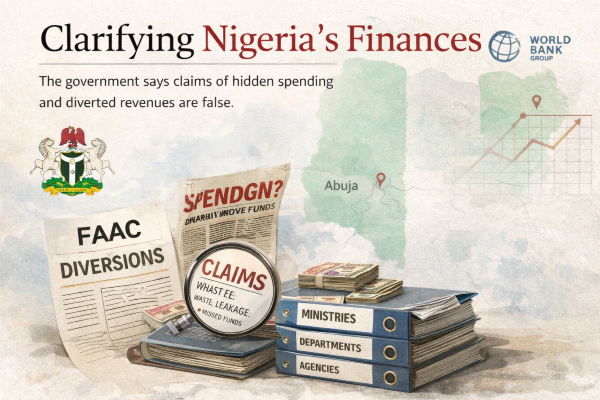 Nigeria’s fiscal debate has once again become a contest not only over numbers, but over interpretation. The Federal Government has moved to rebut claims of concealed public spending and diversion of federation revenues, arguing that recent commentary on the World Bank’s Nigeria Development Update reflects a misunderstanding of how the country’s fiscal architecture actually works.
At the centre of the rebuttal is Mr Taiwo Oyedele, Minister of State for Finance, who insists that deductions under the Federation Account Allocation Committee (FAAC) have been wrongly framed by some analysts and commentators as evidence of waste, leakages or missing funds. In his telling, the issue is less one of hidden expenditure than of fiscal illiteracy.




A Dispute Over Definitions
The controversy turns on the meaning of deductions from federation revenues.
According to Oyedele, the FAAC deductions cited in public debate are not covert diversions but statutory and operational obligations embedded in Nigeria’s intergovernmental fiscal framework. These include transfers, security-related spending, cost of collection, investment allocations, and refunds to Ministries, Departments and Agencies.
That distinction matters. In a federal system such as Nigeria’s, not every deduction from centrally collected revenue constitutes a loss or an abuse. Some are routine obligations tied to constitutional, administrative and fiscal responsibilities across tiers of government.
The minister’s argument, then, is essentially definitional: what some critics describe as “hidden spending” is, in fact, part of the legitimate mechanics of public finance.
The World Bank Report: Warning or Validation?
Oyedele also argues that sections of the World Bank’s report have been selectively cited, stripped of context, and presented in ways that exaggerate fiscal distress while ignoring evidence of reform.
In particular, he points to the Bank’s recognition of ongoing policy adjustments, including a 2026 Executive Order aimed at improving petroleum revenue remittances and strengthening transparency. Those measures, he says, are expected to increase distributable revenues by around 0.4 per cent of GDP annually.
This is not insignificant. In an economy where public finances remain under strain, any improvement in remittance efficiency has direct implications for subnational allocations, fiscal credibility and macroeconomic stability.
The minister’s broader claim is that the World Bank report, read in full, does not portray a state of fiscal collapse. Rather, it suggests a system still under pressure, but increasingly shaped by reform momentum.
The Politics of Fiscal Perception
Yet the government’s response also reflects a more delicate reality: in Nigeria, fiscal narratives are never purely technical.
Public trust in revenue management remains fragile, and accusations of opacity find fertile ground in a country long accustomed to leakages, off-book spending and weak accountability. That is why even legitimate deductions can easily become politically contested when transparency is inadequate or public communication is poor.
Oyedele’s statement therefore serves two purposes. It is both a technical clarification and a political defence of the reform agenda.
Signs of Macro Improvement
In pushing back against the more alarmist readings, the minister highlights several areas of macroeconomic improvement: easing inflationary pressure, stronger external reserves, a current account surplus, and a decline in the debt-to-GDP ratio—the first such reduction in more than a decade.
These indicators, if sustained, would suggest that the fiscal adjustment process is beginning to stabilise the macro environment. But the more important challenge lies ahead: converting those gains into broader welfare improvement.
That is where official optimism still meets public scepticism.
Why the Interpretation Matters
Fiscal data is not merely an accounting exercise; it shapes investor confidence, policy credibility and public expectations.
When deductions are mischaracterised, the risk is not only reputational damage to institutions, but also distortion of economic debate. At the same time, the government’s defence will be credible only to the extent that it is matched by deeper transparency, cleaner reporting and more accessible public finance disclosure.
In short, the argument is not over whether reform is happening. It is over whether citizens can clearly see it.
BRANDECONOMY Insight
- Fiscal Communication Is Now Policy
In an environment of low trust, governments must explain public finance with greater precision. Reform without communication creates room for suspicion and misinterpretation. - FAAC Deductions Need Better Transparency
Even when legally valid, deductions from federation revenues should be clearly disclosed, categorised and publicly explained. Opacity is politically expensive. - Reform Narratives Must Be Grounded in Outcomes
Improved reserves, lower debt ratios and better remittance mechanisms matter. But public confidence will ultimately depend on whether these gains reduce hardship and improve service delivery. - Nigeria’s Fiscal System Remains Poorly Understood
The dispute shows how easily technical aspects of fiscal federalism can be politicised. There is a broader need for public education on how revenue flows actually work. - Investors Watch the Quality of Debate
Markets pay attention not only to headline reforms, but to the credibility of institutions and the coherence of fiscal discourse. Confused narratives can weaken reform dividends.