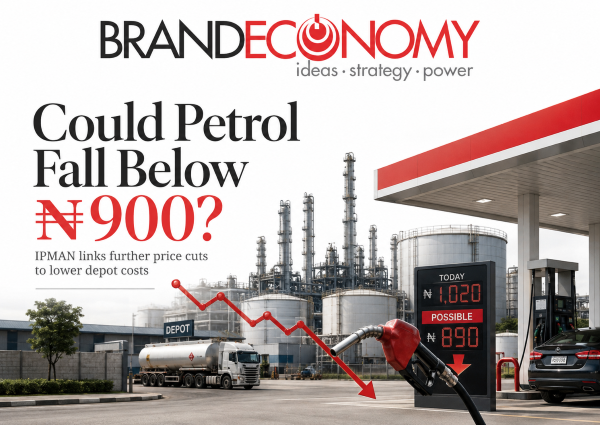
 The Independent Petroleum Marketers Association of Nigeria says further relief at the petrol pump is possible—but only where depot petrol prices, refinery access, logistics costs and marketer margins align.
Nigerians may yet see petrol sell below ₦900 per litre in some markets, but the outcome will depend less on public expectations and more on the underlying cost of supply.




That is the position of the President of the Independent Petroleum Marketers Association of Nigeria, IPMAN, Mr Elijah Shettima, who says independent marketers are ready to reduce pump prices further where their purchase costs allow it.
Speaking in Abuja, Shettima said the association’s central concern is to secure direct access for independent marketers to refined products from the Dangote Refinery. Such access, he argued, could improve availability, reduce avoidable supply-chain costs and create room for more competitive retail petrol prices.
“Our major concern is to ensure that independent marketers can purchase products directly from the Dangote Refinery,” he said. “If importation becomes necessary, marketers should also be allowed to import products independently.”
His message is clear: the pump price begins at the depot.
The Road to ₦900 Starts Before the Filling Station
For motorists, the petrol-price conversation is usually about what appears on the station price board.
For marketers, it begins much earlier—with the ex-depot petrol price, transport charges, financing costs, product availability, loading delays, storage costs and the margin required to keep stations operating.
Shettima said independent marketers have already reduced prices by about ₦125 per litre across the country and remain prepared to transfer further cost reductions to consumers.
But the scale of future reductions will depend on the price at which they can buy petrol from depot operators or directly from refineries.
“If procurement costs continue to decline, marketers will be willing to reduce pump prices further, even below ₦800 per litre, where market conditions permit,” Shettima said.
That is an important caveat.
A price below ₦900 is possible in a more favourable supply environment. It is not, however, a guaranteed nationwide price. Retail prices can still differ sharply between coastal markets, major urban centres and inland locations where haulage, road conditions and depot access add to the final cost.
Why Direct Dangote Refinery Access Matters
Direct purchasing from the Dangote Refinery could give independent marketers a clearer route to product supply and reduce dependence on multiple intermediaries.
Nigeria ended NNPC Limited’s exclusive role as the buyer of Dangote Refinery petrol in 2024, opening the market for local marketers to buy directly under commercial arrangements. The shift was expected to support competition and simplify the supply chain.
For IPMAN members, direct access could mean:
- More predictable product availability
- Lower exposure to layers of depot mark-ups
- Better ability to plan station inventory
- More competitive pump prices
- Stronger capacity to serve smaller towns and communities
The commercial benefit, however, depends on transparency. Direct access must be open, reliable and workable for independent operators—not limited to only the largest and best-capitalised players.
Petrol Prices Fall Gradually, Not Instantly
Shettima explained that petrol prices do not drop overnight because marketers often sell stock purchased at earlier, higher prices.
The same way increases came in stages when supply costs rose, reductions are likely to emerge gradually as depot prices and procurement costs ease.
That is especially important in a deregulated market, where price movements are influenced by several variables at once:
- Refinery-gate and depot prices
- Crude oil costs
- Exchange-rate movements
- Transport and haulage expenses
- Working-capital and bank-financing costs
- Storage and terminal charges
- Location and distance from supply points
- Competition among retailers
In practical terms, a station in Lagos may adjust faster than one in Kano, Maiduguri, Sokoto, Enugu or other locations where petrol must travel longer distances before reaching consumers.
Local Refining Offers Hope—But Not Automatic Cheap Fuel
The Dangote Refinery has altered the structure of Nigeria’s petrol market by increasing local refining capacity and reducing reliance on imported fuel.
Nigeria has also moved to prioritise domestic petrol supply, with the suspension of fresh import licences in early 2026 linked to sufficient local availability under the Petroleum Industry Act framework.
Yet local refining does not automatically translate into one uniform low price across the country.
A refinery still has to secure crude oil, cover operating costs, fund logistics and sell products on viable commercial terms. Reuters reported that Dangote Refinery recently imported crude from the United Arab Emirates, illustrating how feedstock availability and global market conditions can still influence local petrol economics.
The real opportunity lies in building a system that brings refinery output closer to consumers at lower cost.
That means efficient depots, modern truck fleets, better roads, dependable product-loading arrangements and competitive access for marketers.
Market Implications: A New Battle Over Distribution
The next phase of Nigeria’s downstream petroleum market may be less about who refines petrol and more about who distributes it most efficiently.
Dangote Refinery’s planned deployment of thousands of gas-powered trucks for direct fuel distribution signals a push to cut logistics costs and improve supply reach.
That could produce benefits for consumers. It could also reshape the traditional relationship between refineries, depots, marketers, transporters and retail outlets.
For independent marketers, the concern will be ensuring that new logistics models do not squeeze them out of the value chain.
For government and regulators, the task is to protect competition, prevent supply bottlenecks and ensure that market efficiency—not market dominance—determines the benefit passed to consumers.
Brand Implications: Trust Must Travel With the Price Cut
A lower pump price attracts motorists. Consistent value keeps them.
For petrol retailers, the emerging brand advantage will belong to stations that combine competitive pricing with reliable supply, honest dispensing, clean forecourts, safe facilities and transparent customer service.
The station that advertises a low price but frequently runs dry, dispenses inaccurately or changes its rate without explanation will lose trust quickly.
For Dangote Refinery, public perception will increasingly be tied to everyday impact. Nigerians will judge the refinery not only by its scale or industrial significance, but by whether product availability improves and whether market-wide efficiency produces sustained relief at the pump.
Investor Relevance: Opportunities Beyond the Refinery Gate
The strongest investment opportunities in Nigeria’s downstream sector are expanding beyond crude processing.
They include:
- Storage terminals and depots
- Haulage and truck-fleet modernisation
- Retail-station upgrades
- Fuel inventory and payment technology
- Working-capital finance for credible marketers
- Logistics insurance and risk-management services
- CNG and cleaner-energy integration
- Convenience retail around fuel stations
The winners will be operators that can reduce cost per litre, manage supply reliably and earn customer trust in an increasingly competitive retail environment.
BRANDECONOMY Insight
Could petrol price fall below ₦900 per litre?
Yes—where depot prices fall enough, supply is reliable, distribution is efficient and marketers can still make sustainable margins.
But the more important national question is not whether one city records a temporary low price.
It is whether Nigeria can build a downstream market where locally refined petrol reaches every part of the country through a transparent, competitive and cost-efficient supply chain.
That is how petrol price relief becomes more than a headline.