10th Bullion Lecture: Why Nigeria Must Move From Extraction to Value Creation – Experts
"Nigeria’s path to prosperity will not be found in extraction alone"

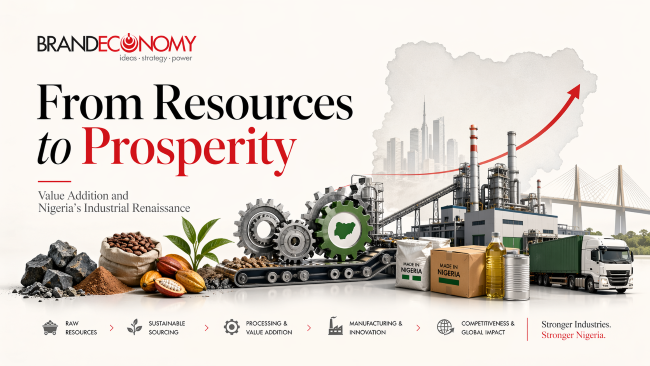 Nigeria has long lived with a strange contradiction: a country rich in raw materials, yet poor in the industrial depth required to turn those materials into enduring prosperity. That contradiction sat at the heart of discussion at the 10th Bullion Lecture in Lagos, where economists, industry leaders and policy thinkers argued that accelerated value addition, stronger industrialisation and tighter policy coherence are now imperative if Nigeria is to escape vulnerability, deepen resilience and build a more competitive economy.
Held under the theme, “From Resources to Prosperity: How Raw Materials Development, Value Addition and Innovation Can Catalyse Nigeria’s Industrial Renaissance,” the forum was less an academic exercise than a warning against drift. Its central message was clear: Nigeria can no longer afford to remain a country that exports raw potential and imports finished value.



At a time of geopolitical turbulence, volatile energy markets and disrupted trade routes, that message has acquired even greater urgency.
A World Growing Rougher, A Nigeria Still Too Exposed
Chairman of the lecture and Chairman of the Alliance for Economic Research and Ethics, Kelvin Oye, framed the challenge in stark terms. The current geopolitical climate, he argued, is not some distant spectacle for Nigeria to observe passively. It is already filtering through energy prices, logistics costs and inflationary pressure into the daily life of businesses and households. In his words, the current global turbulence threatens “higher logistics costs” and imposes “an additional burden on the standard of living of the average Nigerian.”
His deeper point was strategic. A country that remains heavily import-dependent cannot hope to remain stable in a fragmented world. That is why Oye urged Nigeria to “look inward” and move urgently from a consumption-driven economy to a production-driven one, arguing that only by localising supply chains, expanding domestic manufacturing and “fiercely pursuing value addition” can the country shield itself from external shocks and protect livelihoods.
That argument set the tone for the wider conversation: industrialisation is no longer simply a development aspiration; it is a survival strategy.
The Case for Value Addition
Oye pointed to what he described as an encouraging, if still incomplete, policy shift under the current administration. He cited measures such as export restrictions on raw shea nut, a proposed 30 per cent value-addition threshold for exports, and the Economic Development Tax Incentive as signs that government is beginning to treat raw material policy more strategically.
The underlying economic logic is compelling. Countries that export raw commodities without processing them tend to surrender the most profitable parts of the value chain to others. They create fewer industrial jobs, capture less tax revenue, and remain more exposed to price swings in global markets. By contrast, countries that process, refine, manufacture and brand locally are better positioned to generate domestic wealth, build industrial ecosystems and sustain export competitiveness.
Nigeria’s problem is not that it lacks raw materials. It is that it has too often stopped at extraction.
Why Industrialisation Is No Longer Optional
The keynote speaker, Prof. Nnanyelugo Ike-Muonso, Director-General of the Raw Materials Research and Development Council, pushed that argument further. He said industrialisation had become an imperative for Nigeria, noting that manufacturing still contributes only around eight to 10 per cent of GDP—a modest share for an economy of Nigeria’s size and ambition.
He identified several long-standing barriers to industrial take-off: energy deficits, poor infrastructure, logistics bottlenecks and critical skills gaps in fields such as process engineering and materials science. The electricity challenge alone, he noted, imposes enormous losses on the economy. Weak roads and transport systems compound the problem, raising the cost of moving goods and eroding the competitiveness of domestic producers.
His argument was blunt and necessary: industrialisation is not optional. Nigeria must move from extraction to value creation if it hopes to build a resilient and competitive economy.
The significance of that statement lies in what it rejects. It rejects the old idea that a resource-rich country can coast on extraction and trade its way into prosperity. It says, instead, that prosperity has to be built through transformation.
The Missing Link: Finance, Data and Execution
That theme was reinforced by other contributors.
HRH Jacob Esan, Chief Executive Officer of Geo Fluids Plc, argued that one of Nigeria’s biggest market failures lies in the weak linkage between financial capital and resource potential. The problem, he suggested, is not simply that Nigeria has solid minerals such as lithium and nickel; it is that inadequate and unreliable data on the quantity and quality of those deposits makes investment harder to structure and confidence harder to build.
That is a critical insight. Resource wealth without bankable data often remains speculative wealth. Investors do not finance mythology; they finance measurable opportunity. In that sense, better geospatial analysis and more rigorous resource quantification are not technical luxuries. They are prerequisites for attracting long-term capital.
Oye made a parallel point on financing from the industrial side. If Nigeria wants to create what he evocatively described as “junior Aliko Dangotes”—young industrialists capable of building the next generation of productive enterprises—then access to affordable capital must improve dramatically. He urged more deliberate expansion of single-digit financing through institutions such as the Bank of Industry and NIRSAL Microfinance Bank.
This matters because industrial policy without industrial finance remains mostly rhetorical.
Policy Coherence or Policy Confusion
Yet the forum’s most important recurring concern was not merely policy design, but policy coherence.
Nigeria has rarely lacked policy ideas. What it has lacked is consistency in implementation. Oye warned that the government must ensure a seamless operating environment for the country’s more than 400 licensed Export Processing Zones if current value-addition policies are to produce real outcomes.
He also raised a more sensitive point: the need to protect local farmers from the distortions created by excessive or poorly calibrated food importation. Short-term attempts to stabilise food prices, he cautioned, should not come at the cost of destroying the local agricultural base. In his view, government must guarantee minimum prices, invest in storage and processing infrastructure, and prioritise local procurement. Again, the point circles back to value addition: without local processing, Nigeria will continue to suffer post-harvest losses, weak farmgate pricing and cyclical food insecurity.
That is the deeper lesson here. Policy coherence is not just about making announcements in the same direction. It is about ensuring that trade, industry, agriculture, finance and infrastructure policies reinforce rather than undermine one another.
A Lecture, But Also a National Diagnostic
Prof. Akpan Ekpo, Chairman of the Board of Trustees of the Centre for Financial Journalism, described the Bullion Lecture as a platform that has evolved into a serious forum for intellectual discourse and policy influence. That may sound ceremonial, but in this instance it is true enough. The event brought together a diagnosis that is increasingly difficult to dispute.
Nigeria’s current growth model is too shallow, too import-exposed and too disconnected from its own raw material base. It produces vulnerability in times of global calm and instability in times of global stress.
The choice before the country is not mysterious. It is whether to continue exporting unprocessed possibility or begin building the industrial systems that convert resources into domestic prosperity.
BRANDECONOMY Insight
Nigeria’s industrial question is no longer theoretical. It is practical, urgent and unforgiving.
The Bullion Lecture surfaced a hard truth: in a world of geopolitical fragmentation, countries that lack domestic productive depth will pay for that weakness through inflation, external dependence and lost jobs. Nigeria cannot talk endlessly about diversification while continuing to export raw materials and import value-added products at premium cost.
Three insights stand out.
First, value addition for raw materials and natural resources must become a national economic doctrine, not a policy slogan. That means export rules, tax incentives, industrial finance and infrastructure investment must be aligned toward processing and manufacturing.
Second, industrialisation will fail if finance remains detached from productive opportunity. The argument made by both Kelvin Oye and Jacob Esan points to the same conclusion: capital must meet industry where it is, and data must make that meeting credible.
Third, policy consistency is now as important as policy ambition. Nigeria has entered an era in which half-implemented reforms can be as damaging as no reform at all. Investors, manufacturers and farmers alike need predictability, not episodic enthusiasm.
The country’s resources are not the question. Its capacity to govern them into prosperity is.