BRAND REPORTBUSINESSLATEST NEWSNEWS

Customs Deepens Nigeria-China Trade Cooperation, Targets Illicit Flows

Seeks Mutual Administrative Agreement

Customs Deepens Nigeria-China Trade Cooperation, Targets Illicit Flows
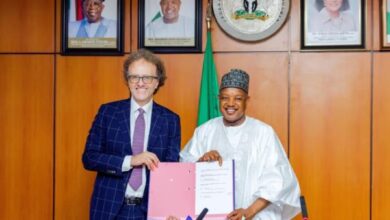
NCS Comptroller-General(C-G), Bashir Adeniyi receiving the Ambassador-Designate to China, retired Lt. Gen. Abdulrahman Dambazau at the Customs Headquarters in Abuja.

As China remains Nigeria’s largest trading partner, the Nigeria Customs Service is pushing for a cleaner, smarter and more accountable trade corridor — one that rewards compliant businesses while tightening the noose around smuggling, false declarations, illegal mining exports and wildlife trafficking.

The Nigeria Customs Service has reaffirmed its commitment to strengthening legitimate trade with China while intensifying action against illicit economic activities that undermine Nigeria’s revenue, security and industrial development.

The Comptroller-General of Customs, Bashir Adewale Adeniyi, gave the assurance while receiving Nigeria’s Ambassador-designate to China, retired Lt. Gen. Abdulrahman Dambazau, at the Customs Headquarters in Abuja.

The engagement focused on deepening trade cooperation between Nigeria and China, improving compliance among Chinese-linked businesses operating in Nigeria, strengthening intelligence sharing, and ensuring that trade facilitation does not become a cover for smuggling, illegal mining, wildlife trafficking or other forms of economic sabotage.

For Nigeria, the stakes are significant. China is not merely another commercial partner. It is Nigeria’s largest source of imports and one of the most consequential actors in the country’s trade, manufacturing, infrastructure and consumer-goods ecosystem. That makes the Nigeria-China corridor both a strategic opportunity and a regulatory test.

Adeniyi said Customs is committed to a framework that enables legitimate trade while enforcing rules more firmly against abuse. According to him, some Chinese companies are already participating in the Service’s Authorised Economic Operator programme, which rewards trusted, compliant traders with smoother processes and improved facilitation.

He noted that businesses that comply with trade regulations and global best practices would continue to receive institutional support and commendation, while those engaged in illicit activity would face tougher scrutiny.

A Cleaner Trade Corridor

The Customs chief said the Service maintains a Customs Mutual Administrative Agreement with the General Administration of Customs of China, a platform intended to support legitimate trade, improve customs cooperation and strengthen information exchange between both countries.

That agreement is important because modern customs administration increasingly depends on data, transparency and cross-border intelligence. Trade fraud is rarely confined to one jurisdiction. False valuation, under-declaration, concealment, prohibited imports, mislabelled goods and questionable certificates often begin before goods arrive at Nigerian ports.

To close those gaps, Adeniyi said both countries must strengthen engagement and ensure better alignment of trade figures. Significant discrepancies in bilateral trade statistics can point to under-reporting, wrong classification, transshipment abuse or revenue leakage.

His position is clear: the Nigeria-China trade relationship must become more transparent, data-driven and mutually accountable.

Stronger engagement and continuous communication between the Nigeria Customs Service and China, he said, would support more effective trade facilitation and deliver mutual economic benefit.

Customs Cannot Work Alone

Adeniyi also stressed that Customs cannot achieve these objectives in isolation. He called for stronger collaboration with relevant government agencies to harmonise processes, improve enforcement and strengthen trade facilitation.

This is a crucial point. Nigeria’s border economy touches multiple institutions: Customs, immigration, ports authorities, standards regulators, environmental agencies, mining authorities, security services, maritime regulators and revenue agencies. When these institutions work in silos, illicit operators exploit the gaps. When they share data and coordinate enforcement, trade becomes cleaner and faster.

For compliant businesses, stronger inter-agency coordination can reduce delays and uncertainty. For government, it can improve revenue collection, protect local industry and strengthen national security.

Wildlife Trafficking, Illegal Mining and Border Intelligence

Beyond ordinary customs infractions, Adeniyi raised concern over the need to prevent Nigeria from becoming a transit route for illegal wildlife trade. He said stronger cooperation and intelligence sharing would be required to disrupt such networks.

He also called for collaboration to combat illegal mining, particularly through tighter border enforcement and data-driven operations.

This speaks to a wider governance problem. Nigeria’s natural resources are often exposed to illegal extraction, weak documentation and cross-border leakages. When minerals leave the country through informal or illicit channels, the nation loses revenue, local value addition, jobs and strategic control over its resource economy.

The Customs message is therefore not only about import compliance. It is also about protecting Nigeria’s export integrity and preventing the country’s trade channels from being hijacked by criminal value chains.

Dambazau’s Diplomatic Assignment and the Customs Link

Adeniyi expressed confidence in Dambazau’s ability to strengthen Nigeria’s mission in China, noting that the former minister’s military background, leadership record and understanding of security architecture would be useful in the diplomatic assignment.

He described Dambazau as no stranger to the Service and said his experience would support deeper engagement on trade, security and customs cooperation.

Responding, Dambazau said close collaboration with the Nigeria Customs Service would make his assignment easier and help Nigeria extract greater value from its relations with China.

He noted that Customs has an important role to play in supporting China’s zero-tariff trade arrangements for African countries, while stressing the need for reduced cargo clearance time, stronger certification processes and tighter regulation of imports from China.

He also warned against abuse of trade policies for unlawful gain, arguing that stronger Customs collaboration would ensure smoother trade processes and fuller realisation of the Nigeria-China trade relationship.

Trade Facilitation with Enforcement Discipline

The core message from the meeting is that Nigeria wants more trade with China — but not at any cost.

The country needs imports that are properly valued, properly classified, safe, certified and compliant with national standards. It needs Chinese businesses that operate transparently and respect Nigerian laws. It needs faster clearance for trusted traders, but tougher consequences for those who abuse the system.

This is the delicate balance modern Customs must strike: facilitate legitimate commerce while making illicit trade more difficult, expensive and risky.

China’s scale in Nigeria’s trade structure makes this balance even more important. The country supplies a large share of machinery, electronics, household goods, industrial inputs, vehicles, building materials and consumer products entering Nigeria. But the same high-volume corridor can become vulnerable to under-invoicing, fake products, substandard imports, misdeclaration and smuggling if enforcement is weak.

A more disciplined Nigeria-China customs relationship could therefore improve trade efficiency, protect consumers, raise revenue, support compliant businesses and strengthen Nigeria’s industrial policy.

BRANDECONOMY Insight

Nigeria-China Trade Needs Trust, Speed and Discipline

Nigeria’s trade relationship with China is too important to be managed casually. It is one of the country’s most active commercial corridors, feeding consumer markets, industrial supply chains, infrastructure projects and import-dependent businesses across the federation.

But high-volume trade is only beneficial when it is properly governed.

The Customs engagement with Ambassador-designate Abdulrahman Dambazau points to a necessary shift: Nigeria must move from passive trade dependence to strategic trade management. That means cleaner data, stronger certification, fewer clearance bottlenecks, better intelligence sharing and firm action against smuggling, illegal mining exports and wildlife trafficking.

For legitimate businesses, the goal should be faster and more predictable clearance. For offenders, the goal should be higher risk and lower room for manipulation. That is the difference between trade facilitation and trade leakage.

The Authorised Economic Operator programme is especially important in this regard. If properly implemented, it can separate trusted traders from high-risk operators, allowing Customs to focus enforcement energy where it matters most.

The deeper economic lesson is clear: Nigeria does not need less trade with China. It needs better trade with China — more transparent, more compliant, more value-adding and more aligned with national development priorities.

Back to top button