Waste Buildup: LAWMA Deploys 25 Trucks to Oshodi in New Waste-Economy Model

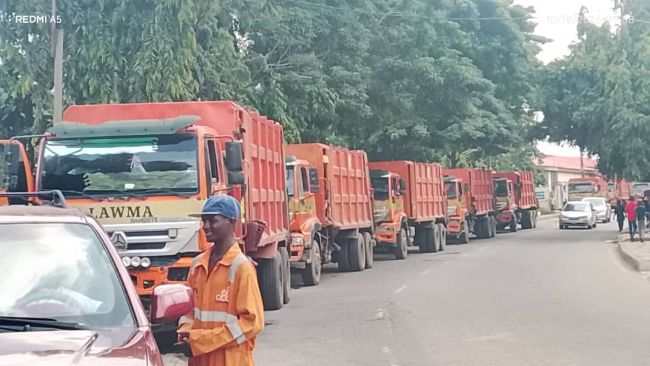 The Lagos Waste Management Authority (LAWMA) has deployed 25 trucks for an emergency clean-up operation in Oshodi, confronting a refuse buildup that has exposed deeper weaknesses in the financing, infrastructure and accountability of waste collection across one of Lagos’ busiest urban districts.
The intervention began around Bolade and extends to other affected areas, including Folorunsho Street and Oluwole, off Oshodi Road. LAWMA said the operation is being undertaken with the support of the local government, Community Development Associations, residents and private waste operators.




Tunde Suleiman, LAWMA’s Head of Private Sector Participation Services, said the immediate objective was to remove the accumulated refuse before discussions resumed on a more sustainable tariff structure.
The authority has established a staging area capable of processing four trucks simultaneously as part of the evacuation exercise.
Deploying 25 trucks should provide visible short-term relief. But emergency evacuation is the end-stage response to a waste-management system that has already failed at collection, storage or compliance. The more important question is why refuse was allowed to accumulate—and what will prevent its return after the trucks leave.
The uncomfortable economics of a ₦750 tariff
Suleiman attributed the problem to Oshodi’s high population density, rising waste volumes, inadequate containers and collection tariffs that no longer reflect the cost of operating waste trucks.
The district has more than 350 streets but remains one of the areas with the lowest waste tariffs in Lagos. Residents reportedly continue to pay ₦750 per room, despite sharp increases in fuel, vehicle maintenance, labour, financing and disposal costs.
Some Private Sector Participation operators must also travel considerable distances between collection routes and disposal facilities. Under those conditions, low tariffs can undermine collection frequency, fleet maintenance and the financial viability of operators.
LAWMA has begun engaging PSP companies, community associations, local-government officials and residents as the state conducts a broader tariff review.
The economics are persuasive, but a higher tariff cannot be treated as an automatic solution. Residents are unlikely to embrace increased charges if service remains irregular, complaints are unresolved or operators continue billing households without collecting waste consistently.
Any tariff adjustment must therefore be tied to transparent service standards: published collection schedules, proof of evacuation, reliable complaint resolution, sanctions for non-performance and protection for vulnerable households.
Lagos must avoid asking residents to pay more into a system whose accountability remains difficult to measure.
Density has overtaken the old infrastructure
Oshodi’s changing physical character has complicated the problem. Buildings originally designed as low-density bungalows are being converted into multi-storey residential blocks without corresponding expansion in waste-storage and collection capacity.
Suleiman cited a building containing about 16 flats but served by only two waste bins. Even when the containers are emptied, they quickly overflow because the available storage does not reflect the number of occupants or the volume of waste generated.
This is a planning failure as much as an environmental one.
Every major increase in residential density should trigger a reassessment of waste containers, drainage, water supply, parking and emergency access. When planning approval concentrates more people on a property without expanding supporting infrastructure, the resulting burden is transferred to streets, drains and public agencies.
LAWMA’s “Adopt-a-Bin” initiative seeks to encourage households and property owners to provide containers appropriate to their population and waste output. The principle is sound, but compliance will require clear minimum standards and coordination with building-control authorities.
Adequate containerisation must become part of development approval and occupancy enforcement—not merely a voluntary response after refuse begins spilling onto the road.
Waste buildup is a business risk
Oshodi is not simply a residential district. It is one of Lagos’ most important transport, retail and informal-commerce gateways. Poor sanitation in such a location carries economic consequences beyond environmental appearance.
Uncollected waste obstructs pedestrian movement, weakens customer traffic, blocks drainage channels and increases the risk of flooding. It can also create breeding grounds for disease vectors, expose traders and commuters to harmful conditions and raise clean-up costs for surrounding businesses.
Retailers operating beside refuse heaps suffer reputational damage even when they did not cause the problem. Restaurants, food vendors, pharmacies and consumer-facing brands face an even greater trust deficit because sanitation is closely connected to perceptions of safety and product quality.
Property owners may also experience weaker rental demand and deteriorating asset values where streets repeatedly become informal dumpsites.
For Lagos, the deterioration of a highly visible commercial district undermines the city’s positioning as an investible African megacity. Investors judge urban competence partly through the quality of everyday services: clean streets, dependable transport, functioning drainage and credible enforcement.
Recycling must become commercially convenient
LAWMA is encouraging residents to separate plastic bottles, cans, paper and other recyclable materials from general refuse. Registered recyclers can purchase some of these materials, helping households recover part of their waste-management expenses.
The authority is also operating an incentive scheme through its Oshodi facility.
This is where the crisis could become an investment opportunity. Lagos needs more than evacuation trucks; it needs an integrated materials economy connecting households, aggregators, recyclers, manufacturers and digital payment systems.
Potential opportunities include container leasing, neighbourhood collection hubs, recycling rewards, route-optimisation technology, digital billing, composting, plastic recovery and materials-processing facilities.
However, private investment will depend on predictable regulation, reliable waste supply, enforceable contracts and transparent tariffs. Investors will not finance modern fleets or recycling plants if payment collection is uncertain and unregistered operators can undermine formal businesses.
Circular-economy rhetoric must therefore be supported by commercially workable systems.
Shared responsibility cannot dilute accountability
LAWMA has placed a desk officer at the Oshodi local-government secretariat to receive complaints. PSP operators serving the area—including Excellence, Tunap, Buckler Enterprises and Pepet—also maintain contact offices through which residents can report collection failures.
These access points are useful, but complaint channels must produce traceable outcomes. Residents should be able to obtain reference numbers, monitor response times and know whether an operator or customer was found responsible.
Households must pay legitimate charges, use adequate bins and stop dumping refuse indiscriminately. PSP operators must collect waste on schedule. Local authorities must enforce sanitation and planning rules. LAWMA must regulate performance and ensure that disposal infrastructure supports the system.
Shared responsibility should clarify these obligations—not blur them.
Brand implications: Lagos cannot normalise emergency sanitation
Emergency clean-ups generate dramatic images of government action, but they can also reveal the absence of routine service. If extraordinary deployments become frequent, the public may reasonably conclude that the underlying model is reactive.
The Lagos brand rests on energy, enterprise and scale. Yet those strengths are diminished when population growth overwhelms basic municipal services.
A credible environmental brand would publish ward-level collection schedules, operator-performance data, tariff bands, complaint-resolution figures and recycling outcomes. It would also show how emergency interventions are being converted into permanent service improvements.
Trust will grow when residents can see not only that trucks were deployed, but also that the conditions requiring emergency deployment have been corrected.
BRANDECONOMY Insight
The LAWMA 25-truck intervention will remove today’s refuse. It will not, by itself, solve Oshodi’s waste problem.
The deeper issue is a broken alignment between urban density, household tariffs, operator economics, container capacity, planning enforcement and citizen behaviour. Every part of that system must work for the streets to remain clean.
LAWMA is right that a ₦750-per-room charge may no longer reflect operating costs. But tariff reform should be presented as a service compact rather than a price increase. Residents who pay more must receive dependable collection, transparent billing and enforceable consumer protection.
The strongest reform would combine cost-reflective but socially sensitive tariffs with compulsory container standards, digital service monitoring, recycling incentives and performance-based PSP contracts.
A clean Oshodi would do more than improve sanitation. It would protect commerce, public health, property values and confidence in Lagos as a competently managed investment destination.
The measure of success is not how many trucks arrive during an emergency. It is how rarely emergency trucks are needed.