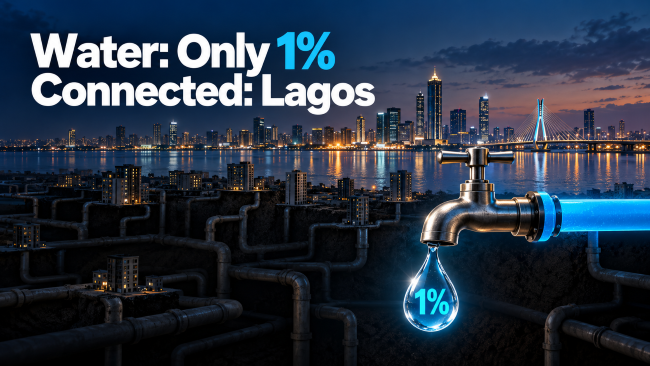
 Lagos, Nigeria’s commercial nerve centre and most populous urban economy, is operating a public water network that reaches barely one per cent of the population, forcing millions of residents and businesses into an expensive private market of boreholes, tankers, vendors, pumps and packaged water.
The Lagos Water Corporation has 34,424 registered household connections, according to Rasaq Anifowoshe, its Deputy Director of Corporate Affairs and Brand Management.



Using the corporation’s average household size of six people, those connections represent approximately 206,544 residents—or 1.03 per cent of an estimated population of 20 million.
The figure reveals more than inadequate coverage. It exposes a public-utility system whose installed assets, actual production and customer reach have become dramatically disconnected from the scale of the city they are meant to serve.
LWC has an installed production capacity of approximately 210 million gallons daily, compared with estimated demand of 540 million gallons under the Lagos State Water Supply Master Plan.
Even if every installed facility operated at full capacity, the system would meet only about 39 per cent of estimated demand.
The more alarming number is actual production.
LWC’s 2025 records show total output of approximately 2.633 billion gallons, equivalent to an average of 7.21 million gallons daily. That represents about 3.4 per cent of installed capacity and only 1.3 per cent of the state’s estimated daily requirement.
This is not simply a capacity shortage. It is an asset-utilisation emergency.
The private cost of public failure
Across Iponri, Oworonshoki, Costain, Apapa Road and Ebute Metta, residents described a daily struggle defined by unreliable supply, failed facilities, weak pressure and dependence on water of uncertain origin.
At Iponri Housing Estate, Adebayo Solomon said his household spent approximately ₦1,500 daily on vendor-supplied water. Sustained throughout the year, that expenditure would reach ₦547,500—before accounting for sachet or bottled water used for drinking and cooking.
Solomon said electricity shortages frequently disrupted availability, forcing the family to ration stored water or purchase at higher prices. He would accept an LWC connection if it offered a dependable and less expensive alternative.
Another Iponri resident, Abdulkareem Ibrahim, relies on public boreholes financed by philanthropists because his community receives no LWC supply. The arrangement reduces his direct expenditure, but electricity failures can stop pumping and push residents back to commercial vendors.
In Oworonshoki, Amanda Ogbodo spends between ₦2,200 and ₦3,600 weekly on vendor-delivered borehole water. Although public supply has recently improved in parts of the community—particularly from Friday afternoon into Saturday—homes on higher ground remain underserved because the network lacks sufficient pressure.
Ogbodo recalled that her business premises once received public water, with eight or nine users jointly contributing ₦10,000 monthly. The supply stopped for roughly four years after a pipe failure and returned only intermittently in 2025.
The experience illustrates an important difference between being connected and being served. A pipe entering a community is not equivalent to reliable access if pressure is inadequate, pumping is irregular or broken infrastructure remains unrepaired for years.
Unknown sources, measurable health risks
At Costain, Eniola Adewale said a truckload of water cost between ₦1,200 and ₦1,500, although vendors sometimes doubled prices during shortages.
Because the source of the water was uncertain, her household used sachet water for cooking. Eunice David, a food vendor on Thomas Street, also reported significant monthly expenditure on pumping water after a public facility serving the area stopped functioning.
On Opeoluwa Street, Apapa Road, Garuba Alasan said the local public water facility had been out of service for approximately 20 years. After living in the neighbourhood for three decades, he has depended on private sources for most of that time.
At Vaughan Street, Costain, residents connected to the public system contribute about ₦1,000 monthly, but water availability depends heavily on electricity. When power fails, supply stops and households return to vendors.
In Ebute Metta, Esther Emokpaire said her household purchased a ₦1,000-to-₦1,500 truckload approximately every two days. Vendors claimed the water was clean and treated, but the household had no independent means of verifying its quality. She recalled an episode in which family members developed skin rashes after bathing with purchased water.
The public-health concern extends beyond individual discomfort. Water of uncertain origin can expose households, food vendors, schools and small businesses to microbial and chemical contamination. When families cannot trust what comes from a tanker or borehole, they must either pay again for packaged water or accept an unquantified health risk.
Lagos is running an expensive coping economy
Public water failure has created a vast alternative economy built around borehole drilling, storage tanks, pumping equipment, generators, tanker deliveries, mobile vendors and sachet water.
This economy creates jobs, but it is an inefficient substitute for a functioning municipal network. It transfers infrastructure costs from government to individual households and businesses, producing enormous duplication.
Hotels, hospitals, restaurants, housing estates, factories and shopping centres must invest separately in water extraction, treatment, storage and power. Those costs eventually enter room rates, rents, medical bills, food prices and product prices.
For low-income households, the burden is even more severe. Families without storage capacity often buy water in small quantities, paying a higher unit price than affluent households that can finance boreholes or bulk deliveries.
The arrangement also creates an environmental risk. Intensive dependence on private boreholes can increase pressure on underground water resources, while poorly constructed wells and septic systems raise the danger of contamination. In coastal areas, excessive groundwater extraction can contribute to saline intrusion.
Lagos is therefore paying twice: first through underperforming public infrastructure and again through fragmented private alternatives.
Spending is not the same as delivery
The state’s Q2 2026 Budget Implementation Report recorded approximately ₦1.781 billion in cumulative expenditure on improving 15 existing mini and micro waterworks. That represented 36.2 per cent of the project’s ₦4.917 billion annual allocation.
The report also showed expenditure of approximately ₦1.039 billion on the 70-million-gallon-per-day Adiyan Phase II Waterworks—just 4 per cent of its ₦26.025 billion annual allocation.
These figures establish that money was spent. They do not show the physical percentage completed, the facilities restored, the kilometres of pipe installed or the additional volume of water delivered to households.
For infrastructure as fundamental as water, financial reporting should be accompanied by operational reporting. Lagosians need to know how budget expenditure changes production, pressure, water quality, network reach and hours of supply.
Expansion plans need clearer arithmetic
LWC says its proposed interventions include rehabilitating the Ojokoro Mini Waterworks, constructing the Lagos Island Micro Waterworks and upgrading other mini and micro treatment facilities.
The corporation also plans to extend and digitise its distribution network, allowing remote monitoring of underground assets and helping to reduce leakages and non-revenue water.
A proposed 100-million-gallon-per-day treatment plant at Igbonla is expected to support the rapidly developing Lekki–Epe corridor.
These are potentially important interventions. But the corporation’s statement that rehabilitating treatment plants would make water accessible to more than 5.616 million households requires clarification.
Using LWC’s own average household size of six and its population estimate of 20 million, Lagos would contain approximately 3.33 million households. A target of 5.616 million households would therefore exceed the implied total number of households in the state.
The intended figure may refer to individuals rather than households, but public infrastructure targets must be stated precisely. Investors, residents and development partners cannot evaluate progress against an ambiguous denominator.
Investor and brand implications
Lagos’ water deficit creates a substantial infrastructure investment opportunity in treatment, distribution, metering, renewable power, pipeline rehabilitation, leak detection and wastewater reuse.
Digitising the network could help identify losses, detect pressure failures, improve billing and increase revenue collection. Performance-based private partnerships could also support rehabilitation, provided tariff regulation, service obligations and consumer protection are clearly defined.
However, investors will require credible operational data. Installed capacity means little when actual production is below four per cent of that figure. Bankable investment depends on verifiable demand, enforceable payment systems, realistic tariffs, dependable power and transparent regulation.
For Brand Lagos, the issue is existential. A city promoting itself as Africa’s investment, technology and entertainment capital cannot afford a public water network that reaches only a fraction of its people.
Water reliability shapes public health, real estate value, industrial productivity, tourism, hospitality and confidence in government. It is as fundamental to urban competitiveness as roads, electricity and broadband.
BRANDECONOMY Insight
The most consequential figure in Lagos’ water story is not the 1.03 per cent connection rate. It is the collapse from 210 million gallons of installed daily capacity to only 7.21 million gallons of actual output.
That gulf suggests that Lagos must prioritise restoration before repeatedly celebrating expansion. The fastest and potentially least expensive new litre may be the one recovered from an existing plant, repaired pump, functioning power system or rehabilitated pipeline.
New mega-projects remain necessary because even full utilisation of current capacity would satisfy less than 40 per cent of estimated demand. But expansion without fixing asset performance risks adding more installed capacity that exists principally on paper.
Lagos needs a public water recovery dashboard showing daily production by plant, operating capacity, downtime, network pressure, water-quality results, non-revenue water, project milestones and new household connections.
The state must also correct the ambiguity around the claimed 5.616 million households and translate budget spending into measurable volumes of water.
For residents, success is not the amount appropriated, the capacity announced or the number of treatment plants proposed. Success is safe water flowing predictably from the tap.
Until that becomes ordinary, Lagos’ households will continue financing a costly parallel water system—and the city’s most basic utility failure will remain embedded in the price of living and doing business.