Fresh Capital: Banks Raise ₦4.65tn, Inflation Falls, Reserves Cross $55bn – Cardoso

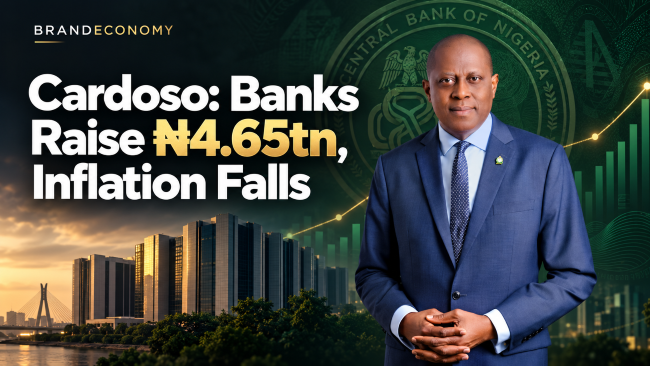 Nigeria’s banking industry has mobilised ₦4.65 trillion in fresh capital under the Central Bank of Nigeria’s recapitalisation programme, giving the financial system a larger buffer against shocks—and creating a much tougher test of what banks will do with their strengthened balance sheets.
CBN Governor Olayemi Cardoso disclosed the figure at a news briefing following Nigeria’s participation in the 2026 Annual Meetings of the International Monetary Fund and World Bank Group in Bangkok, Thailand.




Cardoso placed the capital raise within a broader picture of improving macroeconomic indicators. Headline inflation moderated to 14.63 per cent in September, external reserves climbed above $55 billion—their highest level in 18 years—and formally recorded remittance inflows moved closer to $1 billion a month.
More importantly, the governor said just over 70 per cent of the new banking capital came from domestic investors. That level of local participation represents more than compliance with a regulatory directive. It suggests that Nigerian investors remain willing to commit long-term capital to the country’s financial system despite years of inflation, currency depreciation and policy uncertainty.
The original account’s suggestion that only slightly more than 20 per cent came from domestic investors appears inconsistent with Cardoso’s reported statement. The verified figure is just over 70 per cent.
Capital Is a Beginning, Not a Victory Lap
The ₦4.65 trillion mobilisation marks a major milestone in the CBN’s effort to ensure that banks possess enough paid-up capital to support a larger economy, withstand financial stress and finance increasingly complex transactions.
But headline capital is not the same as productive economic impact.
The more important questions now concern the quality, concentration and deployment of that capital. Investors will want to know how much has been fully verified and recognised by the regulator, whether new issues have materially diluted existing shareholders, and whether banks can generate sufficient earnings to maintain attractive returns on their enlarged equity bases.
Higher capital can strengthen depositor confidence and improve a bank’s ability to absorb losses. It can also support bigger lending tickets for infrastructure, manufacturing, energy, telecommunications and trade. Yet it does not automatically guarantee that credit will reach businesses capable of creating jobs.
Banks may still prefer the comparatively predictable returns available from government securities, particularly when private-sector borrowers face high operating costs, weak consumer demand and elevated default risks.
That is the central development challenge: Nigeria has recapitalised its banks, but it must now ensure that the stronger banks help recapitalise the productive economy.
Inflation Is Slowing, but Prices Are Not Falling
The decline in headline inflation to 14.63 per cent from 15.39 per cent in August strengthens the case that monetary tightening, improved foreign-exchange conditions and greater supply stability are moderating the pace of price increases.
It should not, however, be confused with a return to affordable living.
Disinflation means that prices are increasing more slowly; it does not mean that the accumulated increases of recent years have been reversed. Food inflation remained close to 20 per cent in September, leaving household budgets under considerable pressure.
This distinction matters for banks and consumer-facing brands. A customer whose salary has not kept pace with food, transport, rent and energy costs may remain financially distressed even when the headline inflation rate is falling.
For lenders, that pressure affects consumer credit quality, savings mobilisation and transaction volumes. For manufacturers and retailers, it shapes demand. For policymakers, it means that improved macroeconomic statistics must eventually translate into higher real incomes and better purchasing power.
The CBN’s September decision to reduce the Monetary Policy Rate from 26.5 per cent to 23 per cent signals confidence in the disinflation process. Nevertheless, 23 per cent remains a highly restrictive policy rate. Commercial borrowing costs are therefore unlikely to become affordable immediately, particularly for small businesses and capital-intensive industries.
Reserves Strengthen Nigeria’s External Story
External reserves above $55 billion provide the CBN with a stronger buffer for managing foreign-exchange volatility, settling eligible obligations and reassuring portfolio investors concerned about convertibility and repatriation.
The increase is also significant for Nigerian banks with foreign-currency exposures, international trade-finance operations and regional subsidiaries.
Still, investors should distinguish gross reserves from net usable reserves. The credibility of the external position depends not only on the headline stock but also on the composition, liquidity and associated liabilities of those reserves.
Formal remittances approaching $1 billion monthly offer another potentially durable source of foreign exchange. The strategic opportunity for banks is to move beyond receiving remittance flows and build better savings, investment, insurance and diaspora-mortgage products around them.
The institutions that make remittances cheaper, faster and easier to convert into productive investment will gain both revenue and reputational advantage.
Fitch’s Signal Is Encouraging—but Nigeria Is Not Investment Grade
Cardoso also cited Fitch Ratings’ revision of Nigeria’s sovereign outlook from stable to positive as evidence that international confidence is improving.
The distinction is important. Fitch affirmed Nigeria’s sovereign rating at “B”; it did not upgrade the country to investment grade. A positive outlook indicates that an upgrade could follow if reform momentum, external buffers, disinflation and fiscal improvements are sustained.
Fitch subsequently revised the outlooks of nine Nigerian banks and two bank holding companies to positive while affirming their long-term issuer ratings at “B”. The action recognises improving macroeconomic conditions, but it also illustrates how closely Nigerian banks remain tied to the sovereign.
Banks hold substantial government securities and maintain large cash reserves with the CBN. Their credit profiles are therefore influenced not only by their own management and capital strength but also by the health of Nigeria’s public finances and operating environment.
Cardoso said Nigerian officials held discussions with S&P Global Ratings, Moody’s and Fitch on the pathway towards investment-grade status. Such engagement is useful, but ratings are not negotiated into existence. They are earned through policy consistency, stronger institutions, sustainable public finances and predictable foreign-exchange access.
What Investors Should Examine Next
The recapitalisation story will increasingly shift from how much banks raised to what the new capital produces.
Investors should watch loan growth, asset quality, non-performing-loan ratios, capital-adequacy buffers, cost-to-income ratios and return on equity. Dividend policies will also matter, especially where new shares have expanded the equity base.
A bank can become larger without becoming more efficient. If profits fail to grow in proportion to capital, return on equity may weaken. Conversely, aggressive attempts to restore returns through rapid lending could create future asset-quality problems.
The strongest institutions will be those that balance growth with disciplined underwriting, technology investment, cybersecurity, consumer protection and transparent capital allocation.
From Bangkok to Asia’s Financial Corridors
The Nigerian delegation also pursued closer financial links with Asia. Cardoso said officials engaged the Monetary Authority of Singapore, signed a memorandum of understanding with the Global Financial and Technology Network and convened a Nigeria–Asia Financial Connectivity Dialogue with JPMorgan, Nigerian Exchange Group and FMDQ Group.
Discussions with People’s Bank of China Governor Pan Gongsheng focused on cross-border payments, settlement systems, financial technology and trade finance. Nigeria plans to advance those conversations during a future visit to Beijing.
If converted into practical arrangements, these engagements could reduce payment friction between Nigerian and Asian businesses, improve trade-finance access and support investment flows.
Cardoso also argued that Africa must not remain a passive consumer of artificial intelligence. For Nigerian banks, the challenge is to deploy AI in fraud detection, risk assessment, customer service and compliance without weakening privacy, fairness or accountability.
Technology can deepen trust only when customers understand how decisions are made and have an effective channel for challenging errors.
Brand and Reputation Implications
Recapitalisation has effectively asked investors to renew their belief in Nigerian banking brands. The next stage requires those banks to justify that confidence.
Customers will judge institutions by reliability, dispute resolution, digital security, transparent charges and access to credit—not by capital figures alone. Investors will judge them by governance, earnings quality and capital discipline.
Banks that use their expanded capacity to finance credible businesses, strengthen customer protection and support cross-border commerce can convert regulatory compliance into brand equity. Those that merely enlarge their holdings of government paper risk being seen as well-capitalised institutions disconnected from the real economy.
BRANDECONOMY Insight
Nigeria’s ₦4.65 trillion banking recapitalisation is an important vote of confidence, particularly because more than 70 per cent reportedly came from domestic investors. But the real success metric is not the amount raised. It is whether stronger banks can deliver affordable, intelligently priced and responsibly managed credit to the sectors that create employment, exports and household income.
Falling inflation, stronger reserves and improved ratings outlooks provide a better operating platform. They do not constitute shared prosperity.
The next phase must therefore be measured through productive-sector lending, lower payment friction, improved consumer trust and sustainable shareholder returns. Nigeria does not simply need bigger banks. It needs banks capable of turning financial strength into economic capacity.
The capital has been raised. The development dividend must now be earned.