
SEC Sounds Alarm as Social Media Ponzi Schemes Target Nigerian Investors

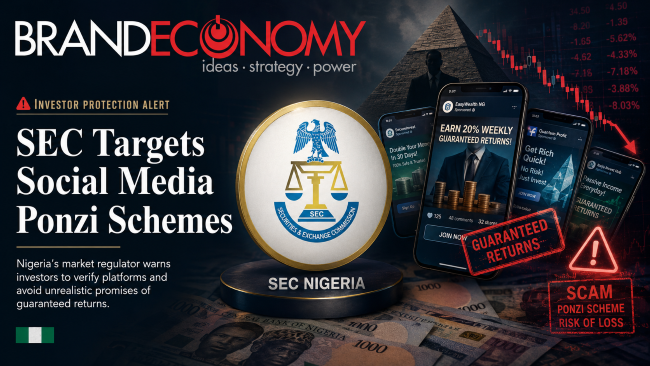 Nigeria’s Securities and Exchange Commission (SEC) has issued a fresh warning against the growing wave of unregistered online investment schemes spreading through WhatsApp, Instagram, Telegram, Facebook, TikTok and other digital platforms, cautioning that many of them bear the familiar fingerprints of Ponzi-style operations and illegal investment solicitation.
The regulator’s latest warning is not merely about fraudulent platforms. It is about an economy in which financial desperation, digital influence and weak investor verification are creating a fertile market for organised deception.
The notice, published by the Commission in May 2026, is both timely and revealing. It comes at a moment when the social-media economy has become one of the fastest channels for financial persuasion in Nigeria — a borderless marketplace where dubious “wealth-building” offers are packaged with glossy testimonials, screenshots of supposed returns, influencer-style endorsements and promises of near-riskless profit.



The SEC’s central message is simple but urgent: any platform offering investment opportunities to Nigerians must be registered and authorised; any promise of unrealistic, guaranteed or unusually rapid returns should trigger suspicion, not excitement.
Yet beneath that regulatory warning lies a much larger economic story.
The New Face of an Old Fraud
Ponzi schemes are not new to Nigeria. What is changing is their distribution model.
In earlier years, fraudulent investment networks leaned heavily on physical seminars, word-of-mouth recruitment, religious circles, workplace clusters and community networks. Today, the fraud architecture has gone fully digital. Social media groups, direct messages, short-form videos, private channels and peer referrals now allow illegal operators to reach thousands of prospective victims at near-zero cost.
The SEC says its attention has been drawn to the “increasing promotion” of these unregistered schemes across major social platforms and websites, with some operators not only soliciting funds illegally but also giving investment advice without regulatory approval.
That distinction matters. The regulator is not warning only against fake “investment companies”; it is also warning against the informal financial advice ecosystem that has grown online — unlicensed individuals presenting themselves as investment mentors, crypto prophets, wealth coaches or portfolio experts without oversight, accountability or qualification.
In a country where millions of citizens are eager to escape inflation, stagnant wages and eroding purchasing power, such narratives can be dangerously seductive.
Economic Anxiety Is Feeding Financial Recklessness
Ponzi schemes thrive not merely because people are careless, but because economic pressure makes extraordinary promises easier to believe.
When household budgets are stretched, legitimate returns on savings appear insufficient and the future feels uncertain, the lure of “double your money,” “daily return,” “fixed profit” or “guaranteed passive income” becomes harder for some people to resist. Fraudsters understand this behavioural vulnerability. They sell urgency as strategy and greed as opportunity.
Nigeria has seen this cycle before. The collapse of several digital investment schemes in recent years, most notably CBEX in 2025, renewed public concern about the scale of household losses tied to platforms that initially appeared credible before withdrawals stalled. The episode became a national reference point for the dangers of unregulated digital investing and accelerated pressure for stronger enforcement.
BusinessDay has also previously reported that Nigerians have lost enormous sums to Ponzi and related fraudulent schemes over the years, citing historical estimates from regulators and deposit insurance authorities. The precise totals vary depending on the category and period measured, but the broad lesson is settled: fraudulent investment schemes are no longer peripheral scams; they are a recurring drain on household wealth and public trust in financial markets.
ISA 2025: The Law Has Become Tougher
The SEC’s latest intervention is backed by a sharper legal framework.
Under the Investments and Securities Act, 2025, only entities registered by the SEC are authorised to promote investment services, provide investment advisory services or solicit funds from the public in Nigeria’s capital market.
The law was designed, in part, to close longstanding gaps exploited by illegal operators. It strengthens the regulator’s hand against prohibited schemes, including Ponzi and pyramid-style structures, and has been publicly described by the SEC as imposing serious consequences on operators of illegal investment ventures. Earlier enforcement commentary from the Commission indicated that promoters of such schemes can face substantial fines and prison terms under the new legal regime.
The message is unmistakable: Nigeria is moving from repeated warnings to a more formal criminal and regulatory crackdown.
But law alone will not solve the problem. Fraud evolves faster than enforcement unless investor education, platform accountability and digital verification systems improve in parallel.
The Social Media Problem: Influence Without Responsibility
One of the most striking features of the SEC’s warning is its focus on social media as the marketplace of deception.
The regulator had earlier cautioned influencers, bloggers and digital promoters against endorsing unregistered schemes, warning that the new securities law exposes promoters of fraudulent investment platforms to legal consequences.
This is significant. The rise of financial content creators has blurred the line between education, persuasion and paid promotion. A polished video, a confident voiceover or a stream of “proof of payment” screenshots can create a false sense of legitimacy. For many unsuspecting retail investors, especially first-time market participants, visibility is mistaken for credibility.
The SEC’s position effectively challenges that assumption. Online popularity is not regulation. Virality is not due diligence. Testimonials are not proof of solvency.
An investment opportunity does not become legitimate because it is trending.
What SEC Is Asking Nigerians to Do
The Commission is urging prospective investors to verify the registration status of any company, platform or individual offering investment opportunities before parting with money. It specifically directs the public to consult the SEC’s authorised operator databases, including its fintech and capital market operator portals, before making financial commitments.
That advice may sound basic, but it addresses one of the biggest weaknesses in Nigeria’s retail investment culture: too many people verify testimonials before verifying licences.
A responsible investor should not ask only, “Who else has been paid?” The more important question is, “Who regulates this platform, and can it legally solicit public funds?”
The SEC is also warning Nigerians not to rely on investment advisories circulated online by persons or entities that are not registered with the Commission. The consequences, it says, may include significant financial losses and exposure to fraud.
Why This Matters for Nigeria’s Capital Market
At first glance, Ponzi schemes may seem separate from the formal capital market. In reality, they are deeply connected to it.
SEC warns taht every time an illegal scheme collapses, public trust in investing is damaged. Potential first-time investors who lose money to scams may become permanently suspicious of legitimate equities, mutual funds, fixed income products, crowdfunding frameworks and regulated digital investment options. The result is a broader mistrust of financial intermediation.
For Nigeria, that is a strategic concern. A country seeking deeper domestic savings mobilisation, stronger pension participation, a broader retail investing culture and more productive capital formation cannot afford a digital environment in which fraudsters routinely masquerade as wealth creators.
Ponzi schemes do not merely steal money. They poison confidence.
The Deeper Problem: Financial Literacy Has Not Kept Pace with Digital Finance
Nigeria’s investment culture is changing rapidly. The smartphone has turned millions of citizens into potential participants in financial markets, whether through stocks, fixed-income products, digital assets, fintech savings tools or peer-to-peer financial networks. But access has expanded faster than literacy.
Many young and middle-income Nigerians now encounter financial content daily, but not always from credible sources. The result is a dangerous asymmetry: financial aspiration is high, but investment verification habits remain weak.
That gap is exactly where Ponzi operators thrive.
The SEC’s warning should therefore be read not only as a prohibition notice but as a call for national investor education reform. Regulators, schools, banks, stockbrokers, fintech platforms, the media and professional bodies all have roles to play in teaching Nigerians how to identify basic red flags:
- Guaranteed or unusually high returns
- Pressure to invest immediately
- Referral-driven reward systems
- Lack of transparent registration
- Unclear business model
- Restricted withdrawals or evasive explanations
- Investment advice from unlicensed online personalities
The more sophisticated fraud becomes, the more disciplined the investing public must become.
BRANDECONOMY Insight
Nigeria’s Ponzi Problem Is Becoming a Digital Consumer-Protection Crisis
The SEC’s latest warning is important because it acknowledges a change in the geography of fraud. The old Ponzi scheme gathered people in hotel halls. The new one lives in the pocket — inside private group chats, disappearing stories, sponsored posts and algorithm-amplified videos.
That makes the threat broader, faster and harder to contain.
Nigeria’s regulators now face a dual challenge. They must punish illegal operators decisively, but they must also ensure that ordinary Nigerians can quickly distinguish between a regulated investment channel and a polished digital trap. The passage of the Investments and Securities Act, 2025 has strengthened the legal hand of the SEC. The next step is to turn that legal strength into visible deterrence, faster enforcement and relentless public education.
For investors, the lesson is equally stark: in a difficult economy, the desire for higher returns is understandable; surrendering judgment to anyone promising effortless wealth is not.
The Nigerian capital market needs more retail participation. But that participation must be built on trust, legitimacy and informed risk-taking — not on viral deception disguised as opportunity.