

Six Weeks In, Nigeria’s National Single Window Fighting for Credibility amid Mounting Cargo Delays, Demurrage
Will The NSW Pass The Test?

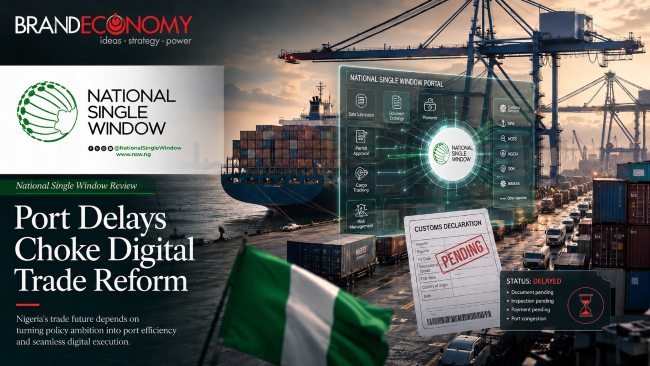 Six weeks after Nigeria’s long-awaited National Single Window went live on March 27, 2026, the reform that was meant to become the country’s new digital gateway for faster, cleaner and cheaper trade is facing its first serious credibility test.
What began as a landmark promise to modernise import and export documentation, reduce bureaucratic friction and accelerate cargo clearance is now being challenged by reports of trapped containers, disrupted port workflows, rising demurrage, stalled regulatory approvals and mounting frustration among importers, customs agents and manufacturers. BusinessDay, in a report published on May 14, 2026, captures the mood across the maritime ecosystem: operators say the platform has, at least in its early weeks, lengthened clearance timelines rather than compressed them.




The larger question is not whether Nigeria needs a National Single Window. It does. The deeper question is whether a reform of this scale was launched with the technical stability, inter-agency alignment and transition architecture required to prevent trade facilitation from becoming trade disruption.
A Reform Nigeria Cannot Afford to Fail
The National Single Window is not merely a “shipping portal,” as it is sometimes casually described. It is a national trade infrastructure platform intended to centralise the submission, processing and exchange of trade-related documentation across Customs, regulatory agencies, shipping interests and other actors in the import-export chain. The Federal Government promoted it as a transformational reform to improve efficiency, transparency and Nigeria’s competitiveness in global trade.
The ambition is compelling. Nigeria’s port system has for years been burdened by multiple submission points, duplicative paperwork, opaque processes and agency silos that inflate transaction costs for businesses. Prior to the launch, public messaging around the Single Window suggested it would help cut clearance delays, reduce regulatory fragmentation and move Nigeria closer to global best practice in trade administration.
Indeed, official communications from the National Single Window Secretariat described the March rollout as Phase 1, focused on statutory permits and cargo manifests, with the stated objective of stabilising the system and building stakeholder confidence before broader expansion.
Yet the immediate post-launch reality appears more complicated.
From Digital Gateway to Operational Bottleneck?
BusinessDay reports that port users are complaining of serious integration glitches, including failed submissions, documentation bottlenecks, inability to process declarations smoothly and difficulties linking several regulatory requirements to the new platform. These disruptions, according to industry operators cited in the report, have left significant volumes of cargo stranded at the ports and pushed importers into escalating demurrage and storage charges.
The complaints are not isolated. By mid-April, the Nigerian Shippers’ Council and the Nigeria Revenue Service had already urged shipping companies and terminal operators to consider waivers for charges linked to National Single Window-induced cargo delays, suggesting that the disruptions had become sufficiently serious to require regulatory intervention.
BusinessDay further reports that demurrage charges in the affected period ranged between $75 and $300 per container per day, with one importer cited as having incurred ₦12.4 million in additional costs within a month due to platform-linked delays. These are not marginal inconveniences. They are the kinds of charges that can erase margins, distort pricing decisions and punish businesses already navigating elevated logistics, financing and foreign exchange costs.
The reform was designed to reduce the cost of trade. In its troubled take-off, operators fear it may be temporarily multiplying it.
Why the Transition Became Painful
Several issues appear to be converging.
1. A Platform Is Only as Strong as the Agencies It Integrates
A National Single Window is not magic software. It is a coordination discipline. It works only when participating agencies have aligned data standards, clean process maps, dependable internal systems and clarity about who does what, when and through which digital path.
The current friction appears partly rooted in the difficulty of synchronising agencies and processes that historically operated in separate institutional lanes. BusinessDay reports continuing challenges with documentation linked to key regulatory bodies, including difficulties around import certifications, product documentation and approval flows.
The Standards Organisation of Nigeria had, effective March 27, 2026, migrated important SONCAP and import permit processes to the National Single Window platform, including the activation of certificates required for Form M, PAAR and cargo clearance. This means the NSW was immediately connected to sensitive clearance-critical processes, raising the cost of any technical instability.
NAFDAC guidance issued around the same go-live date also directed permit applicants to use the National Single Window portal for relevant import authorisations. This reinforces the point: the platform was not a peripheral test environment. It quickly became part of the daily operating backbone for regulated trade documentation.
2. The Gap Between “Phased Rollout” and Market Experience
Official messaging stressed a phased approach. Reuters, citing the Trade Minister before launch, reported that the initial phase would begin with one shipping line and one port, while the National Single Window Secretariat separately described the opening phase as focused on permits and cargo manifests.
Yet the experience described by freight forwarders and clearing agents suggests that the operational consequences extended well beyond a narrow sandbox. Whether because of regulatory dependencies, process migration across agencies or poor transition planning, the perception among users is that the rollout has affected the broader clearance ecosystem more sharply than expected. BusinessDay and other contemporary reporting point to congestion, trapped cargoes and rising cost burdens across the ports.
That disconnect matters. Reforms lose trust when official language suggests controlled experimentation, but frontline operators encounter economy-wide pain.
3. Stakeholder Engagement May Not Have Been Deep Enough
Several practitioners cited in the BusinessDay report argue that the platform’s operational community — customs agents, freight forwarders, terminal operators, importers and manufacturers — was not sufficiently prepared for the practical realities of the transition. Their concern is not that the Single Window concept is wrong, but that the change-management architecture may have been weaker than the technology ambition.
This is a recurring problem in public-sector digitalisation: systems are launched as institutional trophies before they have passed the less glamorous tests of user onboarding, exception handling, data-error resolution, contingency workflows and service desk responsiveness.
A portal can be built centrally. A trade ecosystem must be migrated carefully.
The Stakeholders’ Case: Pause, Stabilise, Then Scale
The most forceful voices in the sector are not necessarily calling for the death of the National Single Window. Rather, many are calling for a temporary operational rethink.
Dr. Segun Musa, Chairman and Chief Executive Officer of Widescope Group and a senior figure within NAGAFF, warned that premature implementation could frustrate importers and manufacturers out of business if institutional capacity, infrastructure and ethical standards remain weak. BusinessDay quotes him as questioning the haste of rolling out a unified platform when several individual agencies are still struggling with basic operational efficiency.
Eugene Nweke of the Sea Empowerment and Research Center similarly argued, in a policy advisory referenced by BusinessDay, that the crisis is not proof that the Single Window is inherently flawed, but rather that it may have been rolled out too broadly, too quickly and without sufficient incremental validation. He reportedly proposed a hybrid operating model that would temporarily allow legacy systems to run alongside the new platform, combined with waivers for charges linked to system delays, a multi-agency crisis response centre and pilot testing at lower-volume ports before scaling further.
This is a crucial distinction. Suspending dysfunction is not the same as abandoning reform. A platform of this importance should not be politically defended into failure.
The Waiver Debate: Who Pays for a Government Transition Error?
One of the most commercially sensitive consequences of the disruption is the question of demurrage and storage charges. Importers, through their agents, argue that they should not be punished financially for delays caused by a public digital transition they did not control. The Shippers’ Council and the Revenue Service have pressed for relief, but BusinessDay reports that operators say actual waiver implementation has not kept pace with the burden on affected cargoes.
The matter is not straightforward. Shipping lines and terminal operators are commercial entities with their own cost structures, concession obligations and operating liabilities. It is therefore unrealistic to expect them to absorb all consequences of system failure indefinitely. Yet it is equally untenable for importers to carry the entire financial punishment for delayed digital integration.
This is where government must act with precision. A credible resolution would require:
- A verified list of cargoes demonstrably delayed by NSW-related glitches
- A transparent, time-bound waiver framework
- Clear apportionment of responsibility among agencies, operators and affected users
- A dispute-resolution mechanism that moves faster than the accumulation of charges
Without such safeguards, the NSW’s first public memory may be not one of modernisation, but of invoices.
The Bigger Economic Risk: Port Friction Becomes Market Inflation
Nigeria’s ports are not an isolated maritime concern. They are the country’s commercial bloodstream. When cargoes are delayed, the effect travels quickly through the economy — from factory inputs to retail pricing, from inventory cycles to working capital costs.
BusinessDay warns that the present disruptions are beginning to ripple through supply chains, raising concerns that clearance delays could feed into higher landed costs and eventual price increases for goods in the domestic market.
This is particularly delicate for Nigeria in 2026. Import-dependent manufacturers are already navigating costly logistics, elevated production expenses and pressure on margins. A poorly managed trade-tech transition can therefore become more than an administrative inconvenience; it can translate into cash-flow stress, slower inventory turnover and higher consumer prices.
A Single Window that slows cargo today risks imposing hidden inflation tomorrow.
What Government Should Do Now
The Federal Government still has an opportunity to rescue the credibility of the National Single Window. But it must move from ceremonial defence to operational honesty.
First, acknowledge the problem fully.
Reforms gain trust when leaders admit friction early and demonstrate command of the solution. Downplaying disruptions while operators are paying demurrage damages confidence.
Second, stabilise the existing rollout before adding complexity.
The temptation to keep expanding in order to preserve the momentum of launch should be resisted. The platform should not scale faster than its weakest integration point.
Third, introduce a formal hybrid contingency mechanism.
Where critical documents cannot move through the NSW because of verifiable system defects, time-bound alternative processing channels should activate automatically, with strong audit trails to prevent abuse.
Fourth, publish performance metrics.
Nigeria needs weekly reporting on platform uptime, transaction completion rates, average processing delays, backlog reduction and unresolved agency-specific issues. Reform cannot be managed by anecdotes alone.
Fifth, establish a trade crisis room.
A dedicated, multi-agency operational command centre — involving NSW, Customs, SON, NAFDAC, NPA, Shippers’ Council, terminal operators and licensed agents — should monitor bottlenecks in real time and resolve systemic faults quickly.
Sixth, protect affected businesses through targeted relief.
Where delays are directly tied to platform failure, a documented waiver or compensation framework should be implemented, not merely discussed.
These steps are not anti-reform. They are what serious reform looks like.
BRANDECONOMY Insight
Nigeria’s Single Window Must Not Become a Single Point of Failure
The National Single Window is one of the most important trade modernisation projects Nigeria has attempted in recent years. Its logic is sound. Its promise is real. If made to work, it can reduce discretion, eliminate repetitive documentation, strengthen revenue assurance, improve port transparency and help Nigeria move closer to the trade facilitation standards demanded by continental and global commerce.
But the first six weeks have exposed a hard truth: digital reform does not automatically create efficiency; it magnifies the quality of the system it connects. If the underlying agencies, processes and data rules are misaligned, digitalisation can accelerate confusion just as easily as it accelerates clearance.
Nigeria’s challenge, therefore, is not whether to keep the Single Window. It is whether the government has the discipline to pause where necessary, fix what is broken, shield businesses from avoidable losses and scale only when the platform is demonstrably stable.
The country cannot return to fragmented paperwork and procedural opacity. But neither should it romanticise a reform that port users currently experience as costly disruption. The National Single Window must become a trade accelerator, not a congestion multiplier.
The next six weeks may matter more than the first six. They will show whether the project is evolving into a resilient national trade infrastructure — or hardening into another well-intended reform injured by premature triumphalism.