

The Refining Paradox: Why Petrol Imports Jumped 207% While Dangote Operated Above Rated Capacity

 Nigeria’s largest refinery was running beyond its original nameplate threshold, yet imported petrol returned in force. The numbers reveal not an industrial failure, but a still-fragile fuel market where production, domestic allocation, exports, inventories, pricing and logistics do not always move together.
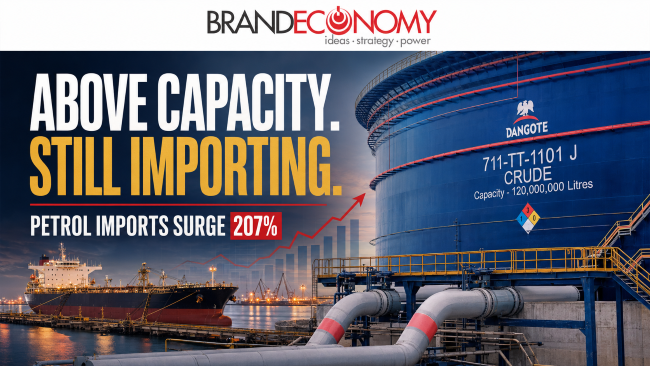 Nigeria’s largest refinery was running beyond its original nameplate threshold, yet imported petrol returned in force. The numbers reveal not an industrial failure, but a still-fragile fuel market where production, domestic allocation, exports, inventories,
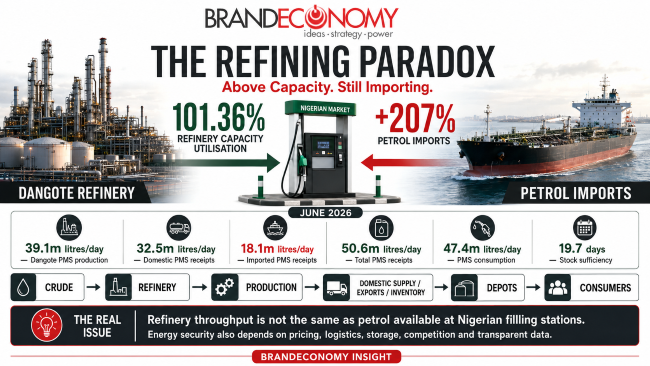
 On one side of Nigeria’s new petroleum economy stood the Dangote Petroleum Refinery—processing crude at a reported 101.36 per cent of its rated capacity and producing an average of 39.1 million litres of petrol daily in June 2026.
On the other stood an expanding line of imported petrol cargoes.




Nigeria’s average daily petrol imports rose from 5.9 million litres in May to 18.1 million litres in June—an extraordinary month-on-month increase of almost 207 per cent. At the same time, domestic petrol receipts dropped from 41.5 million litres to 32.5 million litres daily.
 At first glance, the figures appear irreconcilable. How could a country import three times more petrol while its largest refinery was operating above nameplate capacity?
The short answer is that refinery utilisation, petrol production and supply to Nigerian consumers are not the same measurement.
The deeper answer is far more consequential: Nigeria has built a world-scale refinery, but it has not yet built a sufficiently transparent, diversified and efficiently connected domestic fuel-supply system around it.
That is the real refining paradox.
The June Numbers at a Glance
| Market indicator | May 2026 | June 2026 | Change |
| Domestic PMS receipts | 41.5m litres/day | 32.5m litres/day | –21.7% |
| Imported PMS receipts | 5.9m litres/day | 18.1m litres/day | +206.8% |
| Total PMS receipts | 47.4m litres/day | 50.6m litres/day | +6.8% |
| PMS consumption | 46.3m litres/day | 47.4m litres/day | +2.4% |
| PMS stock sufficiency | 16.2 days | 19.7 days | +21.6% |
| Dangote PMS production | 44.7m litres/day | 39.1m litres/day | –12.5% |
| Crude receipts by domestic refineries | 578,000 bpd | 632,000 bpd | +9.3% |
| Dangote capacity utilisation | 101.25% | 101.36% | Marginal increase |
The first important correction is that petrol production did not fall by 22 per cent. Dangote’s reported PMS output fell by approximately 12.5 per cent—from 44.7 million litres daily in May to 39.1 million litres in June.
It was the volume released into the domestic market that fell by almost 22 per cent.
That distinction opens the door to the real investigation.
Above Capacity Does Not Mean All-Petrol Production
A refinery’s capacity-utilisation rate measures how intensively its crude-processing facilities are being operated relative to nameplate capacity. It does not measure the percentage of Nigeria’s petrol demand being satisfied.
A barrel of crude does not emerge from a refinery as a barrel of petrol. It is transformed into a basket of products—including petrol, diesel, aviation fuel, liquefied petroleum gas, naphtha, fuel oil, petrochemical feedstocks and other components.
Management adjusts that product mix according to crude quality, plant configuration, technical conditions, customer commitments and the relative profitability of different fuels.
Consequently, a refinery can process crude above its original rated capacity while producing less petrol than it did in the preceding month. It may be producing more of another product, drawing down or building intermediate stocks, adjusting operating units or responding to stronger export margins elsewhere in its product slate.
The 101.36 per cent figure is therefore evidence of impressive plant throughput—not proof that every litre required by Nigerian motorists was produced, released and distributed locally.
Indeed, Dangote demonstrated during a June performance test that the complex could process more than 700,000 barrels daily, exceeding its original 650,000-barrel nameplate capacity. That is an important industrial achievement. But processing strength must still be translated into the right products, at the right prices, in the right locations and at the right time.
Refining capacity is only the beginning of fuel security.
Production Is Not the Same as Domestic Supply
The second explanation lies between the refinery gate and the Nigerian marketplace.
Dangote reportedly produced 39.1 million litres of petrol daily in June but released 32.5 million litres daily into the domestic market. It exported approximately 3.3 million litres per day.
That leaves a further difference between reported production and the combined domestic and export figures. It may reflect inventory movements, operational requirements, measurement timing or other refinery balances. The publicly reported summaries do not provide enough detail to conclusively allocate that difference.
This is precisely why the regulator must publish fully reconcilable flow data.
The distinction between production and domestic receipts is particularly important. Fuel may have been manufactured without being immediately evacuated. It may remain in refinery storage, await commercial nomination, be committed to an export cargo or encounter delays in transportation and depot reception.
Domestic receipts, according to the regulator, cover supplies received through the Dangote refinery gantry and coastal evacuation into Nigerian depots. Consumption, by contrast, is measured through volumes trucked out of facilities into the domestic market.
These are different stages of the supply chain.
A litre can be produced in June, received at a depot later and consumed later still. Conversely, petrol imported under a contract agreed weeks earlier can arrive during a month in which domestic refinery performance is already improving.
Monthly statistics are therefore a snapshot of overlapping commercial and logistical cycles—not a single, perfectly synchronised transaction.
Imports Were Also Rebuilding Nigeria’s Safety Cushion
The 207 per cent increase is dramatic, but percentages can obscure the underlying volume.
Imports increased by 12.2 million litres per day, from 5.9 million litres to 18.1 million litres. Domestic receipts declined by nine million litres daily. Imported supply therefore replaced the domestic decline and added a further buffer.
This raised total petrol receipts by 3.2 million litres per day, from 47.4 million litres in May to 50.6 million litres in June.
Consumption, meanwhile, rose much more modestly—from 46.3 million litres to 47.4 million litres per day.
The consequence was an improvement in stock sufficiency from 16.2 days to 19.7 days.
In other words, some of the import surge appears to have supported inventory rebuilding rather than an equivalent surge in immediate consumption. Nigeria entered July with a stronger supply cushion than it had at the end of May.
That matters enormously in a market with painful memories of scarcity, panic buying, queues and sudden price movements.
Imports are not inherently evidence of policy failure. Strategic imports can serve as insurance against refinery outages, shipping delays, road disruptions, unplanned maintenance and demand spikes.
The policy failure arises when imports become opaque, structurally permanent or economically unjustifiable despite adequate and competitively priced domestic supply.
The Commercial Logic Behind Imports
Nigeria’s downstream petroleum market is now substantially deregulated. Marketers must compare the cost and commercial terms of domestic petrol with the landed cost of imported alternatives.
Their decisions can be influenced by:
- The refinery’s ex-gantry or coastal price.
- International petrol prices and refining margins.
- The naira-dollar exchange rate.
- Freight, insurance and financing costs.
- Payment terms and access to credit.
- Depot location and existing storage arrangements.
- Product availability and delivery certainty.
- Previously contracted cargoes arriving during the reporting month.
- The cost of moving petrol from Lekki to distant Nigerian markets.
When imported petrol is cheaper, more accessible or supported by better credit terms, marketers may retain an incentive to buy it. When international disruption makes imported fuel more expensive or unreliable, a nearby domestic refinery gains a strong geographical advantage.
This is why import volumes can reverse rapidly.
It is also why NMDPRA data should distinguish between import licences granted, cargoes nominated, cargoes arriving, products discharged and products eventually evacuated from depots. A June arrival may have originated from a decision made in April or May.
Without that timeline, the public can see the outcome but not the commercial reasoning behind it.
Logistics: The Unfinished Half of the Refining Revolution
Nigeria has concentrated an extraordinary amount of refining capability at one coastal location in Lekki. The achievement is immense, but concentration creates its own vulnerabilities.
Fuel must still move from the refinery into regional depots, retail networks and industrial centres across a vast country. It can leave through loading gantries, road tankers or coastal vessels supplying depots in other parts of Nigeria.
Each route has different economics.
Dangote has argued that direct gantry loading is cheaper because coastal movements introduce vessel charges, port fees, maritime levies, storage costs and additional handling. Marketers, however, may prefer coastal delivery when it fits their depot infrastructure or reduces the complications of moving thousands of trucks through already strained roads.
This tension exposes a deeper national problem.
Nigeria has invested in refining hardware without adequately modernising the pipelines, coastal terminals, storage systems, roads, rail links and transparent capacity-access arrangements required to distribute products efficiently.
The old import system delivered fuel into established coastal depots. A domestic refinery in Lekki does not automatically erase that infrastructure geography.
Until the logistics system is reconfigured, Nigeria may continue to import fuel into one port or depot while domestically refined petrol struggles to reach the same market competitively.
A refinery can solve the production deficit. It cannot single-handedly repair the country’s entire distribution architecture.
The Silent Failure of Nigeria’s State Refineries
The paradox would be far less severe if Nigeria had several functioning refineries.
In June, the Port Harcourt, Warri and Kaduna refineries reportedly remained shut down and contributed no petrol to domestic supply. This left Dangote as the country’s overwhelmingly dominant operating source of locally refined PMS.
That concentration makes the market vulnerable to even minor changes in one company’s operations, product allocation or commercial strategy.
Nigeria’s energy-security objective should therefore not be reduced to making one refinery larger. Dangote is already planning a major expansion towards 1.4 million barrels per day, a development that could transform Africa’s petroleum trade. Yet genuine resilience requires multiple supply points.
Modular refineries should be supported where economically viable. Existing plants should be rehabilitated only under credible commercial and governance structures. Storage infrastructure should be decentralised. Pipelines should be restored or concessioned transparently. Import capacity should remain available as a contingency rather than the default operating model.
The country needs Dangote to succeed—but it also needs a market capable of functioning without being entirely dependent on Dangote.
“Locally Refined” Does Not Mean Economically Isolated
There is another layer to the paradox.
NMDPRA data indicated that Dangote imported approximately 1.46 billion litres of gasoline blendstocks between January and May 2026. These are intermediate components—not necessarily finished petrol—which can be combined with refinery streams to improve octane, meet specifications and increase finished-product yield.
The refinery has also sourced part of its crude internationally when domestic crude was unavailable, unsuitable or commercially less attractive.
This does not invalidate the refinery’s industrial contribution. Modern refineries routinely optimise across different crudes and blending components. What matters is how much value is created domestically, how much foreign exchange is saved or earned, and whether the refinery strengthens Nigeria’s net trade position.
Nigeria must therefore abandon an excessively simplistic definition of energy independence.
True independence does not mean banning every imported petroleum input. It means possessing the productive capacity, infrastructure, reserves, skills and commercial flexibility to prevent external suppliers from holding the economy hostage.
A refinery that imports some feedstock, adds substantial value in Nigeria and exports higher-value products can still be a net positive for industrialisation.
The relevant measure is not gross imports alone. It is net value retained.
The Dangerous Choice Between Monopoly and Permanent Importation
Nigeria’s policymakers face two competing risks.
The first is allowing excessive imports to undercut local refiners, weaken domestic investment and recreate the very import dependence the country spent billions of dollars trying to escape.
The second is closing the market too aggressively and leaving consumers dependent on one dominant producer without a strong competitive benchmark.
Neither extreme is desirable.
An automatic import ban could reduce competitive pressure, increase the consequences of an outage and expose consumers to pricing power. Unrestrained importation, on the other hand, could discourage refinery investment, export Nigerian jobs and keep the naira vulnerable to avoidable product-import bills.
The intelligent position is conditional openness.
Imports should be permitted when independently verified domestic supply is inadequate, when emergency inventories require replenishment or when local pricing is demonstrably uncompetitive after fair comparison of quality and logistics.
But the regulator must publish the basis for those decisions.
Protection without performance breeds complacency. Competition without industrial strategy destroys productive capacity. Nigeria requires disciplined competition—strong enough to protect consumers and intelligent enough to preserve investment.
Consumer Implications
For Nigerian consumers, the most reassuring June figure was not the import increase. It was the rise in total receipts and stock sufficiency.
More available fuel and nearly 20 days of supply cover reduce the immediate risk of queues and physical shortages.
But availability does not guarantee affordability.
The pump price still reflects crude costs, refinery margins, exchange rates, financing, transportation, depot charges, taxes and retail margins. Whether petrol was refined in Lekki or imported from Europe, its opportunity cost remains influenced by the international market.
Domestic refining can remove long shipping routes, reduce some port-related costs, shorten delivery times and retain more value within Nigeria. It cannot make crude oil cease to be a globally priced commodity.
The strongest consumer benefit will emerge only when local refining is combined with competitive pricing, reliable distribution, stable regulation and lower avoidable logistics costs.
Market and Industrial-Policy Implications
The return of imports is not proof that the refining project has failed. Dangote has already altered the structure of West African fuel trade, reduced Nigeria’s dependence on finished-product imports and emerged as a supplier to African and international markets.
The June figures instead show that the transformation remains incomplete.
For manufacturers and transport operators, diversified supply can reduce the risk of scarcity but creates continued exposure to exchange-rate movements. For marketers, the new market offers greater sourcing choice but also demands stronger working-capital management and price-risk analysis.
For banks and insurers, opportunities are expanding across inventory finance, trade credit, cargo insurance, storage, fleet management and supply-chain technology.
For government, the data reinforce the urgency of moving beyond refinery commissioning ceremonies towards the less glamorous work of building pipelines, depots, price-reporting systems, product standards, strategic reserves and competitive logistics.
Nigeria has achieved refining scale. It must now build refining depth.
Brand Implications
Dangote Refinery is more than an industrial facility. It has become a symbol of African productive ambition.
That symbolic power produces both opportunity and reputational risk.
When the public hears that the refinery is operating above capacity, it reasonably expects petrol imports to disappear and domestic prices to fall. When the opposite occurs, suspicion can quickly replace confidence—even where the apparent contradiction has a legitimate technical or commercial explanation.
The company must therefore communicate beyond headline capacity figures. Nigerians need to understand product yields, domestic allocations, export commitments, stock movements, distribution constraints and the relationship between crude prices and pump prices.
NMDPRA faces an even greater trust obligation. Its data must allow the public to reconcile production, receipts, imports, exports, inventories and consumption.
In a market shaped by years of subsidy opacity and disputed consumption figures, transparency is not a public-relations accessory. It is critical economic infrastructure.
Investor Relevance
For investors, 101.36 percent refining capacity utilisation is encouraging—but it is not sufficient for judging long-term performance.
Serious investors will examine:
- Sustained crude throughput rather than one-month or performance-test peaks.
- Product yields and the relative profitability of petrol, diesel, jet fuel and petrochemicals.
- Domestic-versus-export sales mix.
- Crude and blendstock procurement costs.
- Refining margins and exposure to global price cycles.
- Working-capital and inventory requirements.
- Logistics costs and distribution control.
- Regulatory and import-policy risks.
- Planned maintenance and operational reliability.
- Foreign-exchange exposure and access to local-currency crude.
These questions have become more important following the refinery’s reported $2.5 billion private capital raise and its ambitious plan to double capacity.
A refinery of this scale cannot be assessed merely as a Nigerian fuel supplier. It is becoming a regional trading platform, foreign-exchange earner, petrochemical hub and strategically important African infrastructure asset.
Its success will depend on balancing domestic legitimacy with international profitability.
What NMDPRA Should Publish Every Month
To end recurring disputes, Nigeria needs a public downstream dashboard showing:
- Refinery crude receipts, throughput and capacity utilisation.
- Production by individual petroleum product.
- Domestic refinery releases through gantry and coastal channels.
- Export volumes by product and destination.
- Refinery, depot and offshore inventory changes.
- Import permits, cargo arrivals, origins and volumes.
- Imported-product landed costs and domestic ex-depot benchmarks.
- National consumption based on independently verified truck-out data.
- Regional distribution and stock sufficiency.
- A clear reconciliation of beginning stock, production, imports, exports, consumption and closing stock.
That single reform would dramatically improve market confidence, policy quality and investor visibility.
BRANDECONOMY Insight
Nigeria’s June refining paradox is not that imports rose while Dangote operated above capacity. It is that the country continues to treat refinery capacity as though it were synonymous with energy security.
It is not.
Energy security is a chain: crude supply, refinery reliability, the correct product mix, competitive pricing, storage, transportation, market access, strategic reserves, credible regulation and transparent data.
Dangote has supplied the most difficult and capital-intensive component of that chain—a world-scale refinery. Nigeria must now build the market architecture that allows its output to move efficiently, competitively and predictably to consumers.
Imports may remain useful as a strategic pressure valve. Exports are not an act of economic betrayal; they are part of the commercial logic of a regional refinery. High capacity utilisation is an industrial victory, but it cannot by itself guarantee local availability or affordability.
The policy objective should therefore not be the theatrical elimination of every imported litre.
It should be a competitive, transparent and resilient domestic market in which imports are the backup, local refining is the foundation, exports generate value and Nigerian consumers are never held hostage by either scarcity or monopoly.
The refinery is working.
The bigger question is whether the market around it is.