

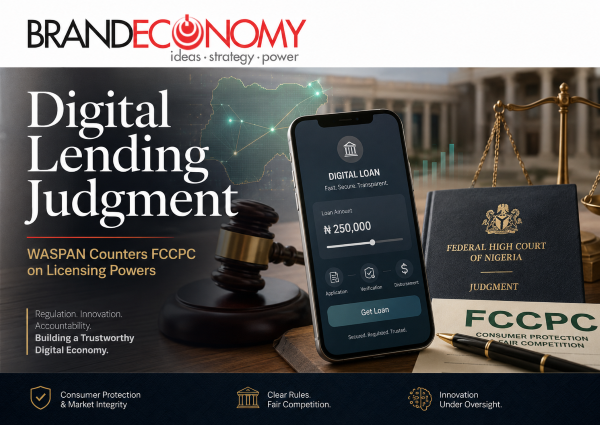
 The Wireless Application Service Providers Association of Nigeria has challenged the Federal Competition and Consumer Protection Commission’s portrayal of the recent Federal High Court judgment on digital lending regulation as an unqualified regulatory victory.
WASPAN acknowledged that Justice A. L. Allagoa of the Federal High Court, Lagos Judicial Division, upheld the validity of the Digital, Electronic, Online or Non-Traditional Consumer Lending Regulations 2025 and dismissed the association’s substantive claims.




However, the industry body argued that the judgment also contained a critical boundary: the FCCPC may regulate competition and consumer-protection issues, but cannot assume the role of a telecommunications licensing authority.
The statement represents WASPAN’s direct response to the FCCPC’s announcement that it had resumed implementation and enforcement of the DEON Regulations following the court’s decision in Suit No. FHC/L/CS/760/2026.
The FCCPC had described the judgment as affirming that the regulations were issued within its statutory and constitutional powers. It said the court discharged the interim order that had restrained enforcement, making the framework fully operational once again.
WASPAN’s counter-position is that this account, while reflecting the court’s validation of the regulations, did not capture the judgment’s full significance for telecommunications companies participating in digital lending.
One judgment, two regulatory narratives
There is no dispute between the parties on the judgment’s central outcome: the DEON Regulations survived the legal challenge.
WASPAN confirmed that the court found the FCCPC acted within its powers under the Federal Competition and Consumer Protection Act when it introduced the rules. It also accepted that the court found no irreconcilable conflict between that law and the Nigerian Communications Act 2003.
But the association said the court expressly held that the FCCPC does not possess the power to issue telecommunications licences.
According to WASPAN’s interpretation, the Nigerian Communications Commission remains the institution responsible for licensing telecommunications operators, while the FCCPC’s authority is limited to competition and consumer-protection oversight.
That distinction is commercially important.
Many digital lending products rely on mobile networks, airtime, data, short codes, messaging platforms and other services delivered by telecommunications and value-added-service companies.
If an FCCPC registration or approval were treated as a substitute for an NCC licence, operators could face overlapping mandates, duplicated fees and conflicting regulatory instructions.
The DEON Regulations themselves recognise this distinction. They state that FCCPC approval does not replace any licence, permit or authorisation required from the applicable sector regulator. The rules also require applicants operating in regulated industries to submit evidence of their sector licences where relevant.
The real legal and commercial question is therefore not whether the FCCPC can protect consumers in digital lending. The court has upheld that authority.
The unresolved tension concerns how far the FCCPC’s registration, partnership-approval and supervisory requirements may go before they begin to resemble a parallel licensing system.
WASPAN records procedural victory
Although the association’s principal reliefs were dismissed, it said the court rejected the FCCPC’s preliminary objection on jurisdiction.
WASPAN stated that the court found it had served a valid pre-action notice, disclosed a reasonable cause of action and approached the court out of a genuine concern about the regulations’ implications.
The association presented this as confirmation that its challenge was neither frivolous nor an attempt to obstruct legitimate consumer protection.
WASPAN said it was reviewing the full judgment with its legal team, led by Kemi Pinheiro, SAN, and Pinheiro LP, and might appeal aspects of the decision.
That possibility means the regulatory dispute may not be entirely over.
What changes for digital lenders?
The immediate consequence is that the FCCPC can resume enforcement of the DEON Regulations.
Digital lenders and their partners must expect scrutiny of loan disclosures, interest and fee transparency, data handling, debt-recovery practices, consumer complaints and lending partnerships.
The framework gives the FCCPC considerable authority to register providers, approve relevant collaborations and impose sanctions for non-compliance. It is designed to address abusive practices that have damaged trust in Nigeria’s rapidly growing digital-credit market.
For telecommunications businesses, however, WASPAN’s reading of the judgment suggests that FCCPC compliance must remain separate from NCC licensing.
An operator may therefore need consumer-lending approval from the FCCPC while retaining the appropriate telecommunications authorisation from the NCC.
That dual-regulator model can work—but only with effective coordination.
Without harmonised processes, businesses could face inconsistent reporting requirements, duplicated due diligence and longer product-approval timelines.
Market and investor implications
The judgment offers investors a measure of certainty because the DEON framework is again enforceable. Responsible lenders now have a clearer basis for compliance, while operators relying on harassment, deceptive pricing or unauthorised data use face greater regulatory exposure.
At the same time, WASPAN’s response highlights continuing jurisdictional risk.
Investors will want clarity on whether the FCCPC is granting a consumer-protection registration, approving a commercial partnership or attempting to authorise the underlying telecommunications service.
The difference affects legal risk, operating costs and the time required to launch products.
The best outcome would be a formal FCCPC–NCC coordination mechanism that provides operators with a unified compliance pathway while preserving each regulator’s statutory responsibilities.
Brand implications
For the FCCPC, the judgment strengthens its position as the leading consumer-protection authority in digital lending. But its institutional brand will be better served by communicating both the powers affirmed by the court and the limits attached to those powers.
For WASPAN, the challenge is to demonstrate that its resistance is about regulatory clarity—not opposition to responsible lending or consumer protection.
Language also matters.
WASPAN criticised the FCCPC for previously describing the association and its members as a “desperate cartel” during the litigation. It argued that regulators should maintain institutional restraint, particularly when disputes are before the courts.
Both sides now have an opportunity to move from public confrontation towards coordinated market governance.
BRANDECONOMY Insight
The judgment appears to deliver a divided but potentially constructive outcome.
The FCCPC won the larger battle: its digital lending regulations remain valid and enforceable.
WASPAN, however, says the court established an equally important guardrail—the FCCPC cannot transform consumer-protection approval into a telecommunications licence or displace the NCC’s sectoral role.
That boundary should not weaken regulation. It should make regulation more precise.
Nigeria’s digital-credit market needs strong consumer protection, ethical lending and enforceable data-privacy standards. It also needs regulators that coordinate rather than compete for jurisdiction.
The winning framework is not multiple agencies issuing overlapping permissions. It is coordinated supervision in which every regulator understands its lane, shares relevant information and acts decisively against abuse.
Digital lending will thrive when innovation is supervised firmly, consumers are treated fairly and legitimate businesses can identify—with certainty—which regulator controls what.