NNPC Partners Chinese Firms To Revive Warri, Port Harcourt Refineries As Revenue Hits ₦2.77trn
Agreement signed in Jiaxing City, China

 NNPC Limited has signed a Memorandum of Understanding with two Chinese firms for a potential technical equity partnership to complete, operate and upgrade the Warri and Port Harcourt refineries. The move comes as the national oil company reported March revenue of ₦2.77 trillion and profit after tax of ₦276 billion. Yet Nigeria’s central refining question remains unchanged: can another refinery revival plan finally deliver sustained output, commercial discipline and public value?
A Fresh Refinery Bet, This Time With Chinese Partners
Nigeria’s long and troubled refinery rehabilitation story has opened another chapter.



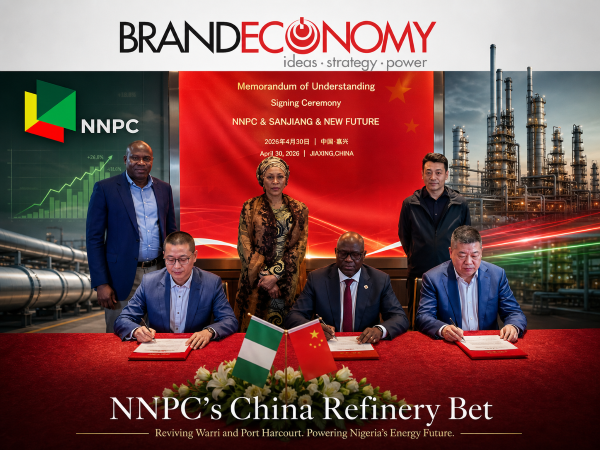
The Nigerian National Petroleum Company Limited has signed a Memorandum of Understanding with two Chinese companies—Sanjiang Chemical Company Limited and Xingcheng (Fuzhou) Industrial Park Operation and Management Co. Ltd.—for a potential Technical Equity Partnership covering the completion and operation of the Warri and Port Harcourt refineries.
The agreement was signed in Jiaxing City, China, by NNPC Group Chief Executive Bayo Ojulari, Sanjiang Chemical Company Chairman Guan Jianzhong, and Xingcheng Chairman Bill Bi.
For NNPC, the objective is clear: complete outstanding refinery works, put the assets under a more sustainable operating and maintenance framework, upgrade product standards, and explore the development of co-located petrochemical and gas-based industrial hubs.
For Nigeria, the stakes are even clearer. A country that produces crude but still carries the burden of refined-product dependence cannot afford another failed turnaround.
Why This Agreement Matters
The proposed partnership is significant because it hints at a different operating model.
Nigeria’s public refineries have suffered not only from ageing equipment, but from weak commercial governance, poor maintenance culture, cost overruns, inconsistent feedstock, politicised expectations and repeated rehabilitation exercises that delivered less than promised.
A Technical Equity Partnership, if properly designed, could change the incentive structure. Rather than merely hiring contractors for repair work, NNPC may be looking for partners with technical competence, operational responsibility and possibly equity-linked exposure to long-term performance.
That distinction matters.
Refineries do not succeed because they are refurbished once. They succeed because they are operated efficiently every day. They require feedstock planning, product optimisation, maintenance discipline, technical competence, cost control and strict performance monitoring.
The MoU is therefore only the first step. The real test will be whether any final agreement creates enforceable obligations, clear timelines and measurable output.
Ojulari’s Refinery Reset
NNPC Group Chief Executive Bayo Ojulari described the MoU as a significant milestone after months of engagement between the technical and management teams of NNPC and the Chinese partners. According to NNPC, the agreement reflects a shared interest in developing and sustaining the profitability of the national oil company’s refining assets.
Ojulari’s task is substantial. He must convince Nigerians and investors that this is not another ceremonial agreement in a sector crowded with old promises.
The Port Harcourt and Warri refineries are not ordinary industrial assets. They are symbols of Nigeria’s energy ambition and its execution failures. They have consumed public attention, huge capital commitments and political goodwill for years. Yet they remain at the centre of Nigeria’s unresolved downstream challenge.
If Ojulari can move these assets from rehabilitation rhetoric to commercially viable operation, it would be one of the most important credibility wins for NNPC’s new corporate era.
The Petrochemical and Gas-Based Industrial Hub Opportunity
One of the more forward-looking elements of the proposed collaboration is the possibility of expanding petrochemical capacity and developing gas-based industrial hubs around the refinery assets.
This is where Nigeria’s refinery strategy must evolve.
Modern refineries are no longer just fuel factories. The best downstream assets are increasingly integrated with petrochemicals, gas processing, industrial feedstock, plastics, fertilisers, solvents, manufacturing clusters and export value chains.
For Warri and Port Harcourt, this could be decisive. If the plants are revived merely to produce petrol and diesel under outdated economics, their long-term competitiveness may remain limited. But if they are upgraded into integrated downstream industrial platforms, they could support jobs, manufacturing, regional trade, cleaner fuels and more diversified revenue.
Nigeria needs refineries that produce industrial value, not national nostalgia.
Revenue Hits ₦2.77trn, Profit Rebounds
The refinery MoU came as NNPC reported improved March 2026 numbers.
According to the company’s Monthly Report Summary, revenue rose to ₦2.77 trillion in March, up from ₦2.68 trillion in February. Profit after tax also improved sharply to ₦276 billion, compared with ₦136 billion in February.
The numbers suggest better momentum after earlier volatility. Crude oil and condensate production averaged 1.56 million barrels per day, up from 1.51 million barrels per day in February, while gas output rose to 7,731 million standard cubic feet per day, compared with 7,458 mmscfd in the previous month.
For a company looking to attract technical partners and position itself as a commercially disciplined energy player, stronger revenue and profit numbers matter. But they are not enough.
NNPC’s credibility will increasingly depend on whether improved monthly performance can be converted into structural reform—higher production reliability, stronger downstream operations, better transparency and commercially viable asset management.
Pipeline Reliability Remains the Weak Link
NNPC’s March report also showed that upstream pipeline availability dropped to 76 per cent, compared with 93 per cent in February.
That decline is a warning signal.
Nigeria’s refinery revival cannot be separated from crude supply reliability. A refinery can be upgraded, staffed and commissioned, but without steady feedstock, it cannot run efficiently. Pipeline outages, vandalism, theft, maintenance problems and evacuation constraints have long weakened Nigeria’s oil economy.
The report also recorded progress on gas infrastructure, with the OB3 pipeline at 96 per cent completion and the Ajaokuta-Kaduna-Kano pipeline at 93 per cent completion.
Those gas assets matter because Nigeria’s downstream future must be tied not only to liquid fuels, but to gas-led industrialisation. If completed and operated well, they could support power, fertilisers, petrochemicals, industrial clusters and cleaner domestic energy.
The Trust Deficit Around Refinery Rehabilitation
NNPC’s latest refinery move will excite some and worry others.
The optimism comes from the possibility that technical partners with industrial experience could bring discipline, capital, systems and operational focus. The worry comes from history.
Nigeria has spent heavily on refinery rehabilitation in the past, yet public confidence remains low. The material provided notes that the last major effort before this reportedly consumed almost $3 billion and has become a matter of scrutiny by anti-corruption authorities.
That history makes transparency essential.
NNPC should provide clear answers on the scope of work, partner obligations, investment size, financing structure, operating model, equity terms, timelines, expected capacity utilisation, product slate and public reporting mechanisms.
A refinery revival plan that cannot be measured cannot be trusted.
BRANDECONOMY Insight
NNPC’s partnership move with the two Chinese firms should be welcomed with cautious seriousness.
The country needs functioning refineries. It needs cleaner fuels. It needs downstream industrial capacity. It needs petrochemicals. It needs gas-based industrial hubs. It needs to reduce dependence on imported refined products. It also needs public energy assets that work as businesses, not as monuments.
But Nigeria has reached a point where refinery announcements no longer impress by themselves. The public has heard too many promises. Investors have seen too many delays. Citizens have paid too much for inefficiency.
This time, NNPC must treat the MoU as a performance test.
The right model would align the incentives of all parties: the Chinese partners must bring real technical and financial commitment; NNPC must provide governance clarity and operational discipline; government must protect the process from political interference; regulators must insist on transparency; and Nigerians must see measurable progress.
The March numbers strengthen NNPC’s hand. Revenue at ₦2.77 trillion and profit after tax of ₦276 billion indicate stronger financial momentum. But the company’s deeper challenge is not only earning revenue. It is building trust.
The refinery question is ultimately a question of institutional credibility.
If Warri and Port Harcourt return to sustained operation, integrated with petrochemicals and gas-based industry, NNPC could rewrite one of Nigeria’s most frustrating energy stories.
If not, this will become another signed document in a long archive of refinery disappointment.
The MoU must quickly move from diplomatic signing to transparent milestones, commercial terms and measurable delivery. Refinery revival should be integrated with petrochemicals, gas hubs, cleaner fuels and industrial policy. The technical equity partnership model could be attractive if risks, ownership, financing and performance obligations are clearly defined. The real test is sustained refinery output, not another announcement.