

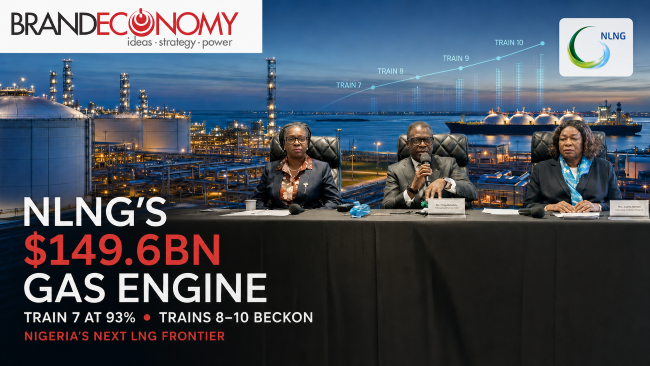
Nigeria LNG (NLNG) Limited has generated $149.6 billion in revenue since inception, underscoring its position as one of Nigeria’s most consequential industrial investments—and signalling ambitions to become considerably larger.
The company is already conducting exploratory work and preliminary consultations on Trains 8, 9 and 10, even as its long-awaited Train 7 expansion approaches completion.


NLNG Chief Executive Officer, Mr Adeleye Falade, disclosed the figures on Tuesday in Lagos at the unveiling of the company’s Facts and Figures 2026 publication.
Falade said NLNG had paid $47.2 billion in dividends to shareholders and $10.8 billion in taxes to the Federal Government since becoming tax-compliant in 2009. Its asset base now exceeds $22.9 billion, while more than 6,285 LNG cargoes have been safely delivered to international markets.
These numbers tell a larger story. NLNG is not merely an exporter of liquefied natural gas; it is a rare Nigerian example of converting an abundant natural resource into a globally traded product, substantial public revenue and long-term shareholder value.
Train 7 approaches the finishing line
NLNG currently operates six liquefaction trains with an installed LNG production capacity of 22 million tonnes per annum. According to Falade, the company accounts for about six per cent of global LNG supply.
The Train 7 project has reached 93 per cent completion and is expected to increase LNG capacity by 35 per cent—from 22 million tonnes to 30 million tonnes annually. It will also raise NLNG’s liquefied petroleum gas output by 50 per cent.
The expansion is strategically important at a time when energy-security concerns are reinforcing demand for reliable gas supply. Europe’s diversification of energy sources, Asia’s appetite for LNG and the need for lower-carbon transition fuels have created an opportunity for gas-producing countries able to deliver consistently.
NLNG’s official project profile similarly identifies Train 7 as the platform that will lift installed capacity to 30 million tonnes per annum and deepen Nigerian participation across the project’s supply chain. NLNG Train 7
However, Train 7 is not being presented as the company’s final growth frontier. Falade said exploratory activities and initial discussions had begun on what would be required to develop Trains 8, 9 and 10.
That ambition could alter Nigeria’s position in the global gas hierarchy. But new trains cannot be justified by reserves alone; they require bankable feedgas, dependable pipelines, commercially attractive contracts, security and regulatory stability.
The gas-supply contradiction
Falade identified inadequate gas supply as NLNG’s most serious operational challenge. He described 2025 as particularly difficult, although supply conditions have improved in 2026.
This exposes a stubborn national paradox: Nigeria possesses immense gas resources, yet one of its flagship processing facilities has struggled to secure sufficient feedstock.
Falade placed Nigeria’s proven gas reserves at approximately 290 trillion cubic feet, with potentially significant volumes still awaiting confirmation. His description of Nigeria as fundamentally “a gas country with some oil” captures the scale of the opportunity—and the policy error of treating gas as a secondary petroleum product.
The commercial window, however, will not remain open indefinitely. Gas is expected to retain an important place in the global energy mix for decades, particularly as a transition fuel. But accelerating renewable-energy deployment, climate regulation and competition from established LNG producers mean Nigeria must develop its resources while demand and financing conditions remain favourable.
From export terminal to domestic energy platform
NLNG’s significance is increasingly visible at home. Falade said the company supplied a record 500,000 tonnes of LPG—commonly called cooking gas—to Nigeria’s domestic market in 2025, representing roughly one-third of national demand.
Since 2022, the company has dedicated all its LPG output to the local market. NLNG’s published domestic-supply profile says deliveries have grown from 50,000 tonnes in 2007 to more than 500,000 tonnes, covering about 30 per cent of the Nigerian market. NLNG Domestic LPG
Additional volumes from Train 7 could support cleaner cooking, reduce dependence on charcoal and firewood and strengthen LPG distribution. Yet greater production will not automatically translate into affordability. Port facilities, coastal receiving terminals, trucking costs, storage capacity, foreign-exchange pressures and retail margins will continue to influence prices paid by households.
Falade also credited NLNG’s gas-utilisation model with helping to reduce Nigeria’s gas-flaring rate from about 65 per cent to below 20 per cent. The shift from flaring to commercial utilisation illustrates how environmental improvement can coexist with export earnings and industrial development.
The Bonny-Bodo development corridor
Falade said NLNG had completed the Bonny-Bodo Road, describing it as one of the country’s largest corporate social-responsibility projects.
The road gives Bonny Island its first direct connection to mainland Rivers State, improving mobility and potentially reducing the cost of moving people, services and goods. Its economic value could extend beyond NLNG by opening new opportunities in hospitality, tourism, logistics, real estate and small business.
At the Lagos event, Palmer-Ikuku reaffirmed the company’s commitment to transparent media engagement. She urged journalists to use the Facts and Figures publication as a primary reference and seek clarification whenever necessary.
Market and investor implications
Train 7 creates opportunities for upstream gas producers, engineering companies, marine-logistics operators, equipment suppliers and Nigerian service firms. Prospective Trains 8 to 10 could widen that investment pipeline significantly.
For investors, however, the central indicator is utilisation—not nameplate capacity. If feedgas constraints persist, new infrastructure may fail to deliver its full commercial potential. Nigeria must therefore stimulate upstream investment, improve pipeline security and ensure contract sanctity.
Brand implications
NLNG’s $149.6 billion revenue record strengthens its reputation as a globally credible Nigerian enterprise. Yet the next phase of its brand will be judged by operational reliability, project delivery and the extent to which expansion improves Nigerian lives.
For the national brand, NLNG is proof that Nigeria can build and sustain a sophisticated export business. The stronger message to investors would be demonstrating that this success can be replicated across the wider gas value chain.
BRANDECONOMY Insight
Train 7 is an impressive expansion, but steel, turbines and liquefaction equipment cannot manufacture gas supply.
Nigeria’s defining challenge is no longer proving that it has enormous reserves. It is converting those reserves into molecules delivered reliably to plants, industries and households.
If supply reform matches NLNG’s expansion ambition, Trains 8, 9 and 10 could anchor a new era of gas-led industrialisation. Without that alignment, the country risks possessing world-class resources while surrendering the market opportunity to faster-moving competitors.