Nigerian Breweries’ ₦93bn Comeback: Can an Iconic Consumer Brand Outgrow the Cost-of-Living Crisis?

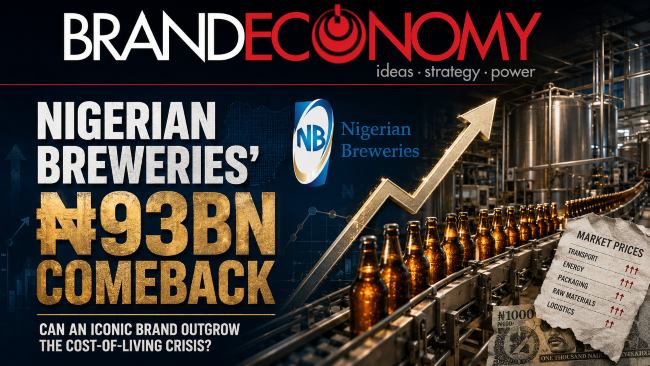
 Nigerian Breweries has returned to profit, erased its accumulated deficit and transformed debt into net cash. But beneath the celebratory numbers lies a tougher test: can financial repair become durable, volume-led growth when consumers are still trading down?
 Nigerian Breweries has returned to profit, erased its accumulated deficit and transformed debt into net cash. But beneath the celebratory numbers lies a tougher test: can financial repair become durable,
 Some corporate results improve a quarter; others appear to close an era. Nigerian Breweries Plc’s half-year 2026 performance belongs, at least symbolically, to the second category.
For the six months ended June 30, Nigeria’s largest brewing company reported net revenue of ₦803.68 billion, profit before tax of ₦156.33 billion and profit after tax of ₦92.95 billion. Even more strikingly, the accumulated deficit that had become the scar tissue of the company’s foreign-exchange and debt crisis disappeared. Retained earnings moved from a negative ₦72.17 billion at December 2025 to a positive ₦13.65 billion by June.




That crossing is more than an accounting footnote. It marks a passage from balance-sheet convalescence towards normal corporate life: reinvestment, dividends and strategic choice.
Yet the headline is more triumphant than the underlying consumer story.
Revenue rose by 8.88 per cent from ₦738.14 billion in the corresponding period of 2025. In an economy where headline inflation was running at 15.91 per cent in June, nominal sales growth below inflation points to a likely decline in inflation-adjusted revenue. Without a volume disclosure, it is impossible to establish how many more—or fewer—units moved through the market. But the accounts do not yet prove that Nigerian households have rediscovered their spending power.
The question is what kind of recovery this is—and how much can survive after the benefits of recapitalisation and debt removal have been fully harvested.
The Comeback in Five Numbers
Cost of sales increased by only 5.1 per cent, considerably slower than revenue. Gross profit consequently rose 14.1 per cent to ₦354.86 billion, while gross margin expanded from 42.1 per cent to 44.2 per cent. That two-percentage-point gain is meaningful. It suggests that pricing, product mix, sourcing, manufacturing efficiency or a combination of the four more than absorbed the growth in direct costs.
The advantage narrowed further down the statement. Selling and distribution expenses jumped 22.2 per cent to ₦159.62 billion, while administrative expenses increased 11.1 per cent to ₦31.96 billion. Advertising and sales spending rose 20.9 per cent to ₦71.93 billion; distribution costs climbed 25.7 per cent to ₦68.04 billion. Operating profit therefore advanced by a more modest 8 per cent to ₦163.97 billion, and operating margin slipped marginally from 20.6 per cent to 20.4 per cent.
The decisive improvement came after operations. Net finance cost plunged by 61.1 per cent, from ₦19.65 billion to ₦7.65 billion. Finance income nearly tripled to ₦2.52 billion, while finance costs were halved to ₦10.16 billion. That propelled profit before tax up 18.2 per cent.
Then came the taxman. The income-tax charge surged 44.6 per cent to ₦63.37 billion as the effective tax rate climbed from 32.7 per cent to 40.54 per cent. Profit after tax consequently increased by only 5.1 per cent to ₦92.95 billion. Net margin actually eased from 12.0 per cent to 11.6 per cent.
The ₦599bn Surgery That Changed the Patient
The most important context sits outside the reporting period. Nigerian Breweries’ 2024 rights issue sought ₦599.1 billion, with the overwhelming purpose of eliminating overdue foreign-currency obligations and reducing naira debt. It was an extraordinary recapitalisation—painful dilution for shareholders, but also a rescue from a capital structure that had become dangerously exposed to devaluation and high interest rates.
The treatment worked.
At June 2025, the group carried ₦152.03 billion in borrowings and had net debt of ₦74.32 billion. By June 2026, reported loans and borrowings were nil, while cash and cash equivalents stood at ₦74.63 billion. Nigerian Breweries had moved through a swing of almost ₦149 billion—from net borrower to net-cash company.
That is the engine behind the collapse in finance costs. It is also why investors must distinguish between recovery in the business and recovery in its financing. Lower interest expense is sustainable for as long as the company resists rebuilding costly debt. But it cannot keep falling by 61 per cent indefinitely. Once the comparative benefit normalises, future earnings growth must come increasingly from volume, mix, productivity and pricing discipline.
Balance-sheet repair is not cosmetic: it reduces currency vulnerability, strengthens supplier confidence and creates room to fund growth. Net cash from operating activities leapt from ₦7.18 billion to ₦111.07 billion, while ₦30.34 billion went into property, plant and equipment. The recovery is therefore supported by cash and reinvestment, not merely a favourable paper revaluation.
Where Is the Consumer in This Recovery?
Brewing is one of the clearest windows into discretionary spending. Consumers can reduce frequency, switch brands, choose smaller packs, move to informal alternatives or stop buying altogether. A producer can raise naira revenue while selling fewer litres, particularly during inflation.
Deflated by June’s 15.91 per cent headline inflation, the 8.88 per cent top-line increase implies a rough real revenue contraction of about 6 per cent. This is not a definitive volume calculation—mix and sector-specific prices matter—but it warns against treating nominal growth as expanding demand.
The quarterly progression makes the issue more pointed. First-quarter profit after tax rose 25.6 per cent to ₦55.95 billion. By subtraction, second-quarter profit was about ₦37.01 billion, down roughly 15.6 per cent from the comparable quarter of 2025, even though second-quarter revenue grew by about 10.2 per cent. The tax charge explains much of the pressure, but the result shows that the comeback is not travelling in a straight line.
Premiumisation alone cannot be the answer. Higher-end brands protect margins, but an iconic national portfolio cannot outgrow a mass-market crisis by abandoning the mass market. It needs aspirational choices at the top, resilient mainstream propositions in the middle and engineered affordability at the entry point.
Its enlarged portfolio—strengthened by the Distell acquisition—offers more occasions and price points, while non-alcoholic brands provide another avenue for growth. But breadth creates value only when distribution, pack architecture and brand investment prevent complexity without scale.
Pricing Power Has a Breaking Point
The expanded gross margin shows that Nigerian Breweries is recovering pricing power or cost control. Yet every price increase transfers stress to distributors, retailers and consumers. Push too cautiously and inflation destroys margin; push too aggressively and volumes migrate to cheaper competitors or unrecorded alternatives.
The increases in advertising and distribution spending should not automatically be labelled inefficiency. In a weakened market, brands must remain remembered, visible and reachable across thousands of fragmented outlets.
Still, the 25.7 per cent increase in distribution expense is a red flag for management attention. Logistics, fuel, route-to-market leakage and working-capital demands can consume the gains made in the brewery. Trade and other receivables nearly doubled from year-end to ₦135.36 billion, indicating that a large amount of cash is now sitting with customers and counterparties. Stronger revenue purchased through looser credit would be lower-quality growth.
The next frontier is granular efficiency: returnable packaging, local inputs, route optimisation, energy productivity and digital visibility from factory to outlet.
Market and Manufacturing Implications
Nigerian Breweries anchors an industrial ecosystem spanning agriculture, packaging, glass, logistics, refrigeration, advertising, hospitality and retail. Its recovery improves the confidence of that value chain and demonstrates that recapitalisation can neutralise currency-created debt. But it also exposes the limits of corporate self-help: a brewer can repair its finances, not national power supply, roads or household incomes. New capital investment must therefore reduce unit costs or unlock genuine demand; capacity without purchasing power is expensive steel waiting for consumers.
Brand Implications: Relevance Before Celebration
For an 80-year-old institution whose flagship lager dates to 1949, longevity is both asset and trap. Heritage supplies trust, but consumer tastes, occasions and media habits keep fragmenting. The winning architecture must connect heritage with contemporary culture, practise responsible marketing and judge success by profitable penetration, repeat purchase and contribution margin—not reach alone. In a cost-of-living crisis, “premium” must mean superior value, not merely a higher price.
Investor Relevance: Four Tests for the Next Results
Four indicators will reveal the quality of the recovery: volume, to separate buyer growth from pricing; operating margin, to test whether gross gains survive commercial costs; cash conversion, so receivables do not outrun sales; and capital allocation, ensuring net cash does not become permission to rebuild leverage.
Tax deserves separate attention. The 40.54 per cent effective rate may not be a permanent new normal, but it changes valuation, retained cash and dividend capacity. Investors need clarity on its drivers and the full-year outlook.
The shares now represent a less fragile, more cash-generative company. Yet valuation should reward repeatable earnings, not simply the completion of a rescue.
BRANDECONOMY Insight
Nigerian Breweries has already won the first battle: it has outgrown the balance-sheet crisis. The rights issue removed debt, finance costs collapsed, cash generation returned and accumulated losses were erased.
The second battle cannot be solved in the treasury department. It must be won in millions of household and retail decisions.
The company’s half-year accounts reveal a comeback built on three pillars: improved gross economics, radical deleveraging and operational cash flow. Consumer expansion is not yet the strongest of them. Revenue growth below inflation, a flat operating margin and weaker second-quarter profit say the recovery remains exposed to household hardship and a high tax burden.
An iconic brand does not defeat a cost-of-living crisis by raising prices faster than its consumers can cope. It does so by continuously redesigning value: the right brand, pack, price, occasion and route to market—delivered at a cost the company can sustain and the consumer can justify.
Nigerian Breweries has repaired the vessel. Now it must prove that the consumer economy can provide the wind.