Nigeria’s High-Cost Capital Trap Is Keeping the Power Sector in the Dark

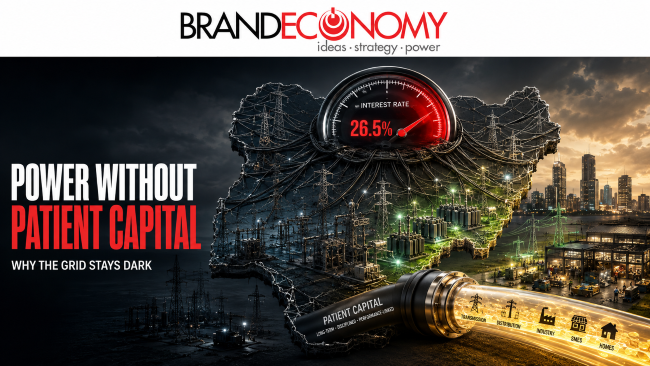 Nigeria cannot sustainably rebuild its electricity and power infrastructure with short-tenor commercial loans priced at some of the highest interest rates in the economy.
That was the central warning from Mr Sunday Oduntan, Executive Director and Chief Executive Officer of the Association of Nigerian Electricity Distributors, who called for concessional finance and patient capital to support urgent investments across the power value chain.



Speaking in an interview with the News Agency of Nigeria in Abuja, Oduntan said lenders remained reluctant to commit funds where recovery prospects were uncertain. He identified expensive credit, policy inconsistency, inadequate investment and weak commercial discipline as major obstacles to private-sector participation.
His argument reflects a deeper mismatch. Electricity networks are long-life assets whose returns may emerge over 10 to 25 years. Commercial banks predominantly mobilise shorter-term deposits and price loans against inflation, liquidity conditions, credit risk and monetary policy.
With the Central Bank of Nigeria retaining its Monetary Policy Rate at 26.5 per cent in July 2026, viable commercial lending rates are considerably higher. A distribution company borrowing at such costs to install meters, replace transformers or reinforce feeders would need unusually strong and predictable cash flows to service the debt.
Nigeria’s power sector offers neither predictability nor low risk.
The problem is bigger than interest rates
Cheap capital alone will not make the electricity industry bankable.
Investors assess whether tariffs reflect prudent costs, customers pay their bills, contracts are enforceable, regulators act consistently and operators can retain sufficient revenue to repay financing. Where these conditions are weak, even concessionary funding can become stranded capital.
Nigerian Electricity Regulatory Commission data illustrate the commercial difficulty. DisCos collected approximately ₦597.56 billion from the ₦756.93 billion billed during the first quarter of 2026, representing collection efficiency of about 78.95 per cent. Roughly ₦159.37 billion in billed revenue remained uncollected.
The revenue that disappears through technical losses, inaccurate energy accounting, electricity theft, unmetered consumption and unpaid bills cannot finance new infrastructure.
This creates a destructive cycle: weak collections reduce investment; inadequate investment worsens service; poor service weakens customers’ willingness to pay; and falling confidence further damages collections.
Patient capital must break that cycle—not finance its continuation.
Transmission remains a critical link
Oduntan described the transmission network as a major bottleneck requiring reinforcement, modern substations and substantially greater capital investment.
He advocated wider deployment of Supervisory Control and Data Acquisition technology to provide real-time visibility, improve system control and strengthen grid management. He also called for transmission operations to be protected from political interference and placed under stronger commercial and technical management.
SCADA is not decorative technology. A grid operator needs to know where electricity is flowing, where faults occur and how equipment is performing. Without real-time information and automated controls, system instability takes longer to detect and contain.
Oduntan proposed structured public-private partnerships to attract private capital into transmission. Such arrangements could finance commercially viable corridors, substations and regional infrastructure while government retains appropriate system oversight.
However, PPPs cannot survive vague risk allocation. Agreements must establish who carries construction, currency, tariff, demand, political and payment risks—and how investors will earn predictable returns.
Transmission should also not become a convenient explanation for every failure. Generation availability, gas supply, distribution capacity and commercial demand must be developed together. Strengthening one segment while leaving the others impaired will merely relocate the bottleneck.
Distribution: where finance meets the customer
At the distribution end, Oduntan identified high technical and commercial losses, inadequate metering, low voltage, frequent outages and poor service as persistent challenges.
DisCos are the electricity market’s principal cash-collection interface. When they cannot accurately measure energy, bill customers transparently and recover revenue, financial distress travels backwards to transmission companies, generation businesses and gas suppliers.
Nigeria therefore needs more than recapitalised balance sheets. DisCos must present credible performance-improvement plans showing how each naira of new funding will reduce losses, install meters, strengthen feeders and increase dependable supply.
Capital should be released against independently verified milestones. Operators that meet targets should gain access to additional funding; those that fail should face regulatory and ownership consequences.
Development-finance solution
Nigeria requires a blended-finance architecture combining government support, development-finance capital, commercial lending, pension funds, infrastructure investors and private equity.
Public and development institutions could provide guarantees, first-loss protection or subordinated capital, reducing risk sufficiently for private lenders to participate. Long-tenor naira financing would also limit the currency mismatch created when electricity revenues are earned locally but infrastructure debt is denominated in dollars.
The financing must remain commercially disciplined. Concessional capital should not become an endless subsidy for inefficient operators or politically connected projects.
Eligible investments should have ring-fenced revenues, transparent procurement, measurable service targets, escrow arrangements and enforceable loan covenants. Priority could be given to metering, distribution automation, transmission corridors, substations, smart-grid systems and industrial power clusters capable of producing verifiable economic returns.
Decentralised regional or zonal networks could also attract investment where technically and economically viable. Smaller systems aligned with industrial clusters and state electricity markets may be easier to finance and manage than relying exclusively on one centralised structure.
Market and investor implications
Reliable electricity would reduce manufacturers’ dependence on diesel and self-generation, improve capacity utilisation and strengthen Nigerian products against imports. SMEs could operate longer hours, digital businesses would suffer fewer disruptions, and new industrial investment would become easier to justify.
For investors, the opportunity is enormous, but demand alone does not make a project bankable. Regulatory certainty, cost-reflective revenue, payment security, transparent procurement and credible operators will determine whether capital enters—and remains in—the sector.
Brand implications
Every outage is also a brand failure. DisCos have lost consumer trust through unreliable supply, estimated billing and weak complaint resolution. Government’s reform brand suffers whenever announced investments fail to produce visible improvements. Regulators lose credibility when rules appear unpredictable or enforcement uneven.
Restoring confidence requires publishing performance data at feeder and project level. Customers should see what was financed, when it was completed and how it improved supply.
BRANDECONOMY Insight
Nigeria should establish a Power Infrastructure Credit Enhancement Platform providing long-tenor naira finance for independently verified projects across transmission, distribution and decentralised electricity markets.
Power funding should be earned through performance—not allocated through influence.
The platform should publish a live scorecard tracking capital disbursed, meters installed, losses reduced, additional supply delivered, outage hours avoided and revenue improvements achieved.
Oduntan is right that Nigeria’s electricity industry needs patient capital. But capital should be patient with long-term infrastructure—not with poor governance, commercial indiscipline or endless non-performance.
Nigeria will not borrow its way out of darkness unless every financed naira is connected to more reliable electricity.