

Nigeria’s Ports Record 24.8% Cargo Growth as Throughput Hits 129.3m Tonnes

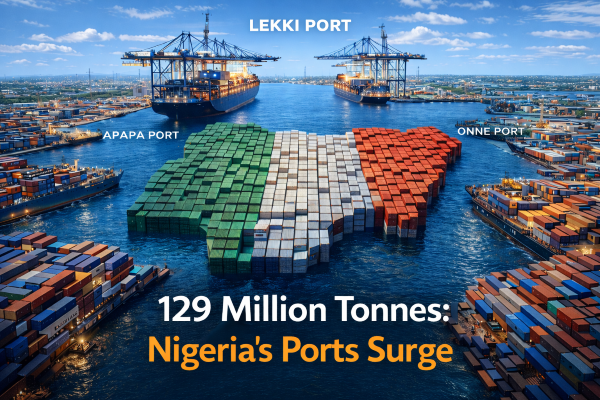 Nigeria’s maritime sector delivered one of its strongest performances in recent history in 2025, with cargo throughput rising sharply as the country’s ports handled a record 129.3 million metric tonnes (MMT) of cargo.
According to the 2025 Operational Performance Report released by the Nigerian Ports Authority (NPA), cargo volumes increased 24.8 percent, up from 103.6 million metric tonnes recorded in 2024.




Presenting highlights of the report in Lagos, the Managing Director of the Nigerian Ports Authority, Dr. Abubakar Dantsoho, described the performance as a landmark moment that reinforces Nigeria’s growing relevance in regional and international maritime trade.
He noted that the growth reflects the combined impact of rising export activity, stronger container traffic and increasing capacity at modern port facilities.
Imports Still Dominate, but Exports Are Rising
Despite the surge in total cargo volumes, imports remain the dominant component of Nigeria’s port traffic.
The report shows that imports accounted for 59.2 percent of total throughput, while exports contributed 39 percent, reflecting the country’s ongoing effort to expand non-oil export capacity.
Trans-shipment cargo — goods transferred through Nigerian ports for redistribution across other destinations — accounted for 1.8 percent of the total cargo mix.
The NPA said the gradual rise in exports demonstrates the impact of federal government policies aimed at reducing Nigeria’s dependence on crude oil and strengthening the non-oil export economy.
Container Traffic Crosses 2.1 Million TEUs
Containerised cargo — widely considered the most reliable indicator of trade activity — also recorded significant growth during the year.
Total container throughput rose 25.7 percent, exceeding 2.1 million Twenty-foot Equivalent Units (TEUs).
Import-laden containers increased by 32.8 percent, while export containers expanded modestly by 3.1 percent.
Perhaps the most dramatic shift occurred in trans-shipment containers, which surged 205.8 percent, signalling Nigeria’s growing role as a logistics hub for the West and Central African maritime corridor.
Industry observers say this trend suggests that global shipping lines are increasingly using Nigerian ports as redistribution centres for the region.
Lekki Port Emerges as Nigeria’s Leading Gateway
The operational data shows a significant structural shift in Nigeria’s port hierarchy.
Lekki Deep Sea Port emerged as the country’s dominant maritime gateway in 2025, accounting for 40.6 percent of total cargo throughput.
This places the deep-sea facility far ahead of:
- Onne Port – 19.1 percent
- Apapa Port – 16.7 percent
The port also handled some of the largest vessels calling at Nigerian terminals, with an average Gross Registered Tonnage (GRT) of 55,712, slightly higher than Onne’s 53,022 GRT.
Meanwhile:
- Tin Can Island Port recorded the highest number of ship calls, representing 22.7 percent of total vessel arrivals.
- Delta Ports handled vessels with an average 17,414 GRT.
Across the port network, total ship arrivals rose nearly 12 percent to 4,477 vessels, reflecting broader operational growth.
Liquid Bulk Cargo Still Dominates Trade Mix
The report also highlights the continuing dominance of liquid bulk cargo, including petroleum products and chemicals.
Liquid bulk accounted for 54.7 percent of cargo handled, while containerised cargo represented 24 percent of total traffic.
Dantsoho said the increasing size of vessels and rising container volumes indicate that Nigeria’s ports are gradually aligning with global maritime logistics standards.
Port Modernisation and Single Window System Next
Looking ahead, the NPA expects the next phase of growth to be driven by the Federal Government’s port modernisation programme and the rollout of a National Single Window system.
According to Dantsoho, the modernisation initiative will focus on:
- Upgrading ageing port infrastructure
- Deepening berths to receive larger vessels
- Rehabilitating quays and terminals
- Expanding cargo-handling capacity
- Deploying digital port management systems
The reforms are expected to reduce vessel turnaround time, shorten cargo dwell time and significantly improve operational efficiency across Nigeria’s port system.
BRANDECONOMY Insight
The 24.8 percent surge in cargo throughput signals a structural turning point for Nigeria’s maritime economy.
For decades, Nigeria’s ports were constrained by congestion, ageing infrastructure and slow cargo clearance processes. The emergence of deep-sea facilities such as Lekki Port is now reshaping the competitive landscape.
Three major strategic shifts are underway:
1. The Rise of Deep-Sea Port Infrastructure
Modern ports like Lekki are designed to handle ultra-large container vessels, positioning Nigeria to compete with major trans-shipment hubs such as Tema in Ghana and Lomé in Togo.
2. Nigeria’s Potential as a Regional Logistics Hub
The 205.8 percent growth in trans-shipment containers suggests that international shipping lines increasingly see Nigeria as a redistribution centre for West and Central Africa.
3. Export-Driven Maritime Growth
While imports still dominate port traffic, the gradual rise in exports indicates that Nigeria’s diversification strategy is beginning to reflect in maritime trade data.
However, sustaining this growth will require faster cargo clearance systems, improved hinterland connectivity and full digitalisation of port operations.
The planned National Single Window system could prove decisive in this regard.
If successfully implemented, Nigeria’s ports could evolve into one of Africa’s most important trade gateways, supporting the country’s ambition of becoming a $1 trillion economy within the decade.