Nigeria, South Korea Launch Entrepreneurship Hub to Strengthen Startups and MSME Growth

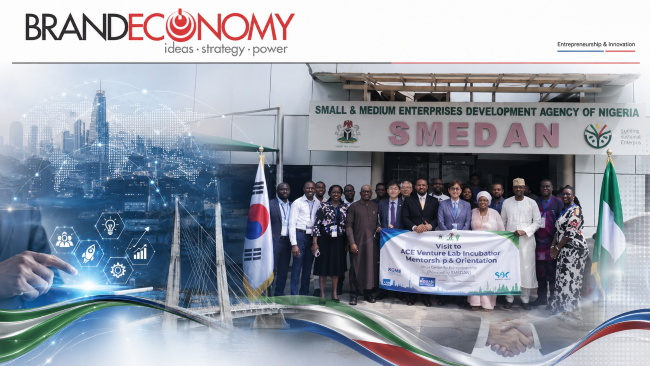 Nigeria’s entrepreneurship ecosystem is set for a new institutional boost as the Federal Government and South Korea advance plans for the Abuja Centre for Entrepreneurship, a platform designed to connect young founders, women-led businesses, startups and MSMEs with training, incubation, mentorship, investors and global partnerships. The bigger ambition is not simply to build another centre. It is to create a more durable pipeline from ideas to enterprise, and from enterprise to jobs, investment and national productivity.
Nigeria has no shortage of entrepreneurs.




From market traders and manufacturers to fintech founders, fashion brands, digital creators, agribusiness operators and service providers, enterprise is one of the country’s most powerful survival instincts. Yet too many promising businesses still struggle to move from hustle to scale.
The barriers are familiar: weak access to finance, limited management capacity, poor business infrastructure, fragmented mentorship, inconsistent market intelligence and the absence of long-term institutional support.
That is the gap the planned Abuja Centre for Entrepreneurship, known as ACE, is expected to address.
The initiative is being developed through a partnership involving the Small and Medium Enterprises Development Agency of Nigeria and the Korea International Cooperation Agency. It is intended to serve as a structured entrepreneurship and innovation platform for Nigerian startups, MSMEs, young people and women entrepreneurs.
The project signals a growing recognition that job creation in Nigeria will not come from government employment alone. It will come from building businesses that can survive, expand, employ people, attract capital and compete beyond their immediate neighbourhoods.
More Than a Building
The Director-General of SMEDAN, Mr Charles Odii, has described ACE as more than a physical structure.
That distinction is important.
Nigeria has seen many innovation hubs, training centres and entrepreneurship initiatives launched with fanfare, only to lose momentum once grants end, political attention shifts or operating costs rise. The real measure of ACE will therefore not be the size of its facility, but the strength of its operating model.
A credible entrepreneurship centre should do at least five things well.
It should identify promising founders early. It should train them in practical business skills. It should connect them to mentors, markets and investors. It should provide incubation support that helps them survive the difficult early years. And it should track whether supported businesses actually grow, create jobs and become investable.
The proposed Abuja Centre for Entrepreneurship model appears designed around these needs. Its planned services include entrepreneurship education, innovation-led training, incubation, mentorship, startup competitions and partnership-building opportunities.
This is the right direction.
Nigeria’s entrepreneurship challenge is not a lack of ideas. It is a lack of systems that help good ideas become functioning businesses.
Why South Korea Matters
South Korea’s involvement gives the project additional strategic significance.
South Korea has built one of the world’s most striking development stories by combining education, technology, manufacturing, export discipline and entrepreneurship. Its experience is particularly relevant to Nigeria because both countries understand the importance of demographic energy, industrial ambition and private-sector development.
For Nigeria, the partnership is not only about development assistance. It is about learning from a country that transformed itself by building institutions that linked talent to production.
The Korean model was never based on innovation alone. It combined policy direction, technical training, industrial clusters, access to finance, export orientation and long-term national discipline.
ACE will not reproduce that model overnight. But it can help Nigeria build some of the institutional foundations required for a stronger startup and MSME economy.
The project’s focus on governance, operational frameworks, performance management and sustainability is therefore encouraging. These are not glamorous subjects, but they are the difference between a temporary entrepreneurship programme and an institution that can outlive donor cycles.
From Training to Market Access
The programme is expected to focus strongly on young Nigerians and women entrepreneurs, while also supporting technology-driven businesses.
This is important because youth entrepreneurship is often discussed as a social intervention rather than an economic strategy. That is a mistake.
Young founders are not merely beneficiaries. They are potential producers, employers, innovators and exporters. A well-supported entrepreneur can build a company that creates jobs, pays taxes, solves local problems and competes across Africa.
Women entrepreneurs also remain one of Nigeria’s most underleveraged economic assets. Many operate businesses with limited access to formal finance, professional networks and scalable distribution systems. A platform that improves their access to training, incubation and investor engagement could generate benefits far beyond the individual business owner.
The promise of ACE will depend on whether it can move participants beyond classroom knowledge.
The centre must help entrepreneurs find customers, not merely certificates. It must improve access to financing, not simply pitch events. It must link startups to real supply chains, procurement opportunities, corporate partners and export markets.
The most successful startup ecosystems are built around commercial outcomes.
The Construction of an Entrepreneurial Pipeline
SMEDAN says construction of the centre is expected to begin at its Industrial Development Centre in Abuja, while some project benefits could begin reaching Nigerian businesses within months.
The timeline matters because entrepreneurs need support now.
Nigeria’s MSME sector carries a large share of employment and economic activity, but most small businesses remain informal, undercapitalised and vulnerable to inflation, exchange-rate movements, high energy costs and weak consumer purchasing power.
A centre such as ACE can help reduce some of those vulnerabilities if it provides the right tools.
Training in bookkeeping, product design, digital marketing, export readiness, financial management and business strategy can improve survival rates. Mentorship can help founders avoid common mistakes. Investor networks can improve access to funding. Incubation support can give businesses time and structure to refine their models before facing the full pressure of the market.
But the centre should also think beyond startups.
Nigeria needs support for small manufacturers, food processors, artisans, digital service providers, renewable-energy businesses, agro-enterprises and creative-economy firms. The strongest entrepreneurship ecosystem will be one that supports businesses across the formal and informal divide.
The Investor Question
For investors, ACE could become useful if it is built as a pipeline for credible deal flow.
One of the biggest frustrations for investors in Nigeria is finding businesses that are not only exciting, but investment-ready. Many startups have ideas but weak governance. Others have customers but poor financial records. Some have potential but no clear path to scale.
An effective entrepreneurship centre can reduce these gaps.
By helping businesses improve governance, strengthen reporting, refine business models and prepare for investor scrutiny, ACE can produce a more reliable pipeline of early-stage enterprises.
This will be particularly important in sectors such as fintech, agribusiness, renewable energy, logistics, education technology, health services, creative industries and manufacturing support services.
The stronger the centre’s relationship with banks, development-finance institutions, angel investors, venture funds, corporate buyers and government procurement systems, the more useful it will become.
Entrepreneurship thrives when capital meets credible opportunity.
Market Implications
- The centre could deepen support for startups and MSMEs operating in technology, agribusiness, renewable energy, creative industries and services.
- Better incubation and mentorship may improve survival rates among early-stage businesses.
- Investor-ready founders could create a stronger pipeline for banks, venture funds, corporate buyers and development-finance institutions.
- Women and youth entrepreneurs may gain more structured access to training, networks and financing opportunities.
- Abuja could strengthen its position as a national enterprise-development and innovation hub.
Brand Implications
ACE has an opportunity to become a national symbol of practical entrepreneurship support.
Its brand should not be built around inspirational language alone. It should stand for results: credible mentorship, investable businesses, market access, founder resilience and measurable job creation.
For SMEDAN, the project could strengthen its image as an agency moving beyond policy advocacy into enterprise-building delivery.
For South Korea, the partnership offers a powerful soft-power opportunity: to be seen not only as a development partner, but as a contributor to Nigeria’s next generation of industrial and digital entrepreneurs through the platform of the Abuja Centre for Entrepreneurship.
Investor Relevance
Investors should watch for opportunities emerging around:
- Startup incubation and accelerator programmes
- Digital entrepreneurship and enterprise software
- Agribusiness and food-processing ventures
- Renewable-energy and climate-tech startups
- Women-led and youth-led enterprises
- Business-support services, including accounting, legal, logistics and payments
- Venture-building partnerships between corporates, banks and development institutions
BRANDECONOMY Insight
The Abuja Centre for Entrepreneurship has the potential to become an important institution in Nigeria’s business-development ecosystem, but its success will depend on execution rather than ceremony.
Nigeria does not need another building that hosts occasional seminars. It needs a working enterprise platform that helps founders build businesses capable of surviving the market.
The strongest outcome would be an ACE that produces investable companies, stronger women-led enterprises, youth employment, export-ready MSMEs and a more disciplined innovation culture.
The partnership with South Korea provides an opportunity to bring global best practice into Nigeria’s entrepreneurship landscape. But adaptation will matter. Nigerian founders face different challenges: power costs, logistics bottlenecks, inconsistent regulation, financing gaps and constrained consumer spending.
ACE must therefore be practical.
It should measure success through jobs created, revenue growth, investment raised, businesses formalised, women supported, products exported and enterprises that remain alive after three to five years.
Nigeria’s entrepreneurship future will not be shaped by ambition alone. It will be shaped by institutions that make ambition investable.