
Nigeria’s Growth Outlook Brightens, But Inflation and Child Development Gaps Persist — World Bank
If growth offers hope, inflation remains the system’s most persistent drag

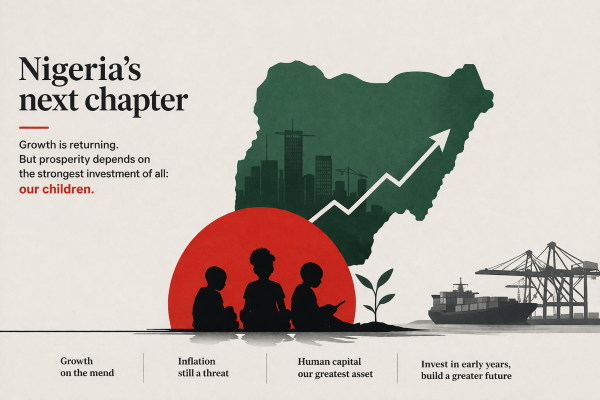 Nigeria’s macroeconomic story is beginning to tilt cautiously toward recovery. But beneath the improving headline numbers lies a deeper structural paradox: an economy stabilising at the top, while human development deficits widen at the base.
That is the central message from the latest Nigeria Development Update released by the World Bank, which projects a gradual economic rebound even as it warns that inflationary pressures and weak early childhood outcomes could undermine long-term prosperity.



A Recovery Taking Shape
Presenting the report in Abuja, Matthew Verghis struck a measured tone—optimistic, but far from celebratory.
Nigeria’s economy, he noted, is on a stabilisation path, supported by ongoing reforms, improved external balances, and a return to policy orthodoxy. The World Bank projects growth of 4.2% between 2026 and 2028, signalling a modest but meaningful rebound.
This recovery is underpinned by:
- Exchange rate reforms and improved FX liquidity
- Fiscal adjustments aimed at restoring discipline
- Renewed investor confidence in key sectors
Yet, the recovery remains fragile—highly exposed to external shocks, particularly energy price volatility linked to geopolitical tensions.
Inflation: The Silent Erosion
If growth offers hope, inflation remains the system’s most persistent drag.
Rising prices continue to erode purchasing power across households, weakening consumer demand and amplifying inequality. For many Nigerians, the gains of reform are yet to translate into lived economic relief.
Fiseha Haile emphasised that stabilisation without price moderation risks becoming politically and socially unsustainable.
The policy prescription is clear:
- Maintain tight monetary and FX discipline
- Improve market efficiency and competition
- Replace broad subsidies with targeted social transfers
- Reduce trade barriers to lower production costs
In essence, Nigeria must transition from stabilisation to transmission—ensuring reforms reach households, not just balance sheets.
The Deeper Crisis: Early Childhood Development
But the report’s most urgent warning lies outside traditional macroeconomic metrics.
Titled “Nigeria’s Tomorrow Must Start Today: The Case for Early Childhood Development,” the report identifies early childhood outcomes as Nigeria’s most critical long-term vulnerability—and opportunity.
The statistics are stark:
- 110 deaths per 1,000 children before age five
- 40% of children stunted
- Over 50% not developmentally on track before school
These are not just health indicators—they are economic signals.
According to Verghis, investments in early childhood development yield returns of 7–13% annually, through higher productivity, improved learning outcomes, and reduced long-term social costs.
Yet Nigeria’s performance remains uneven, with outcomes significantly worse in poorer households and northern regions—reflecting deep structural inequalities in access to:
- Maternal healthcare
- Nutrition
- Clean water and sanitation
- Early learning systems
Human Capital as Economic Strategy
The report reframes early childhood development not as a social policy issue, but as a core economic strategy.
Nigeria’s ambition to become a high-income economy, it argues, will depend less on resource endowments and more on human capital formation—starting from birth.
Efforts are underway.
In collaboration with the National Economic Council, state governments, and partners such as the Bill & Melinda Gates Foundation, Nigeria is developing a coordinated national framework for early childhood interventions.
The objective is to move from fragmented programmes to a holistic, lifecycle-based approach—supporting children from pregnancy through age five.
External Risks and Policy Imperatives
Even as reforms gain traction, the global environment remains uncertain.
The ongoing Middle East crisis continues to disrupt energy markets, with implications for oil revenues, inflation, and exchange rate stability—key variables for Nigeria’s recovery.
The World Bank’s recommendation is pragmatic:
- Treat oil windfalls as temporary gains, not permanent revenue
- Build fiscal buffers
- Prioritise targeted interventions over blanket subsidies
In short, discipline today is the price of stability tomorrow.
BRANDECONOMY INSIGHT
Nigeria’s economic trajectory is increasingly defined by a dual reality:
1. Macroeconomic Stabilisation vs Microeconomic Stress
While headline indicators—growth, reserves, fiscal metrics—are improving, household-level distress remains elevated, driven by inflation and weak income growth.
2. The Human Capital Deficit
Nigeria’s greatest economic risk is not oil volatility—but underinvestment in human development. A generation of undernourished, undereducated children represents a future productivity crisis.
3. Reform Fatigue Risk
Without visible improvement in living standards, public support for reforms could weaken, threatening policy continuity.
4. The Strategic Pivot Required
The next phase of Nigeria’s reform journey must shift from:
- Stabilisation → Inclusion
- Macro gains → Household impact
- Policy design → Policy delivery
The countries that achieve sustained prosperity are not those that grow fastest—but those that convert growth into human capability.
For Nigeria, the message is unmistakable:
economic reform must now meet social reality.