


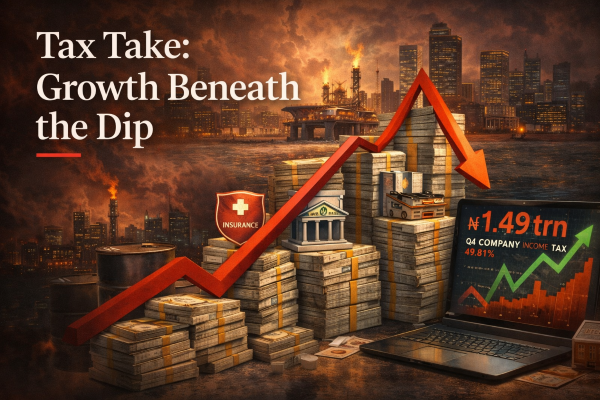
 Nigeria’s corporate tax engine showed signs of cooling at the close of 2025—though not of weakness. According to the latest release from the National Bureau of Statistics, Company Income Tax (CIT) collections for the fourth quarter settled at ₦1.49 trillion, marking a sharp 49.81 percent decline from the exceptional ₦2.96 trillion recorded in the preceding quarter.
At first glance, the contraction appears steep. In context, however, it reflects the volatility inherent in Nigeria’s fiscal cycle—where quarterly spikes are often driven by one-off settlements, exchange-rate adjustments and sector-specific windfalls.




Domestic vs Foreign: A Balanced Mix
Of the total, domestic companies contributed ₦819.83 billion, while foreign entities accounted for ₦668.21 billion—an almost even split that underscores the dual structure of Nigeria’s tax base.
This balance is significant. It suggests that while domestic economic activity remains the backbone of fiscal revenue, multinational and cross-border operations continue to play a decisive role in government coffers—particularly in sectors tied to energy, finance and extractives.
Sectoral Signals: Finance Leads, Industry Follows
The composition of tax contributions offers a clearer window into Nigeria’s economic pulse.
Financial and insurance activities emerged as the top contributor, accounting for 18.17 per cent of total CIT—reinforcing the sector’s outsized influence in a high-interest-rate environment. Manufacturing followed at 17.30 per cent, while mining and quarrying contributed 15.04 per cent, reflecting the continued relevance of Nigeria’s resource base.
Together, these three sectors form the fiscal tripod of the Nigerian economy: finance, industry and extractives.
At the margins, however, the Corporate Tax picture is more uneven. Accommodation and food services recorded a steep contraction, while household-based economic activities remained negligible in tax contribution—highlighting the persistent challenge of capturing value from the informal sector.
Growth Pockets—and Decline Zones
Beneath the aggregate numbers lies a tale of divergence.
Activities of extraterritorial organisations posted the strongest quarter-on-quarter growth, rising by 75.15 per cent—albeit from a low base. Education and real estate also recorded notable expansions, suggesting pockets of resilience in service-driven segments of the economy.
By contrast, sectors tied to consumption and informal labour—such as hospitality and household services—contracted sharply, reflecting the impact of inflationary pressures and weakened consumer spending.
Year-on-Year Resilience
Despite the quarterly decline, the broader trajectory remains positive. On a year-on-year basis, CIT collections rose by 13.38 per cent compared with Q4 2024—evidence that Nigeria’s fiscal capacity is expanding, albeit unevenly.
This divergence between quarterly volatility and annual growth encapsulates the current state of Nigeria’s economy: structurally improving, but tactically unstable.
The Fiscal Imperative
For policymakers, the message is clear. Sustained revenue growth will depend less on cyclical gains and more on structural reforms—broadening the tax base, improving compliance, and formalising economic activity.
In a country where large segments of economic output remain untaxed, the challenge is not merely to collect more—but to collect smarter.
BRANDECONOMY Insight
- Volatility Is Structural, Not Accidental
Quarterly swings in Corporate Tax reflect Nigeria’s dependence on episodic revenue drivers—FX adjustments, large corporate filings and sectoral shocks. - Finance Sector Dominance Signals Opportunity—and Risk
Banks and financial institutions are carrying a disproportionate share of tax contributions. While this boosts revenue in the short term, it exposes fiscal stability to sector-specific shocks. - Manufacturing’s Steady Climb
The strong contribution from manufacturing suggests gradual industrial traction—though still constrained by energy costs and infrastructure deficits. - Informal Economy Remains Untapped
Near-zero contributions from household economic activities highlight a persistent fiscal blind spot. Formalisation remains Nigeria’s biggest revenue opportunity. - Policy Focus Must Shift to Tax Efficiency
Beyond rates, Nigeria must prioritise compliance systems, digital tracking and inter-agency data integration to sustainably grow CIT collections.