

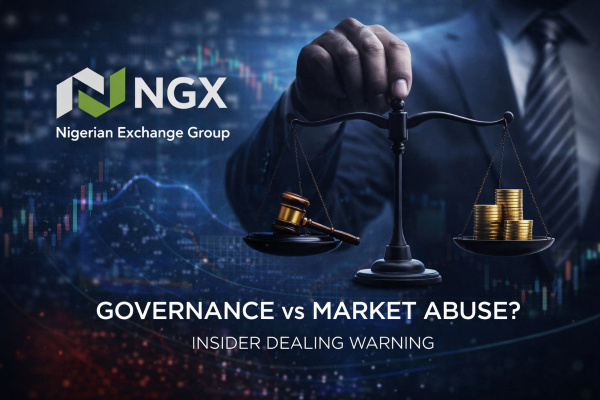
 Shareholder groups have renewed calls for stricter enforcement of corporate governance standards and tougher sanctions for insider trading following recent warnings issued by the Nigerian Exchange Ltd. (NGX) to three listed firms.
The NGX cautioned Sterling Financial Holdings Company Plc, Mutual Benefits Insurance Plc and Austin Laz & Company Plc for breaches of its Listings Rules relating to insider dealing. The Exchange confirmed that appropriate sanctions had been applied in line with its regulatory framework.




Moses Igbrude, President of the Independent Shareholders Association of Nigeria (ISAN), described compliance with governance rules as non-negotiable, stressing that regulatory infractions must attract meaningful consequences.
“When there are breaches, there must be consequences. Sanctions should not exist only on paper; they must be enforced in ways that deter future violations,” Igbrude said.
He argued that governance failures should not be treated as abstract corporate lapses. According to him, individuals responsible for decision-making must also be held accountable.
“A company is run by individuals. When there are governance failures, the individuals responsible should face sanctions. Holding only the company accountable is insufficient,” he added.
Igbrude suggested that penalties could range from monetary fines to suspension, removal from office, or licence withdrawal, depending on the gravity of the violation.
Bisi Bakare, National Coordinator of the Pragmatic Shareholders Association, described the development as troubling but necessary. She emphasised that insider trading undermines minority shareholders, distorts price discovery, and damages overall market credibility.
She called for enhanced surveillance systems capable of detecting suspicious trading activity in real time, as well as closer collaboration between the NGX and the Securities and Exchange Commission (SEC) to ensure that offenders face regulatory and legal consequences where appropriate.
Similarly, Boniface Okezie of the Progressive Shareholders Association of Nigeria urged regulators to escalate sanctions in cases of repeat violations, particularly against culpable directors rather than the broader corporate entity.
ISAN National Coordinator, Sunny Nwosu, described the warning as a step in the right direction but emphasised that consistency in enforcement would ultimately determine its effectiveness.
A Troubling Pattern
The latest warnings come amid persistent concerns about governance discipline within segments of Nigeria’s capital market.
Insider dealing—where privileged information is used for personal trading advantage—represents more than a compliance issue. It strikes at the core of market integrity. When insiders profit from non-public information, market confidence erodes, liquidity weakens, and retail investors retreat.
Nigeria’s capital market has made measurable progress in transparency reforms, technology upgrades, and regulatory alignment over the past decade. However, recurring governance lapses indicate structural weaknesses in internal controls, board oversight, and compliance culture within some listed entities.
The deeper concern is reputational. Markets thrive on trust. Once that trust is compromised, restoring it becomes significantly more expensive than preventing the breach in the first place.
BRANDECONOMY Insight
The NGX’s action signals an important regulatory assertion—but it also highlights a broader inflection point.
For Nigeria’s capital market to attract long-term institutional capital—both domestic and foreign—governance enforcement must be predictable, transparent, and uncompromising. Warnings alone are insufficient if not followed by visible consequences.
Three strategic shifts are critical:
- Personal Accountability: Directors and senior executives must bear financial and professional consequences for insider breaches.
- Technology-Driven Surveillance: AI-powered trade monitoring should become standard practice to detect abnormal patterns instantly.
- Coordinated Enforcement: NGX and SEC must move from administrative warnings to coordinated regulatory prosecution where necessary.
Nigeria’s capital market ambition—to deepen liquidity, increase listings, and compete regionally—depends on the credibility of its governance framework. Insider dealing is not merely a rules violation; it is a structural threat to market development.
If consistently enforced, this moment could mark a reset toward stronger governance discipline. If inconsistently handled, it risks reinforcing perceptions of regulatory leniency.
The difference will define investor confidence in the coming cycle.