NCC Says Faster Fibre-to-the-Home Drive Is Critical to Nigeria’s Digital Economy Growth and $1 Trillion Economy Target

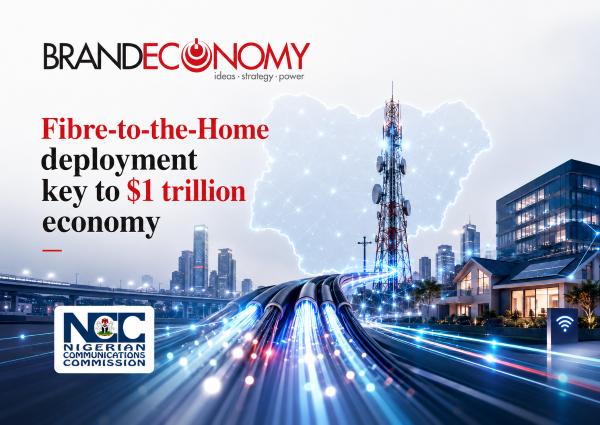 Nigeria’s telecom regulator is pushing for a faster nationwide Fibre-to-the-Home rollout, warning that the country’s ambition to build a $1 trillion economy will be difficult to achieve unless high-capacity broadband reaches homes, businesses, schools, hospitals and industrial clusters.
Nigeria’s digital economy is expanding rapidly, but the infrastructure beneath that growth is still uneven.


The country now has more than 154 million internet subscriptions, broadband penetration has risen beyond 55 per cent, and monthly data consumption has climbed into the millions of terabytes. Nigerians are streaming, trading, learning, working remotely, making digital payments, using cloud platforms and adopting AI-enabled services at a pace that would have been difficult to imagine only a decade ago.
Yet the quality of connectivity remains one of the country’s most important development constraints.
While mobile broadband has widened access, fixed fibre connections to homes and offices remain limited. The Nigerian Communications Commission, NCC, says Nigeria has only about 265,000 Fibre-to-the-Home, FTTH, subscriptions—a small number for a country with a population exceeding 200 million and an economy seeking to compete in digital services, financial technology, artificial intelligence, cloud computing and export-led innovation.
For Dr Aminu Maida, Executive Vice Chairman and Chief Executive Officer of the NCC, that gap represents both a risk and an opportunity.
Speaking virtually at the Association of Telecommunications Companies of Nigeria, ATCON, Critical Conversation Forum on FTTH in Lagos, Maida said accelerated fibre deployment was essential to Nigeria’s ambition of building a $1 trillion economy.
The forum, held under the theme, “Addressing Challenges, Strengthening Standards and Ensuring Sustainable FTTH Deployment in Nigeria,” brought the industry’s attention to the most important question in Nigeria’s connectivity future: how quickly can national broadband infrastructure move from backbone capacity to reliable last-mile access?
From Mobile Access to Digital Productivity
Nigeria has made substantial progress in mobile connectivity. Smartphones and mobile data have become the primary gateways to communication, financial services, entertainment, commerce and social interaction for millions of citizens.
But a $1 trillion economy cannot be built on mobile access alone.
High-capacity fixed broadband is increasingly central to the type of productivity Nigeria wants to create. It supports cloud-based enterprises, remote professional services, software development, digital education, health technology, advanced manufacturing, enterprise systems, data centres, smart logistics and AI-enabled applications.
A reliable FTTH connection can transform how a household works, learns and earns. It can enable a freelancer in Lagos to serve clients abroad, help a school deliver digital learning, allow a clinic to access specialist support, and give a small business the bandwidth to process payments, manage inventory and sell through multiple online channels.
For corporate Nigeria, the stakes are even higher.
Banks need resilient connectivity for digital transactions. Manufacturers need it for supply-chain management and smart production systems. Media companies need it for high-definition content distribution. Technology firms need it for cloud services, cybersecurity and software deployment. Real estate developers increasingly need it to make estates and commercial complexes competitive.
The issue, therefore, is no longer whether Nigerians can connect to the internet.
The issue is whether they can connect at the speed, reliability and quality required to create serious economic value.
The Last-Mile Problem
A fibre backbone can run across a state, city or local government area without necessarily reaching the people and businesses that need it most.
That is the difference between national connectivity and usable connectivity.
Nigeria’s digital infrastructure challenge is increasingly a last-mile challenge: connecting the national backbone to homes, schools, hospitals, offices, factories, markets and public institutions.
Maida noted that the country’s fixed broadband market remains underdeveloped despite the rapid growth of mobile data usage.
This presents a major market opportunity, but it also reveals a critical weakness. A country with millions of active internet users should not have such a limited number of direct fibre connections to households and enterprises.
FTTH offers advantages that mobile networks cannot always guarantee at scale. Fibre can deliver higher speeds, lower latency, greater reliability and the capacity needed for data-intensive applications.
That is particularly important as Nigeria moves deeper into cloud computing, artificial intelligence, digital entertainment, telemedicine, remote work, e-commerce and connected public services.
The future of broadband is not simply about getting more people online. It is about ensuring that people can do more once they are online.
Barriers Slowing Fibre Expansion
The NCC has identified several obstacles holding back faster fibre rollout across Nigeria.
These include Right-of-Way charges, multiple permits, access denials, vandalism, theft, inconsistent deployment standards and weak coordination among government agencies, telecom operators, construction companies and local communities.
For investors, these challenges are not minor administrative inconveniences. They directly affect the cost and viability of broadband projects.
A fibre operator may be ready to invest in a city or community, but deployment can be delayed by excessive charges, overlapping approvals, unclear planning rules and unpredictable levies. In some cases, cables are damaged during road construction or other public works. In others, infrastructure is vandalised or stolen after deployment.
The result is a cycle of higher costs, slower rollout and reduced private-sector appetite.
Maida said 13 states had waived Right-of-Way charges, while 16 had adopted the National Economic Council’s recommended rate of N145 per linear metre.
That progress is encouraging. But it also highlights the uneven policy environment that operators still face across the federation.
Nigeria’s states need to recognise that the long-term economic value of fibre infrastructure is far greater than the immediate revenue that can be generated from permit charges.
A state that makes fibre deployment easier becomes more attractive to technology companies, digital entrepreneurs, property developers, data centres, service providers and investors. It also gives its citizens better access to education, healthcare, commerce and public services.
Project BRIDGE and the National Backbone Ambition
The Federal Government’s Project BRIDGE is expected to play a major role in addressing the country’s fibre deficit.
The initiative is designed to deploy about 90,000 kilometres of fibre optic cable as part of a broader national backbone strategy intended to improve connectivity across Nigeria’s 774 local government areas.
The project has the potential to deepen broadband penetration, improve redundancy, reduce wholesale capacity costs and support more inclusive digital access.
But national backbone infrastructure is only the beginning.
The true economic value will emerge when that backbone is connected to homes, enterprises and institutions.
A fibre route passing through a community is useful. A fibre-enabled school, hospital, business district, university campus, industrial estate and residential neighbourhood is transformational.
That is why the NCC’s push for FTTH deserves attention.
Nigeria needs the digital equivalent of a national highway system. But it also needs local roads that connect people and businesses to that highway.
Without last-mile access, the country risks building infrastructure that remains technically impressive but economically underutilised.
Fibre Cuts and the Cost of Digital Fragility
Telecommunications infrastructure is increasingly becoming a national economic asset.
When fibre cables are damaged, digital payments can fail, banks can experience service disruptions, businesses can lose transactions, schools can be cut off from online platforms and public institutions can struggle to communicate.
The NCC said telecom operators recorded more than 27,000 fibre cuts, 27,000 access denials and over 4,000 theft incidents in 2025.
These figures underline the fragility of Nigeria’s digital infrastructure.
The designation of telecom infrastructure as critical national infrastructure is therefore important. However, the designation must be backed by enforcement, improved planning, stronger security cooperation and more responsible treatment of fibre assets during road works and construction activity.
The protection of fibre infrastructure should not be seen as a telecom-sector issue alone.
It is a banking issue. A business-continuity issue. A national-security issue. A productivity issue. And increasingly, a citizen-welfare issue.
ATCON Calls for Common Standards and Infrastructure Sharing
ATCON President, Mr Tony Emoekpere, also called for stronger infrastructure sharing, common deployment standards and better collaboration across the telecom ecosystem.
His intervention goes to the heart of the cost challenge.
Where operators duplicate infrastructure unnecessarily, deployment costs rise. Where standards differ, maintenance becomes difficult. Where installation quality is poor, consumers suffer outages and service providers spend more on repairs.
A more coordinated industry approach can lower costs and improve quality.
Infrastructure sharing should not reduce competition. It should make competition more efficient.
Nigeria does not need every operator to dig the same roads repeatedly. It needs a system that allows multiple players to use shared ducts, poles, routes and wholesale capacity while competing on service quality, price, innovation and customer experience.
That is the model that can help broadband become more affordable for households and businesses.
Market Implications: A New Digital-Infrastructure Investment Cycle
The push for FTTH creates a wide investment opportunity across Nigeria’s digital economy.
The opportunity goes beyond cable laying.
It extends to fibre installation, civil engineering, ducting, network maintenance, home routers, customer-premises equipment, cybersecurity, data centres, cloud services, managed Wi-Fi, enterprise connectivity, smart-building systems and digital-property development.
For telecom operators and internet service providers, the challenge will be to build viable business models that can connect more homes and businesses at prices consumers can afford.
For property developers, fibre readiness is becoming a strategic selling point. New housing estates, commercial buildings, industrial parks and mixed-use developments that lack broadband planning may quickly become less attractive to tenants and investors.
For state governments, the opportunity lies in positioning their cities as digital-investment destinations.
States that simplify permits, protect infrastructure and integrate fibre into urban planning will be better placed to attract technology-enabled businesses and create new jobs.
Brand Implications: Connectivity Is Now a Trust Promise
Broadband quality is no longer merely a technical matter. It is increasingly a brand issue.
Consumers judge telecom brands by speed, reliability, installation time, customer support and service consistency. Businesses judge providers by uptime, security, response time and the ability to support mission-critical operations.
A slow or unreliable connection can damage trust just as quickly as poor customer service.
The winners in Nigeria’s next broadband phase will be the providers that combine network quality with transparent pricing, credible customer support and a clear understanding of the needs of homes, SMEs, enterprises and institutions.
For real estate brands, fibre-ready properties will become a marker of modernity and value.
For banks, fintechs, schools, hospitals and manufacturers, resilient connectivity will increasingly become part of their own customer promise.
Investor Relevance
For investors, FTTH is a long-term infrastructure play with significant upside.
Demand for bandwidth is rising across virtually every sector of the economy. AI, cloud services, streaming, e-commerce, digital learning, fintech, remote work and enterprise software are all increasing the value of reliable fibre connections.
However, the investment case depends on policy certainty.
Investors will be watching the rollout of Project BRIDGE, the speed of Right-of-Way reforms, the success of infrastructure-sharing models, the security of deployed assets and the pace of household and enterprise adoption.
The strongest opportunities may emerge not only for telecom operators, but also for data-centre operators, cloud providers, property developers, technology companies, construction firms, cybersecurity providers and equipment suppliers.
BRANDECONOMY Insight
Nigeria’s digital-economy ambitions will be constrained if its broadband strategy stops at mobile connectivity.
The country has built a huge consumer internet market. It now needs to build the fixed infrastructure that can turn that demand into deeper productivity, stronger businesses, better public services and globally competitive digital industries.
The NCC is right to emphasise Fibre-to-the-Home.
Project BRIDGE can create the national backbone. But the true breakthrough will come when fibre reaches the last mile: the homes where people work, the schools where children learn, the hospitals where lives are saved, the factories where goods are produced and the businesses where jobs are created.
Nigeria’s race to a $1 trillion economy will not be won only through policy ambition.
It will be won through the digital pipes that allow millions of Nigerians to create, trade, innovate and compete at global speed.