
Nigeria’s Lithium, Copper and Bauxite: The New Blueprint for Green Industrialisation
Critical Minerals, Energy Transition and Industrial Strategy

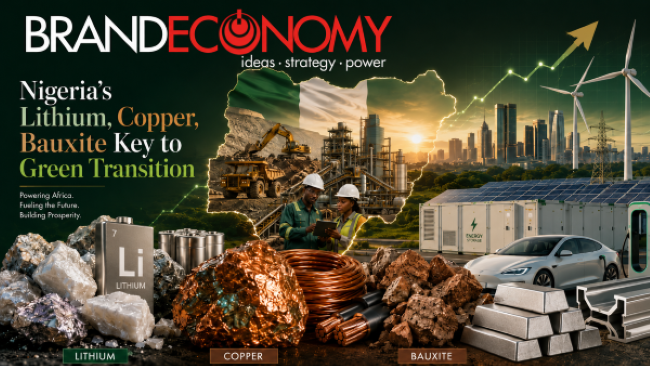 Nigeria’s newest critical-minerals report arrives with an important proposition: the country’s lithium, copper and bauxite potential is unusually well aligned with the materials needed for solar power, battery storage, electricity networks and electric mobility.
That alignment matters. But it is not yet a guarantee of national prosperity.




The report, presented to the Minister of Solid Minerals Development, Dr Dele Alake, by the Council for Critical Minerals Development in the Global South, maps Nigeria’s projected demand for solar photovoltaic systems, battery storage and electric vehicles against its mineral endowment, supply patterns and trade position. Its central argument is simple: Nigeria can use its own mineral wealth not merely to supply the global green transition, but to build part of its own.
This is a potentially consequential shift in the national conversation. For decades, Nigeria has treated solid minerals as an underdeveloped alternative to oil. The green transition now offers a more strategic possibility: minerals as the foundation of a new industrial system involving renewable energy, power infrastructure, processing plants, manufacturing, technical skills, exports and regional influence.
The key question, however, is not whether Nigeria possesses promising solid minerals. It is whether it can convert geological possibility into bankable projects, productive factories, credible supply chains and shared prosperity.
That is where the real work begins.
The New Green Arithmetic
The global energy transition is turning the world from a fuel-intensive economy into a materials-intensive one.
Oil, gas and coal powered the industrial age because they could be burned. The next industrial age will depend increasingly on minerals that can store electricity, transmit power, reduce emissions and support modern infrastructure.
Lithium sits at the centre of rechargeable battery systems used in electric vehicles and energy-storage projects. Copper is indispensable for cables, transformers, grid connections and electrical equipment. Bauxite is the ore from which alumina and aluminium are produced; aluminium is essential for power transmission, solar structures, electric mobility and many clean-energy components.
The International Energy Agency says lithium demand rose by almost 30 per cent in 2024, driven largely by electric vehicles, battery storage, renewables and electricity networks. Yet the same market has become more volatile: lithium prices fell sharply after earlier surges, while future supply gaps remain a concern, especially for copper and lithium.
For Nigeria, this produces a rare strategic overlap.
The country needs more solar energy, stronger transmission and distribution networks, battery-storage systems, cleaner transport and decentralised electricity for homes, farms, clinics, businesses and industry. At the same time, it possesses mineral prospects that may help provide inputs into these systems.
This is the essence of the report’s importance: Nigeria could become both a consumer and producer within the clean-energy economy.
That is a far more compelling proposition than being a mere exporter of rocks.
Why Lithium, Copper and Bauxite Matter
Lithium: The Battery Economy Opportunity
Lithium has become synonymous with the battery revolution. It is central to many rechargeable batteries used in electric vehicles, portable devices, battery-energy storage systems and renewable-power installations.
Nigeria’s opportunity is not automatically to become a global battery-cell giant overnight. Battery production is highly sophisticated, capital-intensive and dominated by established supply chains in Asia, North America and Europe.
But Nigeria can build a credible pathway.
The first stage is geological certainty: proving deposit size, grade, metallurgical characteristics and recoverability. The second is beneficiation and refining. The third is building domestic industries around battery packs, energy-storage assembly, electric two- and three-wheelers, solar-storage systems and recycling.
A country does not need to manufacture everything at once. It needs to capture the right parts of the value chain in sequence.
Nigeria’s greatest early lithium opportunity may lie in linking processing to its rapidly expanding solar and storage market, rather than simply exporting raw ore into foreign battery supply chains.
Copper: The Quiet Backbone of Electrification
Copper may not attract the glamour attached to lithium, but it is arguably more fundamental to the energy transition.
Every serious electrification programme requires copper. Solar farms require electrical connections. Distribution networks require cables. Transformers, substations, inverters, charging infrastructure and industrial equipment all require significant copper inputs.
The IEA identifies copper and aluminium as the two principal materials used in wires and cables for expanding electricity grids.
For Nigeria, this creates an especially practical opportunity.
The country’s electricity challenge is not only about generating more power. It is also about transporting, distributing and reliably delivering that power. A mineral strategy that connects copper development to cable manufacturing, transformer assembly, grid expansion and renewable-energy infrastructure would be far more valuable than a strategy built only around copper exports.
Nigeria’s green transition will be built not only in mines, but in factories making conductors, cables, poles, transformers, switches, inverters and storage systems.
Copper is the mineral bridge between geology and electricity access.
Bauxite: The Aluminium Question
Bauxite is sometimes discussed too casually in green-transition conversations. It is not a battery mineral in the way lithium is. Its relevance comes through aluminium.
Aluminium is used in solar-panel frames, transmission infrastructure, electric vehicles, buildings, battery enclosures and a broad range of clean-energy technologies. It is particularly important to power networks because aluminium, alongside copper, is widely used in transmission lines and cables.
But bauxite presents Nigeria with a more complex industrial decision.
Mining bauxite is one thing. Refining it into alumina is another. Smelting alumina into aluminium is yet another, and it requires enormous volumes of reliable and competitively priced electricity.
The IEA notes that aluminium production is highly electricity-intensive, making access to low-emission and affordable power central to competitiveness.
Nigeria must therefore avoid the temptation of announcing every possible downstream ambition at once.
A smarter approach would be to identify the most feasible points of entry: bauxite beneficiation, alumina production where viable, recycled aluminium, solar mounting structures, electrical conductors, modular construction materials and aluminium-based components for the domestic and West African markets.
The objective should not be industrial vanity. It should be industrial viability.
The Strategic Leap: From Mining Policy to Manufacturing Policy
The most important phrase in the new report is not “critical minerals.”
It is mineral-to-manufacturing localisation.
That phrase signals a shift from extractive thinking to industrial thinking.
Nigeria has already indicated that new mining licences should increasingly be linked to local value-addition plans. The Federal Government has argued that local processing, rather than raw mineral export, should become central to mining-sector policy.
That is the correct direction. But policy intent must now become policy architecture.
Nigeria needs an industrial ladder for each priority mineral:
| Mineral | Immediate Opportunity | Medium-Term Opportunity | Long-Term Opportunity |
| Lithium | Exploration, testing, beneficiation | Refining, battery-pack assembly, storage systems | Battery materials, recycling, e-mobility ecosystem |
| Copper | Exploration, concentration, trading formalisation | Cable, conductor and electrical-component production | Grid-equipment and regional electrification supply hub |
| Bauxite | Mining, beneficiation, logistics | Alumina, recycled aluminium, solar structures | Aluminium products, transmission materials and advanced fabrication |
This is how Nigeria should think about critical minerals: not as isolated deposits, but as industrial ecosystems.
Nigeria’s Domestic Demand Could Become Its Greatest Advantage
The strongest mineral strategy is not built around exports alone.
It is built around a home market.
Nigeria’s NDC 3.0 commits the country to a major expansion of renewable energy, including a target for renewables to account for half of the national power mix by 2030, alongside wider electricity access and electric-mobility ambitions.
That creates a domestic demand story for solar panels, storage batteries, cables, transformers, charging systems, mini-grids, electric buses, electric tricycles and industrial energy solutions.
The strategic advantage is clear.
If Nigeria imports every solar module, cable, battery, inverter, mounting structure and electric-mobility component, it will remain a large consumer of the green economy but a small producer within it.
But if Nigerian minerals increasingly feed Nigerian factories, Nigerian infrastructure and Nigerian clean-energy projects, the country can retain more jobs, technology, tax revenue, skills and industrial learning.
The green transition then becomes not merely an environmental agenda, but an economic-development agenda.
The Missing Ingredient: Investable Geological Data
Nigeria’s mineral potential is encouraging. But investors do not finance headlines; they finance verified resources.
A promising mineral occurrence is not the same thing as a commercially viable deposit.
Before major capital can flow, investors need credible information on ore grade, deposit size, recovery rates, infrastructure access, environmental conditions, security, logistics, land rights, community relations and export routes.
The Nigerian Geological Survey Agency notes that resource evaluation requires drilling and technical assessment to establish grade and tonnage to standards that can support economic and statutory decisions.
This means Nigeria’s critical-minerals push must be built on five foundations:
- Internationally credible geological data
- Transparent licensing and beneficial-ownership disclosure
- Reliable power, transport and water infrastructure
- Clear environmental and community safeguards
- Long-term offtake and processing agreements
Without these, mineral wealth remains speculative.
With them, mineral wealth becomes financeable.
The Investor Case: Strong Promise, Serious Due Diligence
Nigeria’s critical-minerals story is attracting more attention because it sits at the intersection of three major trends: global supply-chain diversification, Africa’s industrialisation push and Nigeria’s need to diversify beyond oil.
Government officials have said that reforms around local processing and licensing have helped attract processing-project commitments, while the sector’s revenue performance has improved.
But investors should remain disciplined.
The best projects will be those that can answer the following questions convincingly:
- Is the mineral resource independently verified?
- Is the mine licence secure and transparent?
- Can the ore be processed economically?
- Is reliable electricity available?
- Is there railway, road or port access?
- Are local communities genuine partners?
- Is the project exposed to illegal mining or security disruption?
- Is there a long-term buyer for the final product?
- Can the project meet global traceability and ESG expectations?
- Can it survive commodity-price cycles?
Lithium prices have already demonstrated the danger of commodity euphoria. The IEA says prices for several battery metals weakened sharply even as long-term demand remained strong, creating uncertainty for investment decisions.
Nigeria must therefore build for resilience, not excitement.
A strong mine with weak infrastructure is not a strong investment. A processing plant without reliable power is not a competitive factory. A licence without community trust is not a durable asset.
The Brand Implications: Nigeria Must Sell Trust, Not Just Minerals
Critical minerals are becoming a global brand category.
Manufacturers, governments, development banks and institutional investors increasingly care about where minerals come from, how they are mined, who benefits, what emissions are created and whether supply chains are traceable.
Nigeria’s minerals must therefore carry a reputation for more than abundance.
They must stand for:
- Responsible extraction
- Transparent licensing
- Safe labour conditions
- Community benefit-sharing
- Environmental restoration
- Ethical supply chains
- Low-carbon processing
- Strong traceability systems
- Local value addition
The future premium will not belong only to countries with minerals. It will belong to countries with trusted minerals.
Nigeria’s country brand in this sector should be built around a simple proposition:
Nigeria: a trusted African platform for responsibly sourced minerals and green industrial production.
That is more powerful than “Nigeria has lithium.”
Many countries have minerals. Few will build credible systems around them.
What Nigeria Must Do Next
The report should now become an implementation agenda.
1. Publish a National Critical Minerals Resource Book
Nigeria needs a credible, investor-facing document showing priority minerals, verified prospects, geology, infrastructure, licensing status, processing opportunities and environmental safeguards.
2. Establish Mineral-to-Manufacturing Corridors
Mining locations should be linked deliberately to industrial clusters, processing plants, renewable-power zones, rail infrastructure, ports and technical institutions.
3. Prioritise Processing Before Full Manufacturing
Nigeria should not rush into expensive battery-cell or aluminium-smelting ambitions without the right economics. The country should first identify profitable stages of beneficiation, refining, semi-processing and component assembly.
4. Build Dedicated Clean-Power Solutions
Mineral-processing projects should be supported by reliable power arrangements, including gas-to-power, solar, hydro, storage and industrial micro-grids where feasible.
5. Tie Public Procurement to Local Content
Government solar, mini-grid, power-transmission and e-mobility programmes should progressively favour local cables, mounting structures, battery packs, electrical components and fabricated materials.
6. Create a National Mineral Traceability Platform
Nigeria needs a credible digital chain-of-custody system covering licences, production, transport, community agreements, exports and environmental compliance.
7. Protect Host Communities
Mining communities should not become sacrifice zones for green industrialisation. They must benefit through jobs, infrastructure, equity participation, local procurement, environmental remediation and enforceable development agreements.
8. Build Skills Before the Boom
Nigeria needs geologists, metallurgists, process engineers, battery technicians, mining lawyers, environmental scientists, logistics specialists, ESG auditors and industrial designers.
9. Develop West African and Global South Partnerships
The Council for Critical Minerals Development in the Global South was created to encourage South-South cooperation, beneficiation and manufacturing linkages. Nigeria should use that platform to build processing, trade, technology and investment alliances across Africa, Asia, Latin America and the Middle East.
BRANDECONOMY Insight
Nigeria’s lithium, copper and bauxite story is not fundamentally a mining story.
It is a national competitiveness story.
The country has an opportunity to move from exporting mineral potential to building industrial capacity. But the window will not remain open forever. Global supply chains are being redesigned rapidly. Refining capacity is highly concentrated. Commodity prices are volatile. Technology is evolving. And countries that organise their infrastructure, policy, capital and institutions fastest will capture the greatest value.
Nigeria should not aim merely to become another source of raw materials for foreign factories.
It should aim to become a serious African base for responsible mineral processing, clean-energy infrastructure, component manufacturing and green industrial innovation.
The winning formula is straightforward:
Prove the resources. Build the infrastructure. Process locally. Manufacture selectively. Protect communities. Earn global trust.
That is how minerals become national advantage.