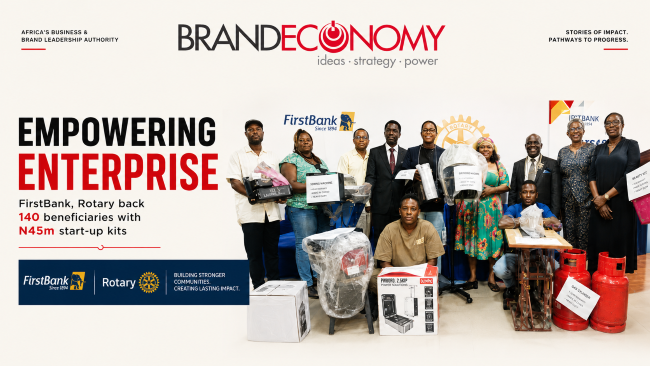
 A partnership between FirstBank and Rotary International District 9111 has delivered vocational start-up equipment valued at more than ₦45 million to 140 beneficiaries from Lagos and Ogun states—turning skills acquisition into a more practical route to livelihoods, small-business creation and local economic resilience.
Nigeria’s employment challenge is often discussed in the language of large numbers: unemployment, underemployment, inflation, poverty, skills gaps and the rising cost of living.

But for many households, economic progress begins with something much smaller and more immediate: a sewing machine, a grinding machine, a set of hairdressing tools, a gas burner, a baking mixer or the basic equipment needed to turn a learned skill into a dependable source of income.
That was the practical logic behind a community empowerment intervention by FirstBank of Nigeria Limited and Rotary International District 9111, which distributed vocational start-up kits worth more than ₦45 million to 140 beneficiaries in Lagos.
The recipients, drawn from Lagos and Ogun states, received equipment across a range of trades, including sewing machines, grinding machines, hair dryers, make-up kits, toolboxes, gas burners and cylinders, bread and cake mixers, and other tools designed to support small-scale enterprise.
The initiative is more than a donation story. It speaks to a wider economic reality: Nigeria’s growth challenge will not be solved by formal employment alone. It will also be shaped by how effectively the country helps skilled people become business owners, service providers, employers and contributors to their local economies.
For FirstBank and Rotary, the goal is to ensure that vocational competence does not end at the point of training because the individual lacks the capital equipment needed to begin.
From Skills to Livelihoods
Many Nigerians have acquired vocational skills but remain unable to translate them into income because they cannot afford the first essential tool of their trade.
A trained tailor without a sewing machine remains dependent on another person’s workshop. A baker without an oven or mixer cannot build a customer base. A trained hairdresser without dryers and kits may have the skill but not the means to monetise it. A technician without tools may remain locked out of the market.
This is the gap the FirstBank-Rotary intervention seeks to address.
Speaking at the empowerment programme in Lagos, Mr Musiliu Olokodana, Acting Head of Retail Business in FirstBank’s SME Banking Department, reaffirmed the bank’s commitment to supporting Micro, Small and Medium Enterprises.
He said the partnership with Rotary International District 9111 had supported more than 400 artisans with vocational tools over the past five years.
According to Olokodana, the latest distribution reflects FirstBank’s broader commitment to entrepreneurship, financial inclusion and community development.
He urged the beneficiaries to treat the equipment as business assets rather than short-term windfalls, using them to build enterprises that can strengthen household income and create wider economic value.
“Beyond the numbers, every sewing machine, grinding machine, hairdressing kit and work tool presented today represents renewed hope and a pathway to financial independence,” Olokodana said.
That framing is important.
The difference between social intervention and sustainable empowerment lies in what happens after the handover. The goal is not merely ownership of an item. It is the creation of cash flow, customer relationships, savings, reinvestment, growth and, eventually, employment for others.
The MSME Question: Why Tools Matter
Nigeria’s MSME economy remains the country’s most important employment engine. Millions of people earn their living through informal and semi-formal businesses in tailoring, food processing, beauty services, repairs, catering, retail, crafts, logistics and other service-led trades.
Yet many of these enterprises begin with limited capital, weak access to credit, little formal financial history and no collateral for bank loans.
For a would-be entrepreneur, the first sewing machine or grinding machine can therefore be more valuable than a conventional loan. It removes an immediate barrier to entry, reduces the need for expensive borrowing and gives the recipient a tangible productive asset.
This is especially relevant in an economy where high interest rates, rising costs and weaker household purchasing power continue to make business start-up difficult.
The equipment distributed through the programme is intended to lower that first hurdle.
FirstBank said it would continue to support beneficiaries as their ventures grow through tailored financial products, advisory services and digital banking solutions. Olokodana noted that the bank provides access to savings products, payment solutions, capacity-building opportunities and business-support services for entrepreneurs seeking to expand.
The implication is that the intervention should not end with a ceremonial presentation. It should become a pathway into the formal financial system.
A beneficiary who begins with a tailoring machine can, over time, build transaction history, develop savings discipline, accept digital payments, access business advice and become eligible for more structured financial support.
That transition—from informal survival to bankable enterprise—is one of the most important development outcomes such initiatives can create.
Rotary’s Model: Equip, Monitor, Multiply
Rotary International District 9111 has placed strong emphasis on the productive use of the donated tools.
District Governor, Rotarian Henry Akinyele, advised beneficiaries not to sell the equipment, describing the items as seeds that could grow into sustainable enterprises if used with discipline and purpose.
“It is not enough just to give you these items. Today, we are sowing the seed,” Akinyele said. “I want you to see them beyond sewing machines, generators or grinding machines. When you plant a seed, it germinates.”
The metaphor is fitting.
A sewing machine is not only a machine; it can become a fashion business. A cake mixer can become a home bakery. A toolbox can become a repair service. A grinding machine can serve a neighbourhood market. Each tool contains the possibility of recurring income—if it is managed well.
Rotary District 9111 Governor-Elect, Mrs Bukola Bakare, said the 140 beneficiaries were selected through the district’s 85 clubs, trade unions and a screening process designed to identify people who had received vocational training but lacked the equipment to begin work.
She said the programme had introduced a one-year monitoring mechanism involving follow-up meetings, phone contact and unannounced visits.
That monitoring framework is a critical feature of the initiative.
Too many empowerment programmes fail because distribution is treated as the end point. A more serious intervention measures utilisation, income growth, customer acquisition, savings habits, business survival and the ability of beneficiaries to create jobs for others.
Bakare said the beneficiaries should see the tools as a route to improved livelihoods, family support and enterprise expansion—not as assets to be sold for immediate consumption.
“They are expected to use them for their daily livelihoods so that in another year or two, they will also be able to empower somebody else,” she said.
That is the multiplier effect every grassroots enterprise programme should aim for.
The Public-Sector and Skills-Development Link
Mrs Olaide Oladunjoye, Director and Head of Vocational Studies at the Lagos State Agency for Mass Education, represented the agency’s Director and Head, Mrs Oluwakemi Kalesanwo, at the event.
She commended Rotary International District 9111 for supporting trainees and community members with tools that could convert learning into practical enterprise.
Kalesanwo’s position, delivered through Oladunjoye, reinforces the connection between skills acquisition, self-reliance and community development.
Vocational education is often undervalued in public discussion. Yet it remains one of the fastest pathways through which young people, women, displaced workers and low-income households can enter productive economic activity.
Nigeria needs graduates, professionals and technology specialists. But it also needs skilled artisans, service providers, makers, repairers, caterers, designers and entrepreneurs with the tools to earn a living.
The strongest economy is not one where everyone seeks a salary. It is one where more people can create value, offer services, employ others and build resilient local businesses.
Brand Implications for FirstBank
For FirstBank, the programme strengthens an institutional brand that has long been associated with enterprise, financial inclusion and national development.
The bank’s participation goes beyond a corporate social-responsibility gesture. It reinforces a more strategic proposition: that financial institutions have a role in helping to build the productive base from which future customers, depositors, borrowers and business leaders emerge.
A woman who receives a hairdressing kit today may become a digital-banking customer tomorrow. A tailor who begins with one machine may later require merchant payment tools, savings products, insurance, working-capital support and payroll services.
This is how financial inclusion becomes commercially meaningful.
The strongest brands are not those that merely advertise support for small businesses. They are those that show up at the point where enterprise begins and remain relevant as those businesses grow.
For FirstBank, the partnership also helps humanise the banking brand. It connects the institution with visible stories of aspiration, economic dignity and local transformation.
Market Implications: Enterprise Is a Local Economic Infrastructure
The programme also highlights an important market truth: MSME support is not peripheral to the economy. It is central to it.
When small enterprises gain tools and customers, they create demand for raw materials, logistics, energy, packaging, mobile payments, business services and local retail. They also reduce household vulnerability by widening income sources.
A single empowered tailor may buy fabrics from local traders, hire an apprentice, use mobile transfers, pay rent, support family members and sell into a wider community. That activity creates a web of economic relationships.
The challenge is scale.
Nigeria needs more interventions that combine tools with training, access to markets, digital payments, bookkeeping, mentorship, affordable finance and post-distribution monitoring.
Equipment opens the door. Business systems keep it open.
BRANDECONOMY Insight
The most effective poverty-reduction programme is not always a cash transfer or a headline-grabbing grant.
Sometimes, it is a properly targeted productive asset placed in the hands of someone who already has the skill and determination to use it.
FirstBank and Rotary International District 9111 have recognised that difference.
By equipping 140 beneficiaries with practical tools, the partnership is helping to move people from training to earning, from dependence to enterprise and from aspiration to ownership.
The true measure of success will come in the months ahead: how many businesses survive, how many customers are served, how many jobs are created and how many beneficiaries become employers or empower others.
That is when a start-up kit becomes more than equipment.
It becomes economic infrastructure at the grassroots.