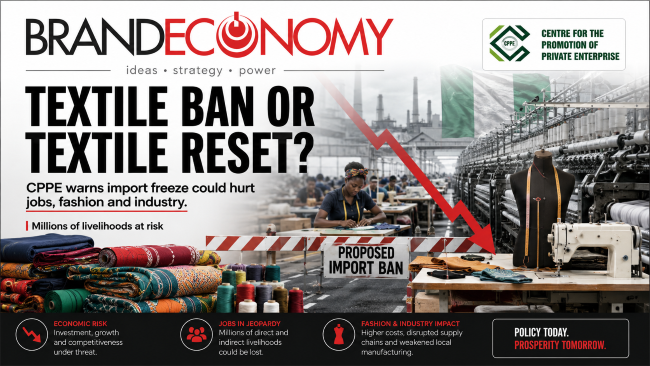
 The Senate wants a five-year protection window for Nigeria’s struggling textile industry. But the Centre for the Promotion of Private Enterprise says a blanket import ban may damage the larger fashion, garment, furniture and interior-design value chains that depend on fabrics to create jobs and value.
Nigeria’s textile industry needs revival. But it may not need a blunt import ban.




That is the central warning from the Centre for the Promotion of Private Enterprise, CPPE, following the Senate’s resolution urging the Federal Government to impose a five-year ban on imported textile fabrics as part of an effort to revive domestic cotton farming and local textile mills.
The Senate’s objective is understandable. Nigeria once possessed a more vibrant cotton, textile and garment chain, with industrial clusters in places such as Kaduna and Kano supporting factory employment, farming communities and related commerce. The decline of that ecosystem has weakened local production, increased dependence on imported materials and left an important industrial opportunity largely underdeveloped.
But CPPE Chief Executive Officer, Dr Muda Yusuf, believes an outright prohibition could produce unintended consequences: fabric shortages, higher costs, increased smuggling, weaker customs revenue and pressure on millions of Nigerians whose livelihoods sit downstream of textile manufacturing.
In a statement issued in Lagos, Yusuf argued that Nigeria’s textile crisis is fundamentally a competitiveness problem—not simply an import problem.
“The core problem lies in production economics rather than import penetration,” he said. “An import ban addresses the symptom while leaving the underlying causes unresolved.”
That distinction goes to the heart of the policy debate.
Nigeria can protect an industry temporarily. But it cannot legislate it into competitiveness.
The Senate’s Aim: Give Local Mills Room to Recover
The Senate resolution, sponsored by Senator Sunday Katung, seeks a protected period in which Nigerian cotton farmers and textile manufacturers can rebuild capacity, expand output and regain market share.
The ambition is not misplaced.
A stronger local textile sector could support cotton cultivation, ginning, spinning, weaving, dyeing, garment production, logistics and retail. It could create jobs, reduce foreign-exchange demand and deepen Nigeria’s industrial base.
The challenge is that protection works only when it is linked to a credible recovery plan.
A ban can limit competition at the border. It cannot, by itself, solve high electricity costs, costly finance, outdated machinery, weak cotton yields, unreliable logistics, inconsistent policy or illegal inflows through porous borders.
Without fixing those constraints, import restrictions could simply shift pressure from domestic mills to the businesses and consumers that rely on fabric as an input.
The Downstream Economy at Risk
Yusuf’s strongest argument is that textile fabrics do not exist only as finished consumer goods. They are also productive inputs.
Tailors, fashion designers, garment makers, uniform suppliers, embroidery businesses, bridal-wear specialists, fabric merchants, stylists, retailers, furniture makers and interior decorators all depend on the availability, variety and affordability of textiles.
According to CPPE estimates, Nigeria’s fashion, garment-making and tailoring ecosystem is worth about ₦10 trillion and supports roughly 10 million livelihoods. The organisation also puts the furniture and interior-design segment, which relies heavily on upholstery and furnishing fabrics, at about ₦7 trillion.
Those figures should be understood as CPPE industry estimates rather than official national accounts. But the direction of the argument is difficult to dismiss: the downstream value chain is large, diverse and highly employment-intensive.
Nigeria’s fashion economy derives value not only from fabric itself, but from design, cutting, tailoring, embroidery, styling, branding, merchandising, photography, retail and digital commerce.
In many cases, the highest domestic value is added after a textile fabric enters the country.
An import ban introduced before local mills can meet demand for quantity, quality, range and price could therefore harm the very creative and small-business economy Nigeria is trying to grow.
Why the Textile Industry Declined
Nigeria’s textile industry did not decline because of one factor.
It has been weakened by a long list of structural pressures: high energy costs, poor transport infrastructure, scarce and expensive long-term credit, obsolete machinery, weak access to modern technology, insecurity in cotton-growing communities, inconsistent policies and persistent smuggling.
These are not problems that disappear when imports are prohibited.
A mill that cannot access stable electricity will still face high costs. A factory with ageing equipment will still struggle with productivity. A manufacturer paying expensive interest rates will still find it difficult to finance inventory and expansion. A cotton farmer facing insecurity, poor seedlings and uncertain offtake will still hesitate to plant at scale.
The policy question, therefore, is not whether Nigeria should support local textiles. It should.
The real question is whether support should begin with a border closure or with a credible industrial recovery programme.
Tariffs Have Not Yet Delivered the Desired Revival
CPPE notes that imported fabrics already face substantial import charges, including duty and adjustment taxes that it estimates at between 35 per cent and 45 per cent.
Yet that tariff wall has not restored the competitiveness of domestic producers.
That should prompt reflection.
If existing protection has not produced a major revival, then simply intensifying protection may not address the underlying economic problem. It may instead raise prices for downstream users while leaving local mills unable to provide the full range of materials the market requires.
A successful industrial policy must do more than discourage imports. It must help local firms become better producers.
That means lower energy costs, improved logistics, modern machinery, affordable finance, stronger quality standards, reliable raw-material supply and effective action against smuggling.
The Cotton Question: No Textile Renaissance Without Fibre
No serious textile revival can happen without rebuilding cotton production.
Nigeria’s cotton value chain has been weakened by low yields, limited access to improved seeds, inadequate mechanisation, poor irrigation, insecurity and weak links between farmers and buyers.
Yusuf has called for a renewed domestic cotton strategy built around improved seedlings, mechanised cultivation, extension services, stronger security and guaranteed offtake arrangements.
That approach deserves attention.
Farmers will plant more cotton when they have confidence that the crop can be sold at a viable price. Mills will invest when they can rely on consistent cotton supply. Banks will lend when the value chain has clearer contracts, better data and stronger risk management.
This is where policy should become more practical: not merely banning fabrics at the port, but rebuilding the supply chain from farm to fibre, mill to market.
A Better Route: Protect Competitiveness, Not Inefficiency
CPPE is proposing a more targeted industrial response.
Its recommendations include a dedicated Textile Competitiveness Fund financed from textile-related import revenues; lower-cost, longer-tenor financing for manufacturers; technology-upgrade support; stronger border enforcement; improved industrial infrastructure; and a greater role for the Bank of Industry.
The organisation also recommends that government become a strategic buyer of locally made textiles and garments through uniforms for the military, paramilitary agencies, schools and public institutions.
That may be one of the most practical interventions available.
Government procurement can create predictable demand for local producers. But it must be tied to quality standards, dependable delivery and transparent contracting. Public institutions should not be forced to buy inferior products. Rather, local manufacturers should be supported to meet the standards that large institutional buyers require.
The most effective protection is not permanent shelter from competition. It is a path to becoming capable of competing.
Market Implications: A Test for Trade and Industrial Policy
The textile-import debate highlights a wider tension in Nigerian economic policy.
On one side is the desire to protect domestic industry, conserve foreign exchange and create jobs. On the other is the need to avoid supply shortages, inflation, smuggling and damage to businesses that rely on imported intermediate inputs.
Both concerns are legitimate.
A poorly sequenced import ban could disrupt fashion production, push up the cost of clothing and furnishings, create artificial scarcity and reward illicit trade. A failure to support local mills, however, would prolong the country’s dependence on imported fabrics and leave a potentially important industrial sector underdeveloped.
The most sensible route is phased, evidence-led and conditional.
Government should establish measurable milestones for domestic capacity: output volumes, quality levels, cotton availability, pricing, employment, power reliability and product diversity. Only when these benchmarks are met should deeper restrictions be considered.
This would shift policy from symbolism to performance.
Brand Implications: “Made in Nigeria” Must Mean Quality, Choice and Reliability
Nigeria’s fashion industry is one of its most visible cultural exports.
From Lagos Fashion Week to indigenous textiles such as adire, aso-oke, akwete and isi agu, Nigerian creativity already has global appeal. But local fashion brands need a dependable supply of fabrics that enable quality, originality and timely delivery.
A textile policy that raises costs or limits choice could weaken designers’ ability to compete.
Conversely, a successful domestic textile revival could become a powerful national-brand opportunity. Nigerian fabrics could serve not only local consumers but also diaspora markets, African trade corridors and global buyers seeking culturally distinctive products.
The goal should be a “Made in Nigeria” textile identity associated with quality, innovation, ethical production, contemporary design and dependable supply—not merely a protectionist label.
Investor Relevance
For investors, the textile sector presents both risk and opportunity.
The risk lies in policy uncertainty, high operating costs, foreign-exchange exposure, weak infrastructure and the possibility of abrupt trade restrictions that disrupt supply chains.
The opportunity lies in a properly structured value-chain revival.
Potential growth areas include cotton farming, ginning, spinning, weaving, dyeing, technical textiles, garment production, industrial uniforms, local fashion brands, furniture upholstery, textile recycling, e-commerce and export-focused African design.
The businesses most likely to benefit from a smarter policy framework will be those with clear supply chains, energy solutions, strong product quality, access to affordable finance and the ability to serve both institutional and consumer markets.
Investors should watch for more than a headline ban. They should look for evidence of policy execution: cotton acreage, energy support, financing disbursement, factory modernisation, procurement reforms and effective anti-smuggling enforcement.
BRANDECONOMY Insight
Nigeria does not need to choose between reviving textile mills and protecting fashion entrepreneurs.
It needs a policy framework that helps both thrive.
The Senate is right to focus attention on a sector that once employed thousands and can still support industrialisation, agriculture and exports. CPPE is equally right to warn that a blanket ban, introduced without adequate domestic capacity, could punish the wider value chain while failing to repair the mills it intends to save.
The winning strategy is not an overnight prohibition.
It is a textile reset: rebuild cotton production, modernise factories, lower energy and finance costs, reward quality, use government procurement strategically, enforce borders and protect intellectual property in the fashion economy.
Nigeria’s textile revival will not be woven at the ports.
It will be built in farms, factories, design studios, industrial clusters and retail markets across the country.