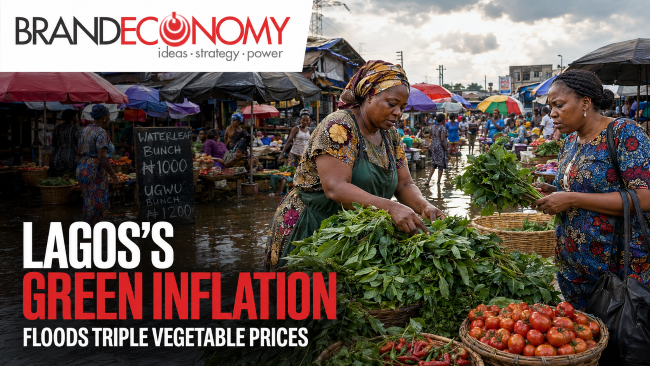
Heavy rainfall is destroying fragile vegetable farms, disrupting market supply and raising the cost of nutritious meals—exposing the climate vulnerability of Lagos’s food-distribution system.
 Heavy rainfall is destroying fragile vegetable farms, disrupting market supply and raising the cost of nutritious meals—exposing the climate vulnerability of Lagos’s
 The rainy season should ordinarily bring abundance to Lagos’s vegetable markets. Instead, excessive rainfall and flooding are destroying farms, reducing market supply and pushing once-affordable greens beyond the reach of many households.
Across Agege, Surulere, Tejuosho and other parts of Nigeria’s commercial capital, traders and consumers are confronting an uncomfortable contradiction: vegetables that should become cheaper during the wet season are recording steep price increases.




Mrs Nancy Umoh, an Agege resident, told the News Agency of Nigeria that a bunch of waterleaf recently cost her ₦3,000—three times the ₦1,000 she previously paid for the same quantity.
When she questioned the price, the trader explained that flooding had washed away more than half of her farm, severely reducing the volume available for sale. Umoh said consumers were now being forced to adjust their purchases to what increasingly constrained household budgets could accommodate.
Her experience illustrates how extreme weather travels rapidly from the farm to the family dining table. A flooded vegetable bed in Lagos or its surrounding agricultural communities quickly becomes a smaller portion of soup in Agege, Surulere or Mushin.
A Market of Uneven Losses
The effect is not uniform across the vegetable trade.
An unnamed trader, who described herself as a newcomer to the business, said she had not suffered significant disruption during her first three weeks of trading. She acknowledged, however, that traders who lost produce to flooding had increased their prices.
Her account also introduces a familiar market concern: genuine supply shortages can sometimes provide cover for speculative price increases by traders whose stocks were not directly affected.
Mrs Ebele Okafor, a fruit and vegetable trader in Tejuosho, offered another perspective. She had not recorded physical losses but was struggling with weak customer traffic because persistent rainfall discouraged shoppers from visiting markets.
Okafor, who sources her produce from Mile 12 Market, said the rainy season should normally favour vegetable harvesting. But farmers who fail to harvest promptly risk losing mature crops to flooding and waterlogging. Timely harvesting, she argued, could help moderate prices and reduce waste.
Her experience reveals the double squeeze confronting the market. Flooding may destroy produce and restrict supply, while heavy rain simultaneously reduces footfall and leaves some traders with perishable stock and fewer customers.
From Farm Damage to Food Inflation
Mrs Ruth Ike, a Surulere resident, said consumers were receiving smaller quantities despite spending more. Pumpkin leaves, commonly known as ugwu, could hardly be purchased for less than ₦500 in Lagos markets, she said, while some traders had no stock because their suppliers had suffered flood losses.
The development comes at a sensitive time for household finances. Nigeria’s food inflation rose to 17.52 per cent year-on-year in June 2026, while month-on-month food inflation accelerated to 3.75 per cent. Fresh pepper, tomatoes and several other food items were among the products contributing to the increase.
Vegetable inflation is particularly consequential because poorer households cannot postpone food consumption in the same way they can delay purchasing clothing, electronics or household appliances. When prices rise, families respond by reducing quantities, changing recipes or eliminating more nutritious ingredients.
The economic cost is therefore not limited to higher market prices. It may also appear later as poorer diets, greater health vulnerability and reduced household welfare.
Lagos’s Fragile Fresh-Food Chain
Vegetables are among the most climate-sensitive commodities in the food economy. They are easily damaged by waterlogging, difficult to store without cooling and highly exposed to transport delays.
Lagos depends on a complex network of peri-urban farms, interstate suppliers, transporters, wholesale markets and neighbourhood retailers. Mile 12 Market remains one of the most important aggregation points in that chain.
Yet inadequate drainage, limited cold-storage capacity, poor rural roads and weak access to weather information mean that disruption at any stage can quickly become a citywide price shock.
This is not simply a farming problem. It is an infrastructure and urban-resilience problem.
Government intervention must extend beyond clearing drains after floods. Lagos requires properly mapped agricultural zones, flood-resistant drainage around farming communities, improved market shelters, climate information services and storage facilities that can preserve harvested produce during periods of weak demand.
Market and Investor Implications
The crisis is creating commercial opportunities in climate-smart agriculture, greenhouse cultivation, hydroponics, cold-chain logistics, produce aggregation and agricultural insurance.
Investors who can help farmers produce vegetables under controlled conditions or move harvested crops more efficiently could reduce seasonal volatility while building scalable businesses around Lagos’s enormous food demand.
Retailers, restaurants and packaged-food companies also face brand implications. Quietly reducing portions or raising prices without explanation may damage consumer trust. Businesses should communicate supply pressures transparently, diversify sourcing locations and develop relationships with multiple farming clusters.
For supermarkets and food-service brands, reliable local sourcing could become a valuable brand proposition—especially if linked to farmer support, waste reduction and climate resilience.
BRANDECONOMY Insight
The tripling of waterleaf prices is more than a seasonal inconvenience. It is a warning about how climate shocks, inadequate infrastructure and weak storage systems are combining to create “green inflation” in Africa’s largest urban consumer market.
Rain should support food production, not turn basic vegetables into luxury purchases.
Lagos must begin treating fresh-food infrastructure as seriously as roads, housing and power. Without resilient farms, efficient drainage, cold storage and better market logistics, every heavy rainfall will continue to impose an unofficial climate tax on household meals.