

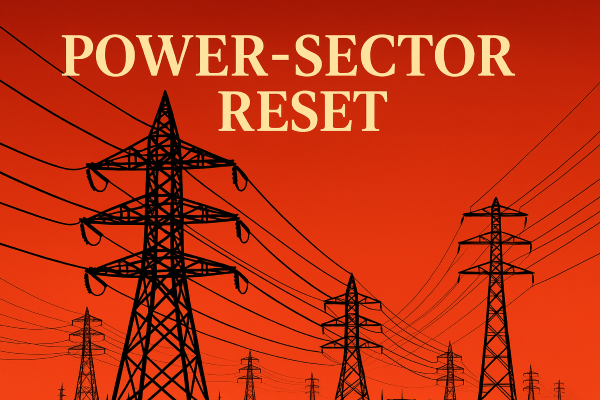
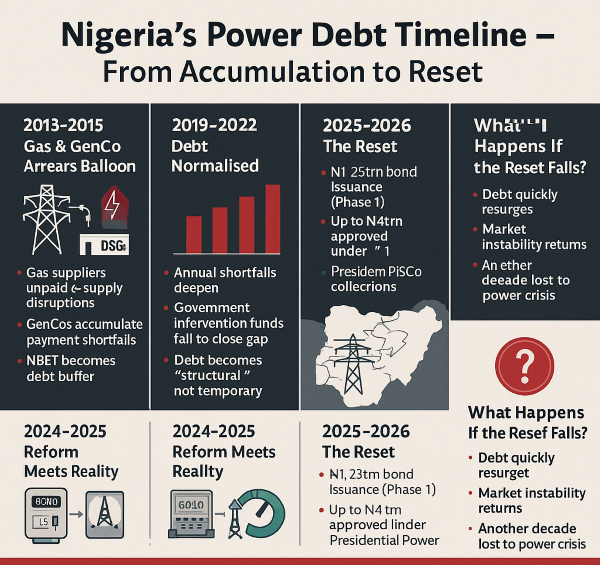
Nigeria’s long-troubled electricity market is entering its most consequential reset in over a decade as the Federal Government moves to raise ₦1.23 trillion within four months to clear verified debts owed to power generation companies (Gencos) and gas suppliers—a burden that has crippled investment, strained supply, and undermined grid reliability.
At the heart of the intervention is the Presidential Power Sector Debt Reduction Programme, a sweeping financial and structural response designed to stabilise liquidity, restore confidence, and prevent the recurrence of Nigeria’s chronic power-sector arrears.




Why This Matters Now
For years, unpaid obligations to Gencos and gas suppliers have created a vicious cycle: weak cash flow → underinvestment → declining generation → unreliable power. The Tinubu administration’s strategy is to break that cycle decisively—not with a bailout, but with a market reset.
The government plans to issue seven-year, fixed-rate bonds fully guaranteed by the Federal Government, with the first phase targeted for completion by Q1 2026. These bonds will be deployed strictly to settle validated and negotiated arrears, ensuring transparency and fiscal discipline.
From Legacy Debt to Market Credibility
According to officials coordinating the programme, settlement agreements already cover 100 per cent of the Phase 1 issuance, with remaining negotiations nearing conclusion. The goal is simple but ambitious: restore trust in Nigeria’s power market so operators can plan, invest, and expand generation capacity without the fear of unpaid receivables.
Crucially, the intervention is being executed alongside broader structural reforms—including tariff rationalisation, metering acceleration, service-level enforcement, and strengthened commercial discipline—to ensure new debts do not replace old ones.
“This is not a bailout; it is a strategic reset,” the programme’s coordinators emphasise. “Clearing verified arrears restores liquidity. Market reforms ensure sustainability.”
Investor Appetite Signals Renewed Confidence
The bond issuance was unveiled at a virtual investor forum attended by over 600 institutional participants, including banks, pension funds, insurance companies, asset managers, trustees, and family offices—an unusually strong turnout that signals renewed interest in Nigeria’s power-reform narrative.
Issuance is being handled by NBET Finance Company Plc, with a consortium of seasoned financial advisers and trustees, underscoring the programme’s scale and credibility.
What Changes for Nigerians
Beyond balance sheets and bond structures, the implications are tangible:
- Improved generation reliability as Gencos stabilise operations
- Stronger gas supply backed by timely payments
- Increased investment appetite across the value chain
- Better service delivery as liquidity constraints ease
Importantly, the government insists that clearing debt alone is insufficient. The parallel reforms—cost-reflective tariffs, improved collections, and tighter regulation—are designed to ensure the power sector finally operates on commercial, not political, logic.
The Bigger Picture
Approved by the Federal Executive Council in August 2025, the programme authorises up to ₦4 trillion in government-backed bonds, making it the largest coordinated financial intervention in Nigeria’s power-sector history. If executed with discipline, it could mark the moment Nigeria’s electricity market transitions from perpetual crisis management to long-term stability.
BRANDECONOMY Insight
This intervention is a litmus test for Nigeria’s reform credibility. Clearing legacy debt is necessary—but preventing its return is the real battle. The success of the ₦1.23trn issuance will ultimately be judged not by how fast arrears are paid, but by whether market discipline finally replaces subsidy logic. For investors, this is less about power generation and more about policy consistency. For Nigerians, it is about whether reforms finally translate into reliable electricity—the foundation of industrial growth, jobs, and economic dignity.