


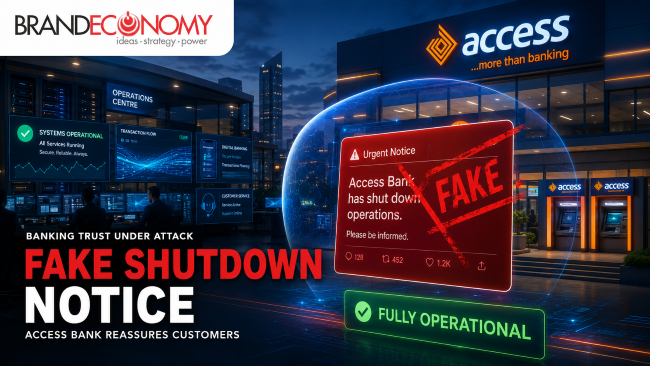
 Access Bank Plc has rejected as false a purported shutdown notice circulating across WhatsApp and social-media platforms, assuring customers that the institution remains financially sound and fully operational.
In a statement addressing the rumour, the bank said its operations and subsidiaries were functioning normally, with services continuing without interruption.




It urged customers, partners and other stakeholders to disregard the message and avoid forwarding it. The bank also advised the public to rely exclusively on information distributed through its official and verified communication channels.
Access Bank disclosed that it was working with relevant regulatory and law-enforcement agencies to identify those responsible for creating and disseminating the notice. It added that legal action would be pursued against anyone found culpable under applicable laws.
When misinformation becomes financial risk
A fake shutdown announcement involving a bank is not an ordinary piece of online misinformation. Banking is built on confidence: customers deposit money because they believe they can retrieve it when required, while counterparties transact on the assumption that the institution will continue meeting its obligations.
A sufficiently believable rumour can therefore alter behaviour before the truth catches up. Customers may attempt panic withdrawals, businesses could divert payments and social-media users may amplify anxiety without verifying the original claim.
Digital platforms make this risk more dangerous. A fabricated notice designed with a familiar logo, corporate colours and official-sounding language can travel through hundreds of WhatsApp groups within minutes. Repetition then creates an illusion of authenticity.
The economic danger is that a false story can begin producing real-world consequences. Even a healthy institution may face service pressure, reputational costs and unnecessary regulatory scrutiny when misinformation triggers widespread alarm.
Bank invokes Cybercrimes Act
Access Bank reminded the public that knowingly creating or distributing false digital information capable of causing serious public disorder could attract legal consequences. It cited Section 24 of the Cybercrimes (Prohibition, Prevention, etc.) (Amendment) Act, 2024.
However, legal liability should not be assumed merely because information is inaccurate. The 2024 amendment narrowed the relevant cyberstalking provision, particularly regarding knowingly false messages intended to cause a breakdown of law and order or threaten life. Whether a particular publication satisfies the statutory tests remains a matter for investigators and the courts. PLAC analysis
That distinction matters because strong action against deliberate financial misinformation must coexist with legitimate public commentary, customer complaints and responsible journalism.
Market and investor implications
For Nigeria’s financial system, the episode illustrates the emergence of misinformation as a form of operational and systemic risk.
Investors should assess banks through audited financial statements, regulatory disclosures, capital adequacy, liquidity, asset quality and officially reported developments—not anonymous broadcasts.
Banks, regulators and market operators must nevertheless recognise that online rumours can affect deposit flows, share-price sentiment and counterparty confidence. Rapid, coordinated rebuttals should therefore form part of financial-sector crisis-management planning.
The Central Bank of Nigeria and other regulators may need more structured protocols for responding when viral claims threaten confidence in a regulated institution.
Brand implications
Access Bank’s response reflects a core principle of modern reputation management: silence creates space for falsehood to consolidate.
Speed, however, is only one requirement. A financial brand must maintain verified channels that customers recognise before a crisis occurs. Regular anti-misinformation education, rapid-response teams, social listening and consistent fraud-reporting processes are now essential components of banking infrastructure.
Access Bank’s decision to engage regulators and law-enforcement agencies also signals that the bank regards institutional trust as an asset requiring active protection.
The bank thanked its customers, partners and stakeholders for their continuing confidence.
BRANDECONOMY Insight
In banking, confidence is not a soft public-relations metric; it is part of the institution’s economic capital.
The fake shutdown notice demonstrates how easily digital impersonation can challenge even a large financial brand. Banks must therefore defend trust with the same urgency applied to liquidity, cybersecurity and regulatory compliance.
The public also carries responsibility. Before forwarding a dramatic financial claim, pause, verify its source and consider the harm that one careless click could unleash.