
Tinubu’s New World Bank Loan Bid Raises Debt Sustainability Concerns

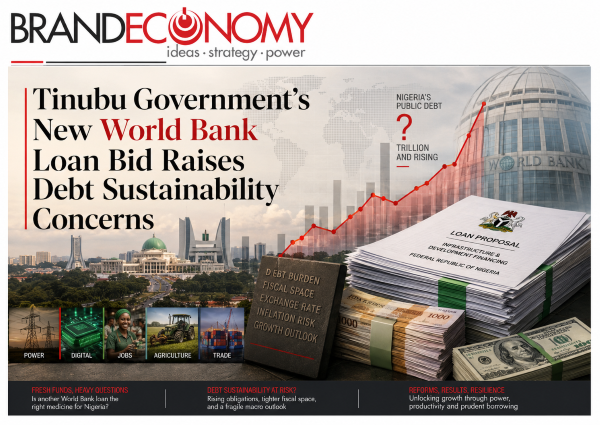 The Federal Government’s push for a fresh $1.25 billion World Bank facility may be framed as reform financing for investment, jobs and competitiveness, but it has reopened a more difficult national conversation: how much more can Nigeria prudently borrow before debt begins to weaken the very development it is meant to support? With public debt already standing at $110.97 billion at the end of 2025, the proposed facility arrives at a politically sensitive moment, just months before the 2027 election cycle gathers full force.
A New Loan, an Old Anxiety
Nigeria is again heading to the World Bank.


The Federal Government is seeking approval for a fresh $1.25 billion financing package under the proposed Nigeria Actions for Investment and Jobs Acceleration programme, a reform-support facility expected to move before the World Bank’s Board of Executive Directors on June 26, 2026.
The package is designed to support government efforts to widen access to finance, expand digital and electricity services, and improve competitiveness through reforms in taxation, trade and agriculture. In development language, it is a policy-backed growth facility. In public perception, however, it is another addition to a debt stock that many Nigerians already consider uncomfortably large.
That tension defines the story.
The Tinubu administration has argued repeatedly that Nigeria must mobilise concessional capital to support structural reforms, stabilise the economy and position the private sector for growth. Yet the country’s rising debt burden, weak revenue profile and continued dependence on borrowing have deepened concern that even relatively cheaper multilateral loans may become problematic if they fail to generate measurable economic returns.
This proposed facility therefore lands in a delicate policy space: Nigeria needs financing, but it also needs fiscal restraint.
What the World Bank Facility Is Meant to Do
The proposed Nigeria Actions for Investment and Jobs Acceleration facility is not a conventional infrastructure loan tied to one bridge, power plant or highway. It is a development policy financing operation, intended to support broad reforms that improve the operating environment for businesses and investment.
The programme is linked to a policy agenda covering:
- greater access to finance;
- stronger digital-economy infrastructure;
- wider electricity access;
- tax administration reforms;
- trade competitiveness;
- and agricultural productivity.
The broader logic is clear. Nigeria cannot sustainably grow jobs or raise productivity without lowering the cost of doing business. Businesses need finance. Households and firms need reliable electricity. Government needs better tax systems. Exporters need simpler trade processes. Farmers need more efficient value chains.
On paper, the facility aligns with the right development priorities.
The concern is not necessarily about the reform intentions. It is about the debt implications, execution discipline and political timing.
Debt Is Already High—and Rising
As of December 31, 2025, Nigeria’s total public debt stood at $110.97 billion, equivalent to roughly ₦159.28 trillion, according to the Debt Management Office. External debt accounted for $51.86 billion, while the balance came from domestic obligations.
Should the new $1.25 billion World Bank facility be approved and fully disbursed, it would push Nigeria’s debt profile higher still. At prevailing exchange-rate assumptions, the package is roughly equivalent to over ₦1.7 trillion, a significant addition even within the context of a large sovereign balance sheet.
The larger worry is not merely the size of the debt stock. It is the relationship between debt, revenue and repayment capacity.
Nigeria’s debt burden becomes more troubling because government revenue remains weak relative to spending needs. The country continues to face large demands in education, health, security, infrastructure and social protection. When borrowing rises faster than revenue and productivity, debt service begins to consume fiscal space that could otherwise support development.
That is why debt sustainability is no longer an abstract concern for economists. It is becoming a practical question for budgets, exchange rates, investor confidence and public welfare.
The Borrowing Case: Why Government May Still Want the Loan
The Federal Government’s argument is not difficult to understand.
Nigeria has a capital deficit. Infrastructure is inadequate. Power remains unreliable. Access to long-term finance is limited. The formal tax system is still being modernised. Agriculture needs scale and productivity. Industrial competitiveness is weak. If the country is to create jobs for a rapidly growing population, it must invest in the systems that make enterprise easier.
Multilateral loans from institutions such as the World Bank are generally cheaper and longer-tenored than commercial debt. They can therefore be more attractive than borrowing from global bond markets or raising costly domestic funding.
In that sense, borrowing from the World Bank can be fiscally more responsible than borrowing expensively elsewhere—provided the funds are tied to reforms that genuinely improve national output.
This is the administration’s best case.
It is effectively saying: Nigeria cannot austerity its way into prosperity. It needs strategic financing to unlock growth.
That is a valid position. But it is only persuasive if the borrowing yields visible improvements in economic performance.
The Sustainability Question: Will Reform Returns Match Debt Costs?
The key issue is whether Nigeria is borrowing to transform the economy or simply borrowing to keep reform programmes alive.
Debt becomes sustainable when it expands the country’s capacity to produce, export, earn revenue and attract investment. It becomes dangerous when it finances policy ambition without sufficient execution, or when results remain too diffuse to justify the burden.
The proposed World Bank package is linked to broad reforms, which means its impact may be less immediately visible than a completed road or power asset. The benefits are expected to come through better systems: improved tax compliance, stronger credit access, better electricity market performance, more productive agriculture and a more competitive trade regime.
Those are meaningful goals. Yet they are also difficult to measure quickly.
This creates a public trust problem. Citizens will hear about another loan today, while the benefits may arrive slowly, unevenly or invisibly. That gap between borrowing and felt impact fuels scepticism.
For the government, the challenge is therefore twofold:
- justify why the loan is needed;
- show, transparently, what results it produces.
A Large World Bank Pipeline Under Tinubu
The proposed facility would further expand the World Bank’s growing financing footprint under the Tinubu administration.
Publicly available reports indicate that between June 2023 and May 2026, World Bank approvals for Nigeria amounted to about $9.35 billion across power, education, healthcare, agriculture, social protection and reform financing. If the latest facility is approved, approvals linked to the administration’s period could climb to roughly $10.6 billion.
That volume of financing illustrates the scale of the government’s development ambition. It also explains why concerns are intensifying. Nigeria is not pursuing a one-off loan; it is operating within a broader cycle of multilateral support.
The unresolved question is whether this pipeline is producing a commensurate acceleration in growth, competitiveness and fiscal resilience.
If the answer is yes, the strategy may be defended. If the answer is unclear, the political and economic criticism will grow louder.
The 2027 Election Shadow
The timing of the loan matters.
The World Bank is said to have flagged elevated political and governance risks ahead of the 2027 election season, warning that sensitive reforms could be delayed, diluted or reversed under electoral pressure.
This is not a trivial observation.
Election cycles often distort economic decision-making. Governments become more sensitive to public anger, less willing to enforce painful reforms and more inclined to prioritise short-term political reassurance. That can weaken implementation of tax, subsidy, trade and public-finance reforms.
For Nigeria, the risk is that the government borrows in the name of reforms whose momentum becomes harder to sustain as politics heats up.
The proposed loan therefore does not merely raise fiscal questions. It raises credibility questions:
- Will the government maintain reform discipline through the election cycle?
- Will borrowed funds support long-term transformation or short-term policy management?
- Will debt rise faster than reform outcomes?
- Can the administration show measurable value before citizens lose patience?
These are the questions that now sit around the $1.25 billion facility.
Debt Without Trust Is Harder to Defend
Public concern over borrowing is also rooted in a historical deficit of trust.
Nigerians have seen debt rise before without a corresponding transformation in electricity, roads, jobs or public services. They have watched governments announce ambitious reforms, borrow against them, and later return for more financing with limited clarity on what earlier facilities achieved.
That history shapes public reaction today.
Even where the current facility is concessional and reform-oriented, the government must recognise that borrowing is no longer judged only by technocrats. It is judged by citizens asking basic questions:
- What exactly is the money for?
- What conditions are attached?
- How will success be measured?
- Who monitors implementation?
- What happens if reform targets are not met?
- How does this affect future taxes and debt service?
A more transparent borrowing culture is now essential.
Debt can be a development instrument. But secrecy around debt breeds suspicion, and suspicion weakens public support for even legitimate reform financing.
What Nigeria Should Demand Before Approval
A responsible national debate should not begin and end with “borrow” or “do not borrow.” The better question is: under what conditions should Nigeria borrow?
Before final approval, the government should place greater emphasis on five areas:
First, reform specificity. Nigerians need a clear breakdown of what policy actions the loan supports and how they improve growth, investment and jobs.
Second, debt transparency. The fiscal implications of the borrowing should be openly stated, including expected debt-service obligations over time.
Third, measurable outcomes. Performance indicators should not remain buried in technical documents. They should be translated into accessible public benchmarks.
Fourth, implementation timelines. Citizens and investors should know when to expect progress in finance, electricity access, digital systems, trade procedures and agricultural competitiveness.
Fifth, accountability. Oversight should not be limited to government agencies and lenders. Parliament, civil society, business groups and the media all have roles in monitoring execution.
The government’s borrowing case becomes stronger when the public can see the logic, the metrics and the guardrails.
BRANDECONOMY Insight
The Tinubu Government’s fresh $1.25 billion World Bank loan bid captures the central dilemma of Nigeria’s reform economy: the country needs capital to accelerate transformation, but its debt profile leaves increasingly little room for casual borrowing.
There is nothing inherently reckless about seeking concessional financing for finance, power, digital infrastructure, trade reform and agriculture. Those are precisely the sectors that can raise productivity and expand the economy’s capacity to create jobs.
But Nigeria’s borrowing problem is not just about the price of debt. It is about the quality of debt.
A cheap loan that produces weak outcomes is still poor borrowing. A large facility that deepens reforms, raises revenue capacity and supports private investment can be justified. The burden of proof now lies with government.
The debt stock is already substantial. Public trust is fragile. Elections are approaching. Reform fatigue is real. In such a moment, every new loan requires a higher standard of explanation and a stronger architecture of accountability.
The World Bank facility should therefore be judged by three questions:
Will it strengthen Nigeria’s productive economy?
Will it improve fiscal sustainability rather than weaken it?
Will the public be able to track the outcomes?
If the answer to all three is yes, the loan may become a useful instrument of development. If not, it risks joining the long list of borrowings that enlarged Nigeria’s obligations faster than they improved Nigerian lives.
Debt should build the future. It should not mortgage it.