

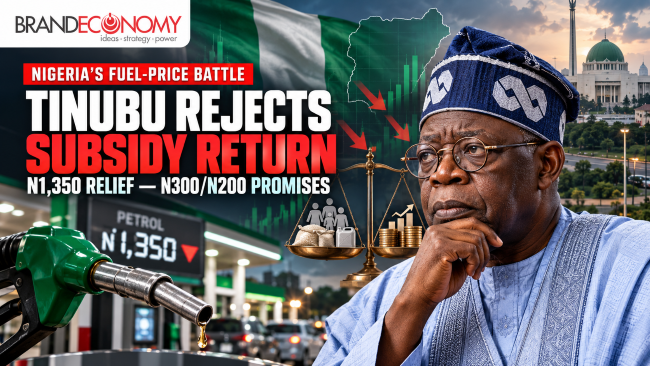
 The Federal Government is defending market-based petrol pricing while proposing temporary relief. But as Atiku Abubakar, Peter Obi, Donald Duke and Adewole Adebayo campaign on cheaper fuel, Nigeria’s 2027 contest is rapidly becoming a referendum on who should bear the real cost of energy.
 The Federal Government is defending market-based petrol pricing while proposing temporary relief. But as Atiku Abubakar, Peter Obi, Donald Duke and Adewole Adebayo campaign on cheaper fuel, Nigeria’s 2027 contest is rapidly becoming a
 The administration of President Bola Tinubu has rejected demands for the restoration of petrol subsidy, setting up a defining economic confrontation with leading opposition figures who are promising Nigerians substantially cheaper fuel ahead of the 2027 general election.
Finance Minister and Coordinating Minister of the Economy, Taiwo Oyedele, said in Abuja that returning to the former subsidy system could destabilise public finances, weaken the naira and ultimately produce an even more severe fuel-price crisis.




Instead, the government is proposing an intervention built around a price ceiling of approximately ₦1,350 per litre at the ex-gantry or landing-cost level, a 30-day discount at Nigerian National Petroleum Company Limited retail stations, expanded transport support and accelerated deployment of compressed natural gas infrastructure.
The distinction is crucial: ₦1,350 is not yet a guaranteed nationwide pump price. It is a proposed wholesale-cost ceiling, meaning retail prices could remain higher after transportation, financing, distribution and dealer margins are added.
That qualification reduces the political force of the announcement. For households already buying petrol at around ₦1,400 or more per litre, relief measured in a few dozen naira may appear modest beside opposition promises ranging from subsidy restoration to petrol at ₦200.
Government Draws Its Fiscal Red Line
According to Oyedele, the latest petrol-price surge followed a global energy shock that pushed Brent crude above $100 per barrel and disrupted shipping through the Strait of Hormuz.
The minister said petrol had consequently risen from approximately ₦830 to around ₦1,400 per litre. He estimated that restoring petrol to its pre-reform price could cost the federation more than ₦20 trillion annually, while fixing it at ₦500 could require over ₦16 trillion a year.
The government’s argument is that such expenditure would compete directly with salaries, pensions, infrastructure, education, healthcare and transfers to state and local governments.
Oyedele said subsidy removal released ₦15.8 trillion into the Federation Account between June 2023 and December 2025, with ₦10.4 trillion accruing to states and local governments.
That figure strengthens the fiscal case for reform but also sharpens the accountability question. Nigerians experiencing higher transport fares, food prices, school costs and declining disposable incomes are entitled to ask where the reform dividend is visible.
This is the strongest element of Atiku Abubakar’s criticism.
Atiku’s Promise—and the Missing Architecture
The African Democratic Congress presidential candidate has promised to restore petrol subsidy if elected, arguing that Nigerians have not received sufficient benefit from the money supposedly saved after its removal.
Atiku has also pledged to pursue those responsible for diverting subsidy funds.
His question—where did the savings go?—has considerable political potency. It speaks directly to households that were asked to endure immediate pain in exchange for future stability but have yet to experience a commensurate improvement in public services.
However, restoring subsidy is not, by itself, an economic programme.
Atiku has not adequately explained the proposed pump price, the eligible beneficiaries, the annual fiscal ceiling, the treatment of smugglers or the mechanism for preventing politically connected marketers from rebuilding the old claims industry.
Without those safeguards, restoration could recreate the same opaque system he promises to investigate.
Peter Obi: Removing Corruption Does Not Remove Cost
Peter Obi has adopted a more nuanced but equally demanding position. The Nigeria Democratic Congress presidential candidate says he would remove corruption from the subsidy system while retaining government support necessary to make fuel affordable.
His campaign has presented the proposal as a transparent, reformed intervention rather than a return to the former regime.
The argument correctly identifies corruption, inflated consumption figures, fraudulent claims and weak oversight as major defects of the old system. But eliminating fraud does not eliminate the underlying economic cost.
If petrol is supplied below its true production, importation or opportunity cost, somebody must absorb the difference. That payer could be the treasury, NNPC, domestic refiners, crude-oil producers, banks financing the supply chain or consumers through reduced government spending elsewhere.
Obi’s proposal therefore requires more than an anti-corruption pledge. It needs auditable consumption data, clearly identified beneficiaries, volume limits, independent reconciliation and a published fiscal ceiling.
It must also resolve an apparent change from his earlier support for removing an inefficient subsidy. A credible clarification would distinguish between universal petrol subsidisation and targeted support for public transportation, agriculture, emergency services and low-income households.
Donald Duke’s ₦300 Proposition
Former Cross River State governor and Peoples Redemption Party presidential candidate Donald Duke has promised to reduce petrol to about ₦300 per litre.
His proposal is to reserve part of Nigeria’s crude production for domestic consumption and price petroleum products locally using production costs rather than international market prices.
The attraction is obvious. Nigeria is an oil-producing country, and citizens reasonably question why domestic fuel prices should rise whenever international crude prices increase.
But crude produced in Nigeria still has an export value. Selling it to domestic refiners substantially below that value creates an opportunity cost, even if the transaction is not labelled a subsidy.
In practical terms, the government would surrender revenue it could have earned from exports. That lost revenue must be acknowledged in the budget, not hidden inside NNPC accounts or refinery supply arrangements.
Duke’s ₦300 promise could therefore be credible only if supported by transparent assumptions covering crude-production costs, refinery yields, taxes, logistics, distribution margins and the revenue forgone from discounted domestic crude.
Adebayo’s ₦200 Pledge
Adewole Adebayo, the Social Democratic Party presidential candidate, has gone further by promising petrol, cooking gas and aviation fuel at no more than ₦200 per litre within 12 months.
His plan includes reviving Nigeria’s existing refineries, encouraging modular refineries and reserving 450,000 barrels of crude daily for domestic processing. Revenue from diesel, naphtha, kerosene, heavy fuel oil and other refinery products would help support the controlled prices.
This is a more developed proposition than a simple price declaration, but several questions remain unresolved.
Refining petroleum locally can reduce freight, insurance, import-financing costs and some foreign-exchange exposure. It does not make crude oil free. Neither does refinery rehabilitation automatically guarantee efficient production, reliable evacuation, competitive distribution or freedom from political interference.
Adebayo must demonstrate that revenue from other refined products can sustainably close the petrol-price gap without making diesel, aviation fuel and industrial energy prohibitively expensive—or transferring losses to government-owned refineries.
The Arithmetic Behind the Promises
Using the government’s estimate of 50 million litres of petrol consumption daily, every ₦100 reduction below the economic price represents approximately ₦1.825 trillion annually.
Against a benchmark of roughly ₦1,400 per litre, a ₦300 price could create an illustrative annual gap of about ₦20.1 trillion. A ₦200 price could produce a gap approaching ₦21.9 trillion.
These are not forecasts. International crude prices, exchange rates, refinery yields, taxes and domestic production costs could change significantly. The calculation nevertheless illustrates the scale of the financing question.
Political promises do not abolish this gap. They merely decide who carries it.
Tinubu’s Intervention Is Not a Fully Free Market
The administration must also confront a contradiction in its own position.
It says subsidy will not return, yet it is offering tax and duty waivers, asking refiners and importers to absorb temporary price increases, providing discounts through NNPC stations and considering an excess-profit tax on energy companies.
These are interventions in the market. The material difference is that they could be limited, targeted and time-bound, unlike an open-ended universal subsidy.
But the proposed price-smoothing arrangement will require exceptional transparency. If refiners are expected to sell below immediate replacement cost and recover their losses later, the government must disclose how those losses will be measured, verified and settled.
Otherwise, Nigeria risks recreating subsidy arrears under another name.
Commercial banks and investors will also be watching. Downstream operators compelled to finance below-cost sales may experience working-capital stress, delayed cargoes and reduced supply. A poorly designed ceiling could produce scarcity even while the government attempts to prevent price escalation.
Similarly, an excess-profit tax could raise revenue for transport support but damage investment confidence if it is retrospective, discretionary or poorly defined.
Relief Must Move Beyond Announcements
The government says more than 120,000 vehicles now use CNG, supported by over 400 conversion centres, 96 refuelling stations and more than 550 buses.
Those are signs of progress, but they remain small relative to Nigeria’s transport market. CNG cannot yet provide immediate nationwide protection against petrol-price shocks.
The strategic fuel reserve proposed by the administration could strengthen energy security, while targeted transport vouchers and subsidised mass transit would be more efficient than subsidising every litre consumed by rich and poor alike.
However, delivery will determine public acceptance. Nigerians are unlikely to reward fiscal reform merely because its macroeconomic logic is sound. They will judge it by transport costs, food prices, wages, employment and the reliability of public services.
Market and Investor Implications
For investors, the most valuable outcome is not necessarily the lowest politically announced price. It is a transparent pricing system with predictable taxes, reliable crude supply, enforceable contracts and clearly funded consumer support.
Tinubu’s market-oriented framework remains more aligned with fiscal sustainability and private investment than an unlimited universal subsidy. Yet forcing companies to absorb losses without a credible settlement framework could undermine those advantages.
Opposition candidates, meanwhile, must demonstrate that their cheaper-fuel promises are compatible with currency stability, debt sustainability and continued investment in refining and distribution.
Cheap petrol financed through hidden losses is not cheap. The cost eventually returns through inflation, currency depreciation, public debt, unpaid contractors or weaker government services.
Brand Implications
Fuel affordability is becoming the defining brand contest of the 2027 election.
Tinubu’s brand proposition is discipline: endure difficult reforms today to avoid fiscal collapse tomorrow. Its weakness is that stability without visible household improvement begins to look like sacrifice without reward.
Atiku’s strongest brand message is accountability for subsidy savings, but his restoration pledge risks reconnecting him with a discredited system unless he publishes a controlled and transparent alternative.
Obi’s anti-corruption framing fits his political brand, but credibility will depend on proving that integrity can solve not only fraudulent claims but also the genuine cost of subsidised consumption.
Duke and Adebayo have offered the most memorable price points. Yet precision can become a reputational liability when the supporting arithmetic is missing. The closer Nigeria moves to the election, the more these promises will be judged as financial commitments rather than campaign applause lines.
BRANDECONOMY Insight
Nigeria’s real debate is not simply whether to subsidise petrol.
It is who should benefit, who should pay, how much the country can afford and whether the cost will appear transparently in public accounts.
Tinubu is right that the old subsidy regime was fiscally dangerous. His opponents are right that reform has not delivered sufficient relief to households.
The credible middle ground is a transparent energy-support framework: market-reflective commercial pricing, targeted transport assistance, auditable support for vulnerable households, competitive domestic refining and a clearly disclosed fiscal limit.
The candidate who can explain that compact—and publish the numbers behind it—will have the strongest answer to Nigeria’s cost-of-living crisis.