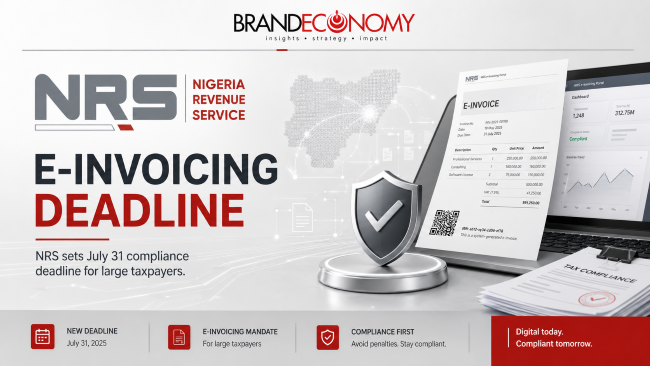
 The Nigeria Revenue Service has fixed July 31, 2026, as the final deadline for all large taxpayers to complete their transition to the national e-invoicing and Electronic Fiscal System, signalling a tougher phase in the Federal Government’s drive to digitalise tax administration and close revenue leakages.
The NRS e-invoicing deadline directive applies to companies with annual gross turnover of ₦5 billion and above. It follows a public notice issued on February 17 by the Chairman of the NRS, Dr Zacch Adedeji, requiring affected businesses to complete onboarding, system integration, testing and active transmission of invoices through the Merchant Buyer Solution platform.




Dare Adekanmbi, Special Adviser on Media to the NRS chairman, said the revenue authority had already commenced compliance monitoring to determine the level of adoption among large companies.
Businesses that fail to meet the deadline could face regulatory and enforcement action under applicable tax laws and regulations.
The NRS advised affected taxpayers to conclude all outstanding technical and administrative processes and begin transmitting invoices before the compliance window closes.
Compliance goes beyond registration
The July 31 NRS e-invoicing deadline is not satisfied merely by opening an account on the e-invoicing platform.
According to the NRS, full compliance requires companies to complete onboarding on the Merchant Buyer Solution, integrate their internal systems through approved Access Point Providers or Systems Integrators, conclude validation and testing, and begin transmitting invoices in accordance with prescribed standards.
Access Point Providers are responsible for securely transferring invoice data between businesses and the NRS platform, while Systems Integrators connect companies’ internal accounting or enterprise-resource-planning systems to the national e-invoicing infrastructure.
Taxpayers must also ensure that invoices received from suppliers are compliant and carry valid Invoice Reference Numbers.
This means the mandate creates obligations on both sides of a commercial transaction. A large company must not only issue compliant invoices but also scrutinise invoices submitted by vendors, contractors and other suppliers.
As a result, the reform could push e-invoicing requirements deep into corporate supply chains, including smaller businesses that transact with large taxpayers.
More than 1,000 companies already onboarded
Adekanmbi said more than 1,000 companies had complied with the requirements by the first quarter of 2026.
The figure suggests that a significant part of the large-taxpayer segment has begun adjusting its financial and technology systems. However, the renewed deadline indicates that some businesses still have outstanding integration, testing or transmission requirements.
For companies yet to complete the process, the immediate challenge will be coordinating tax, finance, information technology, procurement and compliance teams within a limited period.
Large organisations often operate multiple invoicing systems across branches, subsidiaries and product lines. Connecting those systems to a central government platform can require extensive data cleaning, software configuration, security testing and staff training.
Businesses that delay until the final days could face operational disruption, rejected invoices or difficulty completing transactions with compliant counterparties.
What e-invoicing changes
The Merchant Buyer Solution replaces conventional invoice exchanges with structured digital invoice data that can be transmitted, validated and monitored electronically.
For the NRS, the system should provide greater visibility into taxable transactions and create a more reliable trail for tax assessment, audit and enforcement.
For companies, e-invoicing could reduce manual processing, duplicate entries, lost documents and invoice disputes. It could also improve reconciliation between suppliers and buyers if the platform operates reliably.
However, the reform raises concerns around data security, system availability and implementation costs.
Large businesses will need to ensure that sensitive commercial information is protected and that invoice transmission does not become vulnerable to cyberattacks, technical failures or unauthorised access.
The NRS will therefore be judged not only by how firmly it enforces compliance, but by the stability, security and responsiveness of the platform.
Market and business implications
The mandate represents a major opportunity for financial-technology companies, accounting-software providers, enterprise-systems consultants, cybersecurity firms and approved integration specialists.
Demand is likely to rise for software upgrades, application programming interfaces, staff training, compliance reviews and technical support.
The reform could also reshape relationships between large companies and smaller suppliers. Vendors that cannot produce compliant invoices may face delayed payments or exclusion from major corporate supply chains.
This makes education and technical support essential. Large taxpayers may need to help strategic suppliers understand the new requirements rather than simply rejecting non-compliant invoices.
Investor relevance
For investors, stronger digital tax administration could improve revenue transparency and reduce the uncertainty associated with arbitrary or retrospective tax assessments.
A credible e-invoicing system may strengthen audit trails, improve voluntary compliance and help government widen its revenue base without relying only on higher tax rates.
But execution matters.
If the system produces repeated downtime, duplicated obligations or compliance costs disproportionate to the benefits, it could weaken the business environment and increase administrative pressure on companies.
Brand implications
For the NRS, the July 31 deadline is a test of its positioning as a modern, service-oriented revenue institution.
Firm enforcement can strengthen regulatory credibility, but taxpayers will also expect accessible support, clear guidelines and prompt resolution of technical problems.
For corporate brands, compliance is increasingly part of reputation management. Businesses that modernise early can position themselves as transparent, well-governed and digitally prepared.
Those that miss the deadline risk not only enforcement action but reputational questions about their internal controls and tax discipline.
BRANDECONOMY Insight
Nigeria’s e-invoicing reform could become one of the most consequential changes in corporate tax administration in recent years.
Its value lies in converting transactions into verifiable digital records, reducing opportunities for invoice manipulation and giving tax authorities a clearer view of commercial activity.
But technology alone will not create trust.
The NRS must deliver a secure, stable and predictable platform. Companies must treat implementation as an enterprise-wide transformation rather than a routine tax filing requirement.
July 31 is therefore more than a compliance deadline. It is the point at which Nigeria’s largest businesses are expected to enter a new era of real-time, technology-driven tax accountability.