

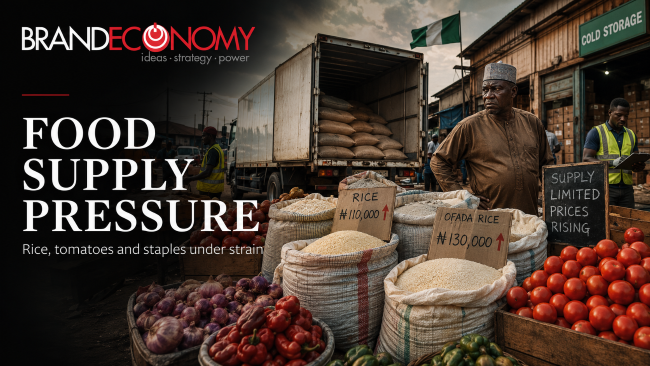
 Nigeria could face shortages of rice, tomatoes and other essential foods within the next three months unless governments, producers and investors urgently address declining cultivation, insecurity, logistics costs and post-harvest losses, the Organisation for Technology Advancement of Cold Chain in West Africa has warned.
The President of OTACCWA, Mr Alexander Isong, said weakening production prospects could further intensify food inflation and increase pressure on households already struggling with elevated living costs.



Isong, who is also Country Director of the Nigeria World Agriculture Forum, said projected declines in rice cultivation and output, combined with supply constraints affecting tomatoes, onions, peppers and grains, could reduce availability across major markets.
According to him, rice production is projected to fall by six per cent to about 8.3 million tonnes, while the area under cultivation may decline by seven per cent to approximately 4.2 million hectares.
“Rice is the big one,” Isong said, noting that international agricultural estimates also pointed to a year-on-year decline in production.
Tomatoes present another immediate concern. He said tight supply could persist until the late harvest season expected around October, while maize, millet and sorghum may also come under pressure because of reduced planting recorded in 2025.
A food-security warning with household consequences
For Nigerian consumers, food scarcity does not need to become absolute before it causes hardship.
Even modest reductions in supply can produce sharp price increases when transport systems are inefficient, household demand remains high and traders expect future shortages.
Rice, tomatoes, onions and peppers are central to everyday Nigerian diets. Rising prices for these products quickly affect family budgets, restaurants, caterers, schools and food-processing businesses.
The poorest households face the greatest exposure because they spend a larger proportion of their income on food. When prices rise, families may reduce meal quality, cut protein consumption or divert money from education, healthcare and transportation.
A three-month supply shock could therefore have wider social consequences, particularly in urban centres that depend heavily on food transported from distant producing areas.
Logistics are pushing food prices higher
Isong identified transportation as one of the strongest drivers of food costs.
Moving one tonne of grain from Kano to Lagos now costs about ₦70,000, compared with roughly ₦45,000 previously. On some routes, transport charges have doubled or tripled.
The impact extends beyond fuel prices. Poor rural roads increase journey times, damage vehicles and raise maintenance costs. Multiple levies, checkpoints, insecurity and limited backhaul opportunities also increase what transporters charge.
These expenses are eventually transferred to consumers.
The journey from farm to market is therefore becoming as important as the volume produced on the farm.
Nigeria may harvest adequate quantities in some regions, yet consumers still experience shortages because food cannot be moved quickly, cheaply and reliably.
Greater use of rail freight for grains and other agricultural commodities could reduce road congestion and lower the cost of long-distance movement. But rail services must connect efficiently with aggregation centres, warehouses and urban wholesale markets.
Insecurity is shrinking cultivated land
Isong also blamed insecurity in major food-producing areas, particularly in northern Nigeria, for declining output.
Thousands of farmers have been displaced, while others are unable to access their land safely or cultivate at the scale required.
This reduces planted acreage, weakens farm labour availability and discourages investment in fertiliser, irrigation and improved seeds.
Agricultural output, including rice and tomatoes, cannot be stabilised through input subsidies alone if farmers remain exposed to kidnapping, banditry, conflict and crop destruction.
Food security must therefore be treated as a national-security issue.
Protecting farming communities, securing rural transport corridors and restoring confidence in production zones are essential to expanding supply.
The economic consequences of insecurity extend far beyond the affected villages. Lower farm output raises prices nationwide and increases dependence on imports.
Nigeria remains heavily dependent on wheat imports
Isong said Nigeria would continue relying heavily on imported wheat, with expected imports of about 7.2 million tonnes.
That dependence exposes the country to foreign-exchange movements, global commodity prices, shipping costs and geopolitical disruptions.
A weaker naira makes imported wheat more expensive, affecting the prices of bread, noodles, biscuits and other widely consumed products.
Nigeria may not immediately eliminate wheat imports, but greater investment in local substitutes, improved wheat varieties, irrigation and food-processing technology could gradually reduce vulnerability.
Diversifying consumption towards locally available grains can also support domestic farmers, although such shifts require consumer education, product development and competitive pricing.
Post-harvest losses remain a national scandal
One of Nigeria’s greatest food-security failures occurs after crops have already been harvested.
Isong said the country loses between 30 and 50 per cent of some perishable produce before it reaches consumers.
Tomatoes, vegetables and fruits are particularly exposed because of inadequate cold rooms, poor packaging, limited refrigerated transport and weak processing capacity.
The result is a painful contradiction: farmers suffer losses while consumers pay high prices.
Reducing post-harvest waste could increase food availability without immediately expanding cultivated land.
Cold storage, aggregation centres, refrigerated trucks, drying facilities and local processing plants can preserve produce, stabilise prices and extend selling periods.
State governments should therefore invest in facilities close to farming communities rather than concentrating agricultural infrastructure in state capitals.
Growth figures have not translated into full markets
Isong noted that stronger agricultural Gross Domestic Product growth in the first quarter of 2026 had not yet translated into improved food availability.
Production gains, he said, were being offset by reduced planting, insecurity and post-harvest losses.
This distinction is important.
Agricultural GDP can rise because of higher prices, increased activity in selected subsectors or statistical changes, while consumers still face scarcity in specific staples.
Policymakers must therefore look beyond aggregate output figures and monitor actual market supply, farmgate prices, storage capacity and regional production conditions.
Food-security planning requires accurate, timely data.
Immediate actions before the next planting cycle
Isong called for coordinated intervention by the Federal Government, states, private businesses and development partners.
He urged authorities to accelerate the distribution of improved seeds, fertiliser, irrigation support and affordable credit ahead of the 2026/2027 planting season.
Since lower rice production is partly linked to reduced cultivation, farmers must be encouraged to expand planted acreage during the next cycle.
But intervention must be timely. Seeds or fertiliser delivered after the planting window offer little value.
Affordable finance should also be linked to real production plans, extension support, insurance and guaranteed market access.
Small farmers frequently avoid borrowing because crop failure, insecurity or unstable prices could leave them unable to repay.
Market implications
Shortages would affect food companies, retailers, restaurants, hospitality businesses and logistics operators.
Processors may face higher raw-material costs or reduced factory utilisation. Traders may require more working capital to hold inventory, while retailers could experience weaker demand as consumers cut purchases.
Conversely, the emerging challenge creates investment opportunities in cold-chain logistics, processing, warehousing, irrigation, agricultural insurance and farm-input distribution.
Businesses that can reduce waste or move food efficiently may capture significant value while helping stabilise supply.
Investor relevance
Nigeria’s enormous population guarantees strong long-term demand for food, but agricultural investment remains exposed to infrastructure, security and policy risks.
Investors require reliable land arrangements, predictable import and export rules, effective crop insurance and access to affordable energy.
Contract farming can provide processors with more dependable supply while giving farmers guaranteed buyers and technical support.
However, such arrangements must be fair and transparent to avoid shifting excessive risk to smallholders.
Brand implications
For the Federal Government, food affordability is one of the most visible measures of economic performance.
Consumers may not experience macroeconomic reforms through reserve figures or investment announcements. They experience the economy through the cost of rice, tomatoes, transport and household essentials.
For food brands, unstable supply creates both cost and reputational risks. Companies that suddenly reduce pack sizes, compromise quality or raise prices without clear communication may weaken consumer trust.
Brands that invest in local sourcing, storage and farmer partnerships can position themselves as contributors to national food resilience.
BRANDECONOMY Insight
Nigeria’s looming food shortage especially of rice and tomatoes, is not simply a production problem. It is a systems failure involving farms, security, roads, storage, finance, processing and market coordination.
The country often produces more than its distribution infrastructure can preserve and move.
That is why reducing post-harvest losses in rice and other food crops may be as important as increasing acreage.
Government must secure agricultural communities, lower logistics costs and deliver inputs before planting windows close. States must invest in aggregation and cold-chain infrastructure. Private investors must expand processing, storage and contract farming.
Nigeria cannot control rainfall, global commodity prices or every external shock.
But it can stop allowing large quantities of food to rot while consumers go hungry and prices rise.
The next three months should not become another cycle of warnings followed by emergency reaction. They should mark the beginning of a coordinated national food-resilience strategy.