

Nigeria’s Company Income Tax Falls to ₦1.37trn in Q1 2026 as Corporate Earnings Signal Pressure
CIT Decline Is a Warning Against Taxing a Weak Productive Base Too Hard

 The latest NBS data shows a quarterly and yearly decline in Company Income Tax collections, raising fresh questions about corporate profitability, sectoral resilience, tax efficiency and the strength of Nigeria’s productive economy.
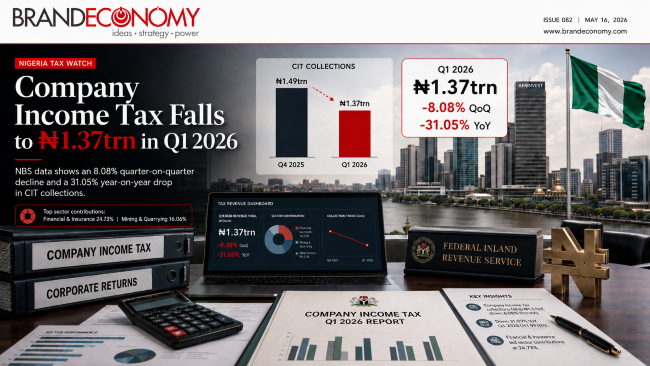 The latest NBS data shows a quarterly and yearly decline in Company Income Tax collections, raising fresh questions about
 Nigeria’s aggregate Company Income Tax collection stood at ₦1.37 trillion in the first quarter of 2026, according to the latest report released by the National Bureau of Statistics.
The figure represents an 8.08 per cent decline from the ₦1.49 trillion recorded in the fourth quarter of 2025. On a year-on-year basis, CIT collections fell by 31.05 per cent compared with the first quarter of 2025.




The numbers present a cautious picture of Nigeria’s corporate tax base. While the headline amount remains substantial, the decline suggests that businesses may still be adjusting to a difficult operating environment marked by high financing costs, inflationary pressure, exchange-rate volatility, weak consumer demand and uneven sectoral performance.
Company Income Tax is a useful indicator of corporate performance because it reflects taxable profits. When collections rise sustainably, it often points to stronger business earnings, better compliance or improved tax administration. When they fall sharply, it may suggest weaker profitability, sector-specific stress, timing effects in tax payments or broader economic softness.
In Q1 2026, domestic CIT payments amounted to ₦538.91 billion, while foreign CIT payments stood higher at ₦828.82 billion. That split is important because it shows the continued significance of foreign-linked tax contributions to Nigeria’s corporate revenue pool.
Financial Services and Mining Lead Sector Contributions
The NBS report showed that financial and insurance activities recorded the highest sectoral contribution to CIT in Q1 2026, accounting for 24.73 per cent of total collections.
This was followed by mining and quarrying, which contributed 16.06 per cent.
The dominance of financial services is not surprising. Banks and financial institutions have benefited from elevated interest-rate conditions, strong trading income, foreign-exchange-related gains, increased digital transactions and balance-sheet expansion in recent years.
However, the heavy contribution from financial services also raises a structural question: is Nigeria’s tax base being driven enough by production, manufacturing, agriculture and export-oriented sectors?
A tax system built on a narrow set of highly profitable sectors may generate revenue in the short term, but it does not necessarily reflect broad-based economic strength.
Mining and quarrying’s strong contribution shows the relevance of extractive activity to government revenue, but Nigeria’s long-term goal should be to build deeper value addition around minerals, energy and industrial processing rather than relying heavily on raw extraction.
Sectors With Strongest Quarter-on-Quarter Growth
On a quarter-on-quarter basis, water supply, sewage, waste management and remediation activities recorded the highest growth rate at 485.71 per cent.
This was followed by activities of households as employers and undifferentiated goods and services producing activities of households for own use, which grew by 197.04 per cent.
These high growth rates should be interpreted with caution. Some sectors have very small tax bases, so even modest absolute changes can produce dramatic percentage increases.
At the other end of the table, agriculture, forestry and fishing recorded the weakest growth rate, declining by 73.52 per cent, followed by construction, which fell by 63.15 per cent.
The contraction in agriculture-related CIT is particularly concerning. Agriculture is central to food security, employment and rural livelihoods, yet the sector continues to face insecurity, poor logistics, limited mechanisation, climate stress, weak storage systems and financing constraints.
Construction’s decline also deserves attention. The sector is usually a proxy for infrastructure activity, real-estate demand, public works and private capital spending. A fall in construction-related tax performance may point to weaker project execution, high input costs, reduced purchasing power or tighter financing conditions.
Low-Contribution Sectors Show the Limits of Formalisation
The least sectoral share came from household-related activities, with only 0.01 per cent contribution.
This was followed by activities of extraterritorial organisations and bodies at 0.13 per cent, while water supply, sewage, waste management and remediation activities contributed 0.38 per cent.
These figures reveal the uneven structure of Nigeria’s formal corporate tax system. Many activities in the economy remain informal, under-documented or poorly captured by the tax net.
Nigeria’s challenge is not simply to raise tax rates. It is to broaden the tax base by expanding formalisation, supporting business growth, improving data systems, simplifying compliance and reducing the burden on already compliant firms.
A healthier tax system should bring more businesses into the net without punishing productivity.
Market Implications
The fall in Company Income Tax collections carries important market signals.
First, it suggests that corporate profitability may be under pressure in several parts of the economy. Businesses are still contending with high energy costs, expensive credit, logistics disruptions, weaker household purchasing power and uncertainty around input prices.
Second, the dominance of financial services shows that the economy may be leaning too heavily on sectors that benefit from monetary tightening, rather than sectors that create broad employment and real production.
Third, the weak performance in agriculture and construction points to deeper problems in sectors that should ordinarily drive jobs, infrastructure and inclusive growth.
For the market, the message is clear: Nigeria needs more productive corporate earnings, not just higher tax enforcement.
Policy Implications
The Q1 2026 CIT data should push policymakers to focus on three priorities.
The first is business productivity. Tax revenue grows sustainably when companies are profitable, not when government simply intensifies collection pressure. Policies must reduce operating costs, improve power supply, strengthen logistics, stabilise the exchange rate and expand access to affordable credit.
The second is tax-base expansion. Nigeria must bring more firms into the formal economy through simplified registration, digital compliance, incentives for SMEs and better taxpayer education.
The third is sectoral balance. Government should pay attention to weak CIT performance in agriculture and construction because both sectors are critical to jobs, food security and infrastructure.
A tax system is only as strong as the economy beneath it.
Brand Implications
For Nigeria’s investment brand, lower CIT collections raise a credibility question: are reforms translating into stronger corporate performance?
Investors want to see a tax system that is predictable, fair and growth-supporting. They are wary of environments where businesses face rising compliance burdens while operating conditions remain difficult.
For the Federal Government, the brand challenge is to show that tax reform is not merely about collection, but about building a more competitive economy.
For companies, the data reinforces the need for stronger governance, proper tax planning, transparent reporting and improved financial discipline.
A country that wants to attract long-term capital must build a reputation for both tax responsibility and business friendliness.
Investor Relevance
Investors will read the CIT numbers as a mixed signal.
On one hand, ₦1.37 trillion in quarterly corporate tax collection shows that Nigeria still has a substantial corporate earnings base. On the other hand, the quarter-on-quarter and year-on-year decline points to pressure across parts of the economy.
The sectoral data is especially useful. Financial services remain strong, mining is significant, but agriculture and construction appear weak.
Investors will therefore continue to examine sector resilience, profitability trends, regulatory risks, tax exposure, interest-rate direction and consumer demand.
The data also suggests that companies operating in high-margin, formalised and well-capitalised sectors may continue to outperform firms in sectors exposed to insecurity, weak infrastructure and high input costs.
BRANDECONOMY Insight
Nigeria’s CIT Decline Is a Warning Against Taxing a Weak Productive Base Too Hard
Nigeria’s ₦1.37 trillion Company Income Tax collection in Q1 2026 is still sizeable, but the decline from the previous quarter and from Q1 2025 should not be ignored.
Corporate tax is not magic. It comes from profit. If businesses are squeezed by inflation, insecurity, exchange-rate instability, high interest rates, weak infrastructure and low consumer demand, taxable profit will eventually reflect that stress.
The lesson is simple: government cannot tax its way into prosperity if the productive economy is not expanding.
Nigeria needs better tax administration, but it also needs stronger companies. It needs more manufacturers, processors, exporters, builders, agribusinesses and technology firms making real profits. It needs SMEs moving from survival to scale. It needs construction and agriculture to recover. It needs the informal economy to become gradually formal without being suffocated.
The strongest tax systems are built on thriving businesses, not frightened businesses.
The policy question after this report should therefore not be, “How do we squeeze more from the same taxpayers?” It should be, “How do we help more businesses become profitable, formal and tax-paying?”
That is the real development economy test.