
AfDB Approves $200m BoI Facility to Power Nigeria’s Industrial Growth

 The financing package is more than another development-bank intervention. It is a strategic attempt to place long-term capital behind local manufacturing, SMEs, women-led businesses and the productive sectors Nigeria needs to rebalance growth.
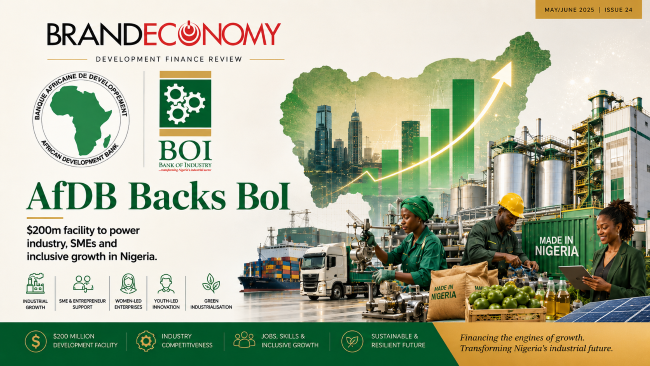 The financing package is more than another development-bank intervention. It is a strategic attempt to place long-term capital behind local manufacturing, SMEs, women-led businesses and the productive sectors Nigeria needs to rebalance growth.
The African Development Bank Group has approved a $200 million financing facility for Nigeria’s Bank of Industry, in a move designed to widen access to medium- and long-term capital for businesses operating in sectors considered critical to the country’s industrial transformation.
The facility will support enterprises in infrastructure, transportation, agro-food processing, healthcare, pharmaceuticals and green industrialisation, while dedicating at least 30 per cent of the funding to small and medium-sized enterprises. Women-owned businesses and youth-led ventures are also expected to receive priority consideration, reflecting the growing emphasis on inclusive financing as a condition for sustainable growth.



For Nigeria, where productive businesses routinely struggle with high borrowing costs, short loan tenors and thin access to patient capital, the AfDB approval represents a consequential development. It signals renewed international confidence in the country’s industrial prospects, but also acknowledges a longstanding structural problem: Nigeria cannot manufacture its way into economic resilience without development finance that matches the rhythm of real-sector investment.
A Development-Finance Intervention with Industrial Intent
According to the African Development Bank, the financing arrangement is intended to deepen industrial capacity, improve economic competitiveness and provide businesses with the longer-term funding necessary for expansion, equipment acquisition and value-chain investment. The facility forms part of AfDB’s broader strategy of supporting private-sector development and productive transformation in Nigeria.
That emphasis matters. Nigerian businesses, particularly manufacturers and processors, rarely suffer from a shortage of ambition. They suffer from a shortage of financing structures that understand production cycles. A factory cannot be built on a three-month overdraft. A pharmaceutical plant cannot scale on capital priced as though it were a speculative trade. Agro-processing, transport infrastructure and green industry require capital that is long-dated, affordable and aligned with productive cash flows.
The Bank of Industry is one of the few institutions specifically structured to bridge that gap. Its mandate is to provide financial and advisory support to enterprises across Nigeria’s industrial economy, with a focus on manufacturing, agro-processing and other priority sectors. The institution says it operates nationwide and supports both MSMEs and larger enterprises through tailored financing and business-development services.
The AfDB facility therefore strengthens an existing policy channel rather than creating a new one. It gives BoI greater firepower to lend into sectors that commercial banks often view as too long-term, too specialised or too capital-intensive.
The Sectors That Matter Most
The structure of the facility reveals its strategic intent.
Infrastructure and Transport
Nigeria’s industrial economy is heavily constrained by logistics costs, unreliable distribution networks and infrastructure gaps. Financing that reaches transport-linked enterprises can improve supply-chain efficiency, reduce production bottlenecks and expand market access for manufacturers.
Agro-Food Processing
Nigeria produces large volumes of agricultural commodities but continues to lose value through weak processing, post-harvest waste and inadequate industrial conversion. AfDB has consistently treated agro-processing as a major route to food security, job creation and import substitution, including through its wider efforts to finance Special Agro-Industrial Processing Zones in Nigeria.
Healthcare and Pharmaceuticals
Domestic pharmaceutical capacity has become a strategic economic and public-health priority. Financing local production can reduce import dependence, strengthen medical supply security and support higher-value industrial activity.
Green Industrialisation
The inclusion of green industrialisation reflects the changing priorities of development finance. New capital is increasingly being directed toward projects that improve efficiency, reduce environmental pressure and align with the transition to more sustainable production systems. AfDB’s statement also links the facility to climate-smart business initiatives through a grant component.
Taken together, these sectors speak to a broader policy goal: Nigeria must grow by producing more, processing more and importing less of what it can competitively make at home.
SMEs at the Heart of the Package
One of the most important features of the approval is the commitment that at least 30 per cent of the financing facility will be directed toward SMEs. This is not a small concession. It is an acknowledgment that the future of job-rich industrialisation in Nigeria will depend heavily on firms below the scale of conglomerates but above the fragility of micro-enterprises.
SMEs sit at the intersection of employment, local innovation and inclusive growth. Yet they are also among the most financing-constrained businesses in the economy. Many lack the collateral profile demanded by commercial lenders; others operate in sectors with capital needs that exceed what informal finance can support. AfDB’s intervention aims to widen the lending corridor for precisely this group.
The bank also said women-owned businesses and youth-led enterprises would receive priority support. That design choice reflects a growing body of development-finance thinking: inclusive growth is not a social add-on to economic policy; it is an efficiency requirement. Economies that underfinance women entrepreneurs and young founders are leaving productive capacity idle.
A Grant Layer for Capacity, Not Just Capital
The package includes a $650,000 grant from the Fund for African Private Sector Assistance, intended to strengthen SME capacity and support climate-smart business initiatives. In addition, technical support under the Affirmative Finance Action for Women in Africa framework will improve financing access for women-led enterprises.
This grant element is more important than it may appear. In many developing economies, the financing problem is not only that businesses lack capital; it is also that many firms need stronger bookkeeping, governance, investment-readiness and climate-compliance practices to absorb capital effectively. Development finance without business strengthening can lead to poor deployment. Business support without capital can lead to frustrated capacity.
The AfDB-BoI structure appears designed to address both sides of the problem.
AfDB’s Confidence — and Nigeria’s Test
Abdul Kamara, Director-General of AfDB’s Nigeria Country Department, described the approval as a reflection of the Bank’s confidence in Nigeria’s industrial potential and its commitment to private-sector-led development. Olasupo Olusi, Managing Director of the Bank of Industry, likewise framed the facility as a milestone in the long-running partnership between the two institutions, saying it would unlock investment opportunities, support jobs and promote inclusive growth.
These statements are encouraging, but the more important question is execution.
Nigeria has received major development-finance commitments before. The value of this facility will be determined by whether the money reaches the right enterprises, at the right pace, under structures that encourage productivity rather than bureaucracy. That means transparent eligibility, clear sector targeting, measurable disbursement milestones and strong monitoring of developmental outcomes.
The country’s industrial transformation cannot be measured merely by how much financing is approved. It must be judged by factories expanded, jobs created, exports increased, import bills reduced and businesses made more competitive.
Why the Facility Matters in a Difficult Credit Environment
The intervention arrives at a time when access to finance remains one of the biggest constraints facing Nigerian enterprises. High interest rates, elevated operating costs and macroeconomic volatility have made business expansion more expensive, particularly for firms in manufacturing and capital-intensive sectors. Against that backdrop, development-finance institutions such as BoI become more important as stabilisers of productive investment.
BoI has been scaling its domestic support programmes as well. In 2025, it announced a ₦200 billion support framework for businesses, including manufacturing-sector funding and other intervention programmes designed to cushion production costs and extend more affordable credit.
The AfDB facility adds an international layer to that domestic financing strategy. It broadens BoI’s ability to finance Nigeria’s industrial pipeline and strengthens the case for using blended development capital to crowd in private investment.
BRANDECONOMY Insight
Nigeria Does Not Have a Shortage of Enterprise — It Has a Shortage of Patient Industrial Capital
The AfDB’s $200 million financing facility for the Bank of Industry deserves to be read as a statement about the type of economy Nigeria must now build. For too long, the country has depended heavily on import flows, oil-linked revenues and consumption-led growth. The next phase must be anchored in production, processing, industrial capability and export competitiveness.
That requires capital with patience.
Commercial banks play an important role in the economy, but the needs of industrialisation are often poorly matched to short-tenor lending. Manufacturing plants, pharmaceutical facilities, agro-processing hubs and green-industry projects need longer repayment horizons and financing structures that recognise gestation periods. This is where institutions like BoI — and facilities like AfDB’s — become essential.
The most encouraging aspect of the package is its blend of scale and inclusion. It backs strategic sectors, but reserves space for SMEs. It seeks industrial output, but also prioritises women and youth. It funds growth, but adds technical support to improve business quality. That is how development finance becomes more than disbursement; it becomes economic architecture.
Still, the true success of the facility will lie in discipline. Nigeria cannot afford another well-announced intervention that disappears into administrative fog. The public should be able to track where the money goes, what sectors benefit, how many jobs emerge and whether the facility measurably strengthens domestic production.
If executed with rigour, the AfDB-BoI partnership could help accelerate a more productive Nigerian economy — one in which capital finally moves more deliberately toward factories, processors, innovators and job creators.