Nigeria Pitches Innovation-Led Growth at BRICS, Seeks Deeper Global South Cooperation

 At the BRICS Foreign Ministers’ Meeting in New Delhi, Abuja framed technology, digital skills and green development as the pillars of a more competitive Nigerian economy — and as its contribution to a changing Global South.
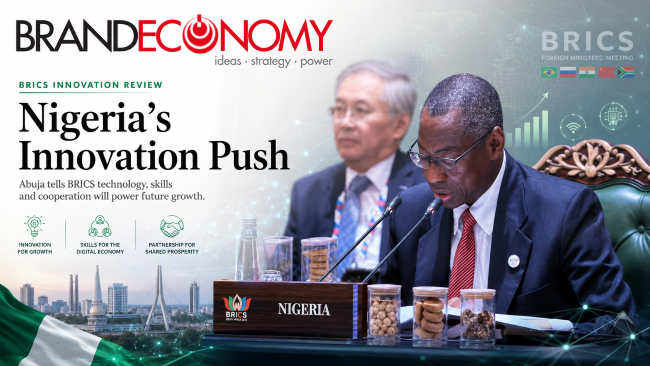 At the BRICS Foreign Ministers’ Meeting in New Delhi, Abuja framed technology, digital skills and green development as the pillars of a more competitive Nigerian economy — and as its contribution to a changing Global South.
Nigeria has placed innovation, digital capability and international cooperation at the centre of its economic diplomacy, telling the 18th BRICS Foreign Ministers’ Meeting in New Delhi that the country intends to drive its next phase of growth through technology-led transformation, inclusive enterprise and stronger partnerships with emerging economies.
Speaking on Nigeria’s behalf, Ambassador Bianca Odumegwu-Ojukwu, Minister of Foreign Affairs, represented by the ministry’s Permanent Secretary, Ambassador Dunoma Ahmed, said Nigeria sees innovation not as a fashionable policy slogan, but as a practical engine for economic diversification, sustainable development and national competitiveness. The intervention came during the May 14–15 ministerial meeting held under India’s 2026 BRICS chairship theme: “Building for Resilience, Innovation, Cooperation and Sustainability.”




The message was both domestic and diplomatic. Domestically, Nigeria is seeking to reposition a young, entrepreneurial population as a productive force in the digital economy. Internationally, Abuja is using its BRICS partner-country status to argue that Africa’s largest economy must be part of conversations shaping technology flows, development finance, energy transition and the future architecture of South-South cooperation. Nigeria formally joined BRICS as a partner country in January 2025, a status that gives it access to the bloc’s broader policy engagements without conferring full membership.
Innovation as Economic Policy
Odumegwu-Ojukwu’s address rested on a clear proposition: Nigeria’s future growth will depend increasingly on knowledge, skills, platforms and innovation ecosystems, rather than on the traditional comfort of commodity dependence.
She pointed to the country’s expanding technology landscape, noting that Nigerian entrepreneurs have already gained international recognition in fintech, digital platforms and creative industries, while innovators in mobile banking, renewable energy and agritech are helping to close financial inclusion gaps and extend services to underserved communities. Reports from the BRICS meeting indicate that Nigeria presented this innovation ecosystem as evidence of an economy gradually building new growth levers beyond oil.
This is a strategically important argument. Nigeria’s economic problem has never been a shortage of talent. It has been the inability to convert talent into productivity at national scale. The rise of payment companies, digital marketplaces, logistics platforms, entertainment businesses and data-driven services has shown what private initiative can achieve when capital, market need and technology meet. The next policy challenge is to turn such pockets of success into a broader national development model.
The Foreign Affairs Minister therefore highlighted a number of flagship initiatives aimed at building a more digitally capable workforce. These include the Digital Literacy for All programme, the 3 Million Technical Talent initiative and the expansion of innovation hubs. Nigeria’s official digital-policy framework targets 70 per cent digital literacy by 2027 and 95 per cent by 2030, ambitions that are increasingly being woven into the country’s economic and diplomatic messaging.
The BRICS Opportunity
Nigeria’s innovation pitch fits neatly into India’s 2026 BRICS agenda. The chairship framework identifies resilience, innovation, cooperation and sustainability as the central pillars of the bloc’s programme, with particular emphasis on digital public infrastructure, fintech, emerging technologies, green finance and development cooperation.
For Nigeria, that creates a diplomatic opening. BRICS is no longer merely an acronym for fast-growing emerging economies; it is evolving into a platform through which countries of the Global South seek greater influence over trade, finance, infrastructure, technology standards and multilateral reform. Nigeria has repeatedly signalled that it intends to use the platform to deepen cooperation in trade, investment, infrastructure and people-to-people engagement, while also projecting African priorities into the wider BRICS conversation.
Odumegwu-Ojukwu’s message that innovation must be inclusive is therefore significant. It suggests that Nigeria does not want to enter BRICS merely as a market for finished technology, but as a partner in co-developing solutions, sharing experience and linking innovation ecosystems across continents. That vision is ambitious, but not unrealistic. Nigeria’s fintech infrastructure, startup culture and large domestic market could make it a compelling BRICS innovation partner if policy consistency, broadband depth and institutional support improve.
Cooperation as Foreign Policy Doctrine
The address also reaffirmed cooperation as a guiding principle of Nigeria’s foreign policy. Odumegwu-Ojukwu linked Nigeria’s BRICS engagement to its longstanding role in ECOWAS and regional integration, arguing that prosperity and peace are inseparable from collaborative institutions.
This emphasis matters at a time when the global economy is fragmenting into overlapping networks of strategic partnerships. Supply chains are being reconsidered; trade is increasingly shaped by geopolitics; development finance is under pressure; and middle powers are seeking room to manoeuvre between competing blocs. Nigeria’s diplomatic posture at BRICS suggests a desire to avoid passivity in this changing order and instead anchor itself within forums that can widen its economic options.
That posture could prove valuable. BRICS engagement may help Nigeria secure stronger links in areas such as industrial technology, agriculture, renewable energy, infrastructure financing, digital cooperation and export market access. But those benefits will not arrive automatically. They will depend on whether Nigeria can arrive at such forums with credible domestic reforms, bankable projects and a clear sense of strategic priority.
Development Finance and the New Development Bank
Odumegwu-Ojukwu also described the New Development Bank as an important instrument for financing projects that advance sustainable growth and community development. That reference reflects Nigeria’s broader interest in development-finance alternatives capable of supporting infrastructure and energy-transition needs.
The point is timely. Nigeria’s development constraints are capital-intensive: electricity, transport, industrial parks, renewable energy, broadband, logistics and climate resilience all require long-horizon financing. Traditional public budgets cannot carry the burden alone. If Nigeria can use BRICS-associated institutions, alongside other sources of multilateral and private capital, to finance productive infrastructure rather than recurrent inefficiency, the economic impact could be substantial.
Still, finance is only useful when matched with execution. Nigeria’s challenge has often been less about announcing grand plans than about implementing them coherently. Development banks and foreign partners are attracted by scale, but they are persuaded by project discipline, governance quality and policy predictability.
Green Growth and Nigeria’s Energy Transition
Sustainability was another pillar of Nigeria’s message. The minister reiterated the country’s commitment to the Paris Agreement, the United Nations Sustainable Development Goals, and its own Energy Transition Plan, which targets net-zero emissions by 2060. Nigeria argued that BRICS can play a leading role in advancing global sustainability through knowledge sharing, resource mobilisation and green innovation.
This is a delicate but necessary position for an oil-producing country. Nigeria cannot simply abandon hydrocarbons overnight without undermining public revenue, energy access and industrial stability. Yet it also cannot ignore the global shift toward low-carbon investment, climate finance and renewable technologies. Its path will therefore require a pragmatic balance: using existing energy assets to support development while investing steadily in solar power, gas transition infrastructure, clean cooking, green industry and climate-adaptation finance.
BRICS, with its mix of resource-rich and technology-capable economies, could become a useful platform for that balancing act.
Nigeria’s Strategic Message to the Global South
Perhaps the most politically resonant element of the speech was Nigeria’s insistence that its role in BRICS is to bring the voice of Africa and the Global South into the conversation. That phrase captures a broader ambition: to be more than a passive attendee in forums dominated by larger powers, and instead serve as a continental advocate for fairer trade, inclusive finance, technology access and development-sensitive climate policy.
It is a powerful aspiration. Nigeria has the demographic scale, market depth and diplomatic history to play that role. But influence is rarely granted on rhetoric alone. It is earned through economic credibility. The stronger Nigeria’s innovation ecosystem, human-capital base, export diversification and institutional reliability become, the more weight its voice will carry in BRICS and beyond.
BRANDECONOMY Insight
Innovation Diplomacy Will Matter Only If Nigeria Converts Talent into National Productivity
Nigeria’s BRICS intervention was well timed and strategically framed. In a world where economic power is increasingly tied to technology, intellectual capability and adaptable institutions, the country is right to present innovation as a central pillar of national growth.
But there is an important distinction between celebrating innovation and organising an innovation economy.
Nigeria has already demonstrated that its entrepreneurs can build globally relevant solutions in payments, digital commerce, entertainment and service platforms. What remains is to create the conditions that make innovation broad-based rather than exceptional. That means reliable broadband, electricity, patient capital, research-commercialisation pathways, stable regulation, stronger intellectual-property systems and an education sector better aligned with the future of work.
The BRICS platform can help. It can widen cooperation, open doors to technology partnerships and strengthen access to development finance. Yet the ultimate determinant of Nigeria’s gains will be domestic readiness. Countries benefit from global partnerships when they know what they want from them.
The deeper opportunity is clear: Nigeria can position itself as Africa’s innovation bridge within the Global South — a country large enough to scale ideas, youthful enough to drive adoption and strategically placed to connect emerging markets. But that future will require more than diplomatic declarations. It will require policy discipline at home.
Innovation may indeed drive Nigeria’s economic growth. The question is whether the state can build the conditions that allow it to do so at scale.