
NCC Drives Fibre Expansion Push with Focus on Collaboration and Skills
Infrastructure as Economic Policy

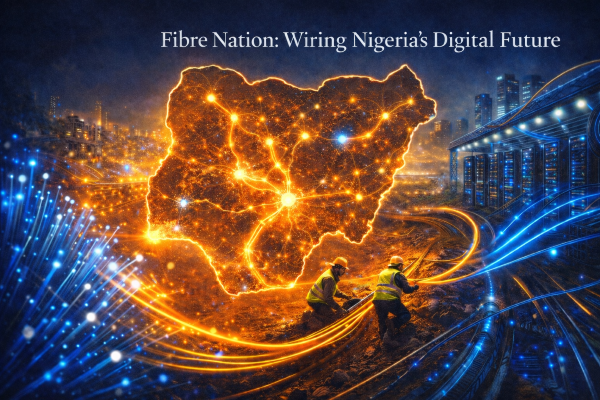 Nigeria’s digital ambitions are increasingly being routed through a single, critical pathway: fibre. At a strategic training workshop in Abuja, the Nigerian Communications Commission (NCC) reinforced a message that has become central to the country’s technology policy—broadband expansion will depend not just on infrastructure investment, but on collaboration, regulation and human capital.
Delivering a goodwill address at a high-level fibre optics training programme organised by the International Telecommunication Union in partnership with the Digital Bridge Institute and supported by the European Union, the NCC positioned fibre deployment as the backbone of Nigeria’s digital economy.




Infrastructure as Economic Policy
At stake is more than connectivity. Fibre infrastructure underpins a wide range of economic functions—from financial inclusion and e-commerce to healthcare delivery, education systems and agricultural efficiency.
According to NCC leadership, the Federal Government’s flagship initiative—Project BRIDGE (Building Resilient Digital Infrastructure for Growth)—aims to deploy an additional 90,000 kilometres of fibre optic cable nationwide, extending connectivity to all 774 local government areas.
If realised, the project would mark one of the most ambitious digital infrastructure expansions in Africa.
The Bottlenecks Beneath the Ambition
Yet, the constraints are structural.
High Right-of-Way (RoW) charges at subnational levels, bureaucratic delays, and persistent infrastructure vandalism continue to slow deployment. These frictions are not merely administrative—they are economic, raising the cost of capital and deterring private investment.
The NCC’s response has been to prioritise coordination across government layers. Advocacy efforts have already led 13 states to waive RoW charges—a policy shift that is beginning to unlock fresh investment from telecom operators.
Equally significant is the 2024 presidential designation of telecom infrastructure as Critical National Information Infrastructure (CNI), elevating its protection status and signalling its strategic importance.
Public-Private Capital Alignment
The financing challenge remains formidable.
As European Union representatives at the workshop noted, the scale of infrastructure required far exceeds public sector capacity. The EU’s €820 million digital economy package for Nigeria—combining grants and development finance—reflects a broader shift toward blended financing models that leverage private sector participation.
This is not optional. Without private capital, Nigeria’s broadband ambitions will struggle to scale.
Human Capital: The Missing Link
Infrastructure alone, however, is insufficient.
The workshop’s focus on capacity building highlights a critical gap: the need for a skilled workforce capable of designing, deploying and regulating complex digital systems. As networks become more sophisticated, regulatory expertise and technical competence must evolve in tandem.
In this regard, the training programme serves as both a knowledge platform and a policy instrument—aligning technical skills with regulatory priorities.
BRANDECONOMY Insight
Nigeria’s fibre push is not just a telecom story—it is a development strategy.
- Fibre Is the New Oil of the Digital Economy
Just as pipelines enabled energy markets, fibre networks will define digital productivity, innovation and competitiveness. - Policy Alignment Determines Speed
RoW waivers and infrastructure protection policies demonstrate how regulatory coordination can unlock investment and accelerate deployment. - Private Capital Is Indispensable
Public funding alone cannot close Nigeria’s connectivity gap. Blended finance models will be central to scaling infrastructure. - Skills Will Define Outcomes
A digitally connected nation requires a digitally competent workforce. Capacity building is as critical as cable deployment. - Inclusion Is the Ultimate Metric
Extending fibre to all 774 LGAs is not just about coverage—it is about economic inclusion, ensuring that rural and underserved communities participate in the digital economy.
In essence, Nigeria’s fibre strategy is a race—not just to connect, but to compete.