Aba’s Fashion Boom: 10,000 Producers Target $3bn Industry Growth
From Craft to Capital

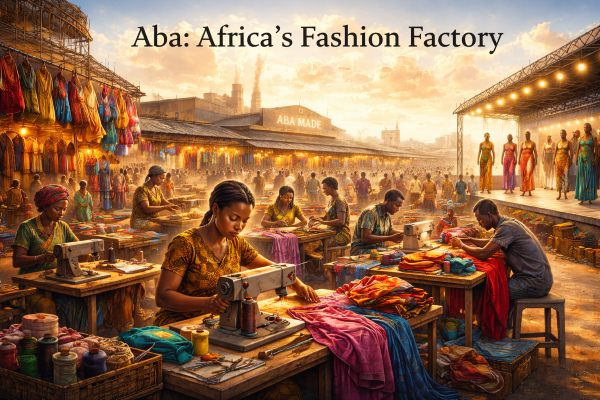 Aba—long regarded as Nigeria’s informal manufacturing capital—is preparing for a decisive moment in its evolution into a structured creative economy hub. More than 10,000 fashion producers are expected to converge on the city for the second edition of The Fashion Games 2026 (TFG 2026), a platform increasingly positioned as both a cultural showcase and an economic intervention.
Organised by Ethnocentrique Ltd., the Aba Fashion event signals a growing ambition: to transform Aba’s fragmented but vibrant fashion ecosystem into a coordinated, investment-ready industry capable of competing regionally and globally.




From Craft to Capital
At its core, The Fashion Games is less about spectacle than structure.
The 2026 edition—under the theme “AHIA 360”—aims to deliver a full-spectrum market experience, linking producers with buyers, financiers, policymakers and institutional partners. The objective is clear: to move Aba’s fashion cluster from informal production to formalised value chains.
This matters. Aba’s artisans—who produce garments, footwear, and accessories at scale—have long operated outside structured finance, certification systems and global distribution networks. The result has been a persistent value gap: high productivity, but limited profitability.
Designing a Market Ecosystem
The two-day programme reflects a deliberate economic architecture.
Day one will focus on curated industry sessions—bringing together MSMEs, investors and policymakers in deal-making environments designed to unlock partnerships and capital flows. Selected producers will pitch, showcase capacity, and engage in structured negotiations aimed at translating creativity into contracts.
Day two shifts to scale: a public showcase at the Enyimba International Stadium, blending runway presentations, cluster competitions and the graduation of participants from the Fashion Future Programme.
The model mirrors global best practice—where fashion weeks double as trade platforms, not merely cultural exhibitions.
Scaling the Aba Advantage
The numbers tell a compelling story. The inaugural edition in 2025 attracted 4,500 participants, engaged 1,400 MSMEs and graduated 2,000 trainees under a skills development initiative supported by the Mastercard Foundation.
The projected leap to 10,000 participants in 2026 signals accelerating momentum.
More importantly, industry leaders estimate that the Aba fashion cluster could evolve into a $3 billion industry within the next decade—if supported by the right infrastructure, financing mechanisms and policy alignment.
That projection is not implausible. Global demand for African fashion—driven by diaspora markets, digital platforms and shifting consumer tastes—is rising steadily.
Bridging the Missing Links
Yet, the constraints remain familiar.
Access to finance is limited. Intellectual property protection is weak. Market linkages—particularly to international buyers—are inconsistent. Without addressing these gaps, scale will remain constrained.
TFG 2026 is designed to confront these challenges directly—creating a convergence point where production meets capital, and where local craftsmanship intersects with global demand.
BRANDECONOMY Insight
The Aba fashion ecosystem represents one of Nigeria’s most underleveraged economic assets—rich in talent, but historically poor in structure.
- Informal Clusters Are Nigeria’s Hidden Growth Engines
Aba’s production capacity rivals industrial hubs, yet operates largely outside formal economic systems. Formalisation could unlock significant GDP contribution. - Fashion Is a Serious Export Industry
Globally, fashion is a multi-trillion-dollar sector. Nigeria’s entry point lies in niche, culturally distinctive products with scalable manufacturing potential. - Financing Is the Critical Bottleneck
Without access to structured finance—working capital, equipment financing, export credit—the sector cannot achieve meaningful scale. - Platforms Like TFG Are Market Catalysts
By creating direct linkages between producers and buyers, such events can accelerate commercialisation and reduce reliance on intermediaries. - The AfCFTA Opportunity Looms Large
Aba’s proximity to regional markets positions it as a potential export hub under the African Continental Free Trade Area—if logistics and standards are aligned.
Ultimately, The Fashion Games is more than an event—it is a test case for how Nigeria can convert creative energy into industrial value.