FirstHoldCo 2025: The Painful Reset of Nigeria’s Oldest Banking Franchise
“The FirstBank brand remains powerful, but in modern banking, brand must now be backed by capital discipline, clean credit and dividend credibility.”

 For FirstHoldCo Plc, the 2025 financial year was not merely another reporting cycle. It was a reckoning.
The parent company of First Bank of Nigeria entered the year with one of the strongest franchises in African banking: a century-old name, a formidable deposit base, a sprawling customer network and deep corporate relationships. But 2025 also forced the group to confront the hard arithmetic of prudential banking — capital adequacy, loan impairments, forbearance exposures, dividend restraint and the quality of earnings beneath headline revenue.



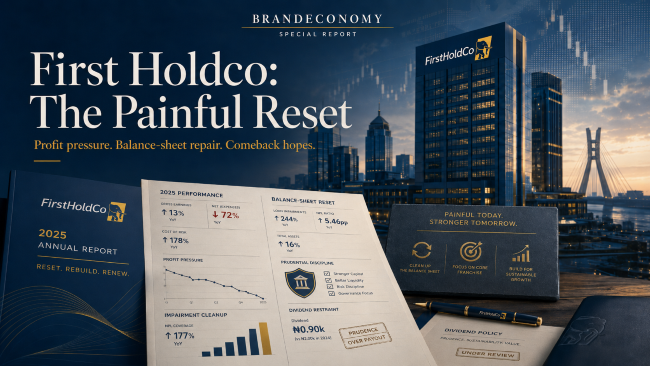
The story, therefore, is not a simple tale of decline. It is better understood as a balance-sheet reset. FirstHoldCo grew gross earnings to ₦3.44 trillion in 2025, from ₦3.21 trillion in 2024. Interest income rose strongly to ₦2.99 trillion, while net interest income climbed to ₦1.92 trillion. Yet the force of impairment charges — ₦826.3 billion, almost double the prior year’s ₦426.3 billion — pulled profit sharply lower. Profit for the year fell to ₦139.5 billion, compared with ₦677.0 billion in 2024.
That contrast is the heart of the FirstHoldCo story: the engine was still running, but the repairs were expensive.

The Numbers Behind the Reset
FirstHoldCo’s 2025 performance presents two realities at once.
On the surface, the group remained a revenue heavyweight. Gross earnings of ₦3.44 trillion confirmed the scale of the franchise. Interest income of nearly ₦3 trillion showed the benefit of a high-rate environment, repricing power and a large earning-asset base. Fee and commission income also improved, rising to ₦357.5 billion from ₦304.5 billion.
But beneath that top-line strength, the provisioning bill changed the entire investment conversation. Impairment charges of ₦826.3 billion represented the cost of cleaning the books, absorbing weaker credits and adjusting to a stricter regulatory environment. In effect, FirstHoldCo’s 2025 annual report is less a celebration of profit and more an x-ray of risk.
The group’s total assets still stood at a formidable ₦27.25 trillion, up from ₦26.52 trillion in 2024, while total equity rose to ₦3.30 trillion from ₦2.80 trillion. Customer deposits increased to ₦18.88 trillion, from ₦17.17 trillion, underlining the resilience of the FirstBank franchise and the trust that continues to reside in its deposit base.
In plain English: customers stayed, deposits grew, the balance sheet remained huge — but shareholders felt the pain of prudential repair.
Key Numbers at a Glance
| Indicator | FY2025 | FY2024 | Direction |
| Gross earnings | ₦3.44trn | ₦3.21trn | Up |
| Interest income | ₦2.99trn | ₦2.40trn | Up |
| Net interest income | ₦1.92trn | ₦1.40trn | Up |
| Impairment charge | ₦826.3bn | ₦426.3bn | Sharply up |
| Profit for the year | ₦139.5bn | ₦677.0bn | Down |
| Total assets | ₦27.25trn | ₦26.52trn | Up |
| Customer deposits | ₦18.88trn | ₦17.17trn | Up |
| Total equity | ₦3.30trn | ₦2.80trn | Up |
| Risk-weighted CAR | 10.95% | 17.32% | Down |
| FY2025 proposed final dividend | Nil | ₦25.13bn for FY2024 | Down |
Dividend: The Signal That Matters
Dividend is where the story becomes more delicate.
The document supplied by the company shows that FirstHoldCo announced a final dividend of 60 kobo per 50 kobo ordinary share for the financial year ended December 31, 2024, with qualification date of May 12, 2025, register closure from May 13 to May 14, 2025, and payment scheduled for May 23, 2025, subject to the usual approvals and e-dividend mandates.
That dividend, however, belongs to the 2024 financial year, although paid in 2025. It should not be confused with a dividend for the 2025 financial year.
The 2025 audited financial statements show a different picture: under proposed dividend, the line for 2025 carries no final dividend, while the 2024 comparative shows ₦25.13 billion. The same note confirms that the ₦25.13 billion cash dividend at 60 kobo per share, relating to the year ended December 31, 2024, was paid in May 2025.
This distinction is critical. In normal banking years, investors ask: How much profit did the bank make, and how much dividend will it pay? In 2025, the better question became: How much capital must the bank preserve before it can return confidently to dividend normalisation?
That question became even more important after the Central Bank of Nigeria directed banks operating under regulatory forbearance to suspend dividends, defer executive bonuses and avoid new offshore subsidiary investments until they fully exited the forbearance regime and met required capital and provisioning standards.
The CBN Prudential Shadow
FirstHoldCo’s 2025 numbers must be read within the wider CBN prudential reset.
For years, regulatory forbearance helped parts of the banking system manage stressed exposures without creating sudden systemic shocks. But forbearance is not forgiveness. It is temporary breathing space. By 2025, the CBN had shifted the tone from accommodation to correction.
For FirstHoldCo, this meant that legacy credit issues, forbearance-related exposures and impairment assumptions had to be confronted more directly. S&P Global Ratings had earlier noted that FirstBank’s non-performing loans and impairment charges increased after the lifting of forbearance, with NPLs rising to 12.9% of gross loans as of June 30, 2025, from 10.2% as of December 31, 2024.
The audited statements also show that, as at December 31, 2025, the group was in breach of a gross non-performing loans ratio covenant on a credit facility, with an actual ratio of 18% against a threshold of below 10%. The group disclosed that it had notified the lender and submitted a formal waiver request.
This does not mean the franchise is broken. It means the 2025 accounts exposed the cost of legacy risk.
For investors, that is uncomfortable. For regulators, it is necessary. For the bank, it is painful medicine.
Capital: The Hard Centre of the Story
Capital adequacy is the centre of gravity in this entire episode.
The audited statements show that FirstHoldCo’s risk-weighted capital adequacy ratio fell to 10.95% in 2025, from 17.32% in 2024, while Tier 1 CAR declined to 8.21% from 12.99%. The company further disclosed that as at December 31, 2025, the group’s CAR was below the applicable regulatory minimum, stemming from its banking subsidiary. It added that the CAR had been restored by March 2026 through a capital remediation plan involving improved Q1 2026 earnings, capital injection, a planned ₦200 billion Additional Tier 1 capital injection into the banking subsidiary, and ongoing recoveries.
There is also a positive capital signal. First Bank of Nigeria Limited’s paid-up capital is shown at ₦500.03 billion, an important figure within the ongoing banking recapitalisation context for internationally authorised banks.
That makes FirstHoldCo’s position more nuanced. The group is not without capital capacity. But after impairments, covenant pressures and prudential demands, the investment market will want proof that capital strength is not only restored, but sustainable.
Brand Asset: Why FirstBank Remains a Top Bank Brand
The temptation is to read FirstHoldCo’s 2025 report only through profit decline. That would be incomplete.
FirstBank remains one of Nigeria’s deepest banking brands. Its strength is not simply nostalgia. It sits in distribution, account relationships, public trust, corporate banking history, retail reach, transaction flows and a deposit base that still expanded in a difficult year.
That is why the deposit number matters. A customer deposit base of ₦18.88 trillion is not merely a liability line. It is a brand asset. It tells the market that customers still trust the institution with their money, even when shareholders are processing a difficult year.
In banking, brand is not decoration. Brand is liquidity. Brand is deposit stickiness. Brand is regulatory confidence. Brand is the ability to recover from a bruising year without losing the franchise.
FirstBank still has that asset. But 2025 shows that even the strongest brand must now be backed by cleaner credit, tighter underwriting, stronger capital planning and better investor communication.
The Hidden Strength: Core Earnings Were Not Dead
The most important counterweight to the impairment story is that FirstHoldCo’s underlying earnings engine remained alive.
Management commentary around the results pointed to resilient core earnings and a comprehensive balance-sheet reset, with gross earnings up 6.9%, net interest income up 36.8%, and normalised pre-provision profit reportedly rising to about ₦1.07 trillion.
This is the investment case bulls will emphasise: once the heavy impairment cycle moderates, a bank with FirstBank’s deposit base and earning capacity can rebound quickly.
The early signs of that rebound appeared in Q1 2026. FirstHoldCo reported interest income of ₦704.5 billion, profit before tax of ₦321.1 billion, and profit after tax of ₦267.8 billion, a sharp recovery from the depressed FY2025 outcome.
The question is whether this is a one-quarter relief bounce or the beginning of a sustained recovery cycle.
What Shareholders Should Watch Next
For shareholders, the 2025 annual report raises seven questions:
- How quickly will impairment charges normalise?
The recovery of profit depends heavily on whether 2025 was the peak provisioning year. - When will dividend confidence return?
The market will closely watch whether the group can resume a clearer payout path after satisfying regulatory and capital expectations. - How credible is the NPL recovery plan?
Loan recoveries, restructurings and write-backs could become major earnings supports if well executed. - Will capital remediation hold?
The March 2026 restoration claim must translate into durable capital adequacy, not temporary relief. - Can FirstBank convert deposits into cleaner returns?
A large deposit base is powerful only if deployed through disciplined lending and risk-adjusted pricing. - Will governance and communication improve investor trust?
In a reset year, silence is costly. Shareholders need clarity, not corporate fog. - Can the old franchise become a modern compounding machine?
FirstBank has history. The real test is whether it can turn history into future shareholder value.
BRANDECONOMY Insight
FirstHoldCo’s 2025 performance is best understood as a painful but necessary reset.
The headline numbers are severe: profit collapsed, impairments surged, capital adequacy came under pressure and dividend visibility weakened. But the deeper story is more strategic. FirstHoldCo used 2025 to absorb a heavy provisioning shock, expose legacy credit risk, rebuild prudential credibility and prepare the ground for a possible earnings recovery.
This is not yet a victory lap. It is a transition story.
For the CBN, FirstHoldCo’s results validate the argument that regulatory forbearance must end with transparency. For investors, the lesson is that trillion-naira earnings mean little unless they translate into clean profits, sustainable capital and reliable dividends. For FirstBank, the message is even sharper: Nigeria’s oldest banking franchise cannot rely on history alone. It must now prove that its future balance sheet is stronger than its legacy book.
The FirstHoldco 2025 annual report may therefore be remembered not as the year FirstHoldCo disappointed shareholders, but as the year it finally paid the price of repair.
The opportunity now is clear: if impairments reduce, capital strengthens, recoveries improve and Q1 2026 momentum holds, FirstHoldCo could move from a reset story to a comeback story.
But the market will not reward promises. It will reward proof.
By BRANDECONOMY Banking & Markets Desk