

Emefiele’s $6.3bn Trial: Court Weighs Foreclosure demand by Defence Over EFCC ‘Missing’ Witnesses
Economic crime trials are also institutional signals

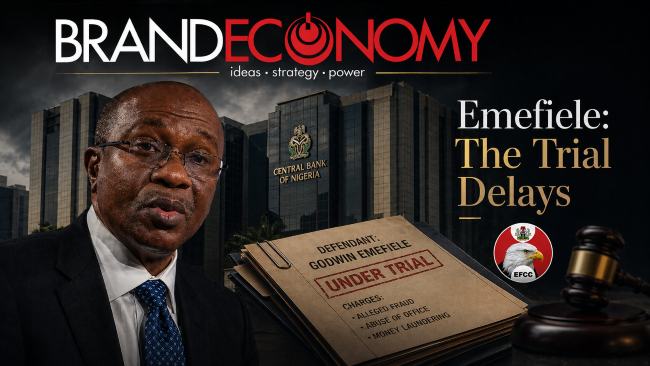 Former CBN Governor Godwin Emefiele has asked an Abuja High Court to shut the door against further prosecution witnesses if the EFCC fails to produce them as scheduled. The application, made in his ongoing trial over alleged criminal breach of trust, forgery, abuse of office and a disputed $6.3 billion election-observer funding claim, has again exposed the tension between prosecutorial diligence, judicial efficiency and the rights of a defendant facing a high-profile economic crime trial.
The trial of former Central Bank of Nigeria Governor, Godwin Emefiele, has entered another delicate phase, not only over the substance of the allegations against him, but over the pace, discipline and courtroom strategy of the prosecution itself.




At the centre of the latest proceedings before an Abuja High Court is a simple but consequential question: how long should the prosecution be allowed to keep calling witnesses if it appears unable to produce them when the court requires them?
Emefiele, through his counsel, Matthew Burkaa, SAN, has urged the court to foreclose the prosecution if the Economic and Financial Crimes Commission fails to bring its remaining witnesses as scheduled. The request followed an indication by prosecution counsel, Rotimi Oyedepo, SAN, that he could not guarantee the appearance of two proposed witnesses at the next sitting because the subpoena had not yet been obtained and the witnesses were outside the court’s jurisdiction.
In a routine criminal trial, such a development might have passed as another scheduling difficulty. But this is not a routine case. Emefiele is not an ordinary defendant. He was once the most powerful monetary policymaker in Nigeria, presiding over the Central Bank at a time of currency pressure, controversial monetary decisions, fiscal-monetary overlap and a bruising public debate over institutional accountability.
The allegations against him are weighty. He is facing charges bordering on criminal breach of trust, forgery, abuse of office, conspiracy to obtain by false pretence and obtaining money by false pretence. The EFCC alleges that while serving as CBN Governor, Emefiele obtained by false pretence the sum of $6.3 billion, purportedly meant for international election observers during the 2023 general election. Emefiele has pleaded not guilty.
That plea has set the stage for a trial that sits at the intersection of law, politics, finance, institutional memory and public trust.
The Prosecution’s Witness Problem
At the resumed hearing, the EFCC called Chinedu Eneanya, an Assistant Commander II, as its 13th prosecution witness. Eneanya told the court that his team was assigned to investigate the matter and that the investigation revealed that funds had allegedly been removed from the coffers of the Central Bank for the purported funding of foreign observers during the 2023 elections.
According to his testimony, investigators interviewed persons connected to the movement of the funds and recovered documents from the CBN relating to the release of the money. He further stated that the investigation revealed alleged forgery of the signatures of then President Muhammadu Buhari and then Secretary to the Government of the Federation, Boss Mustapha, in connection with the release of the funds.
The witness also said forensic examination was conducted on the disputed signatures. That point became critical during cross-examination, when Emefiele’s counsel asked whether any forensic examination had been carried out on Emefiele’s own signature, especially since the former CBN Governor had allegedly complained that his signature was also forged. Eneanya answered that no forensic examination had been conducted on Emefiele’s signature.
For the defence, that answer was not a minor procedural detail. It went to the heart of their emerging courtroom argument: if the prosecution is alleging forgery and financial misconduct, but has not forensically tested the defendant’s own disputed signature, how complete, balanced or reliable is the investigation?
Burkaa also questioned the repeated calling of investigative officers to testify on matters that, in the defence’s view, had already been covered by previous witnesses. His objection appeared to suggest that the prosecution was stretching the trial unnecessarily, possibly repeating evidence rather than advancing it.
His complaint was blunt. He accused the prosecution of what he saw as a strategy that was placing avoidable hardship on the defendant and, in his words, creating a scenario that appeared to ridicule the court. He maintained that justice is not the exclusive property of the prosecution; the defendant is also entitled to finality, expedition and fairness.
The Defence Seeks Foreclosure
The defence’s application for foreclosure is not merely a tactical move. It is a pressure point in the broader architecture of criminal justice.
In criminal proceedings, the prosecution carries the burden of proving its case. That burden includes the obligation to present witnesses and evidence within a reasonable framework. Courts are generally cautious about shutting out evidence, especially in serious criminal matters. At the same time, courts are also custodians of fairness. They cannot allow trials to drift endlessly because one side is unprepared, indecisive or unable to organise its witnesses.
This is the balance Justice Hamza Muazu must now manage.
On one side is the prosecution, insisting that it should not be shut out from calling witnesses who may be necessary to establish its case. Oyedepo argued that he was not attempting to delay proceedings or obstruct the case. He urged the court not to grant the defence’s request and not to close the door against the prosecution’s evidence.
On the other side is the defence, arguing that the prosecution has repeatedly created similar situations and should not be permitted to continue imposing hardship on the defendant. For Emefiele’s lawyers, the issue is no longer merely whether the EFCC has more witnesses. It is whether the prosecution can present them without turning the trial into an indefinite burden.
The court, seeking to keep the proceedings focused, asked the prosecution how many more witnesses it intended to call. Oyedepo identified two: Jim Obessa and CP Eloho Okpozikbo. The court then directed that all remaining witnesses be brought between Monday and Tuesday.
That direction is important. It suggests that the court is signalling impatience with delay while still allowing the prosecution a narrow opportunity to conclude its evidence properly.
The Larger Meaning of the Trial
Beyond the courtroom exchanges, the Emefiele trial carries wider significance for Nigeria’s financial governance and institutional accountability.
The Central Bank of Nigeria is not a minor agency. It is the country’s monetary authority, custodian of price stability, regulator of banks, manager of currency policy and one of the most consequential institutions in the economic life of the nation. Any allegation that funds of such magnitude were removed from its coffers under questionable circumstances is not simply a legal matter. It is a governance matter. It is a reputational matter. It is an economic confidence matter.
For investors, institutions and citizens, the integrity of public finance institutions matters deeply. When a former CBN governor stands trial over allegations involving billions of dollars, the case becomes part of the broader story of whether Nigeria can hold powerful officeholders accountable without turning justice into spectacle or political theatre.
That is the fine line the court must preserve.
The prosecution must be given a fair chance to prove its case. But it must do so with discipline, rigour and respect for procedure. The defence must be allowed to challenge the evidence robustly. But it must not be allowed to use technical pressure to prevent relevant evidence from being heard where the prosecution is acting within lawful limits.
The judiciary, therefore, is not merely managing a trial. It is managing public confidence in the rule of law.
Why This Case Matters
Economic crime trials are not just about guilt or innocence. They are also about institutional signalling.
In countries struggling with fiscal pressure, currency instability, debt-service burdens and weak public trust, the way high-profile corruption and financial misconduct cases are handled can affect public morale and investor perception. If trials drag endlessly, citizens conclude that powerful defendants can outlast the justice system. If prosecutions appear poorly prepared, the public begins to suspect that anti-corruption cases are launched more for optics than conviction. If courts appear too permissive of delay, confidence weakens. If courts appear too eager to shut out evidence, justice may be seen as compromised.
Nigeria has suffered too many trials that began with dramatic allegations and ended in procedural exhaustion. The Emefiele case must not become another entry in that familiar catalogue.
For a country seeking to rebuild trust in its financial institutions, the trial must be seen to be serious, fair and competently managed. The prosecution must not approach a matter of this scale casually. If the EFCC alleges the movement of $6.3 billion under false pretence, its case must be evidentially coherent, forensically sound and procedurally disciplined. Anything less damages not only the case, but the anti-corruption enterprise itself.
Equally, the defence has the right to press every weakness in the prosecution’s case. That is the essence of adversarial justice. If signatures were allegedly forged, but Emefiele’s own signature was not subjected to forensic examination despite his complaint, the defence is entitled to ask why. If multiple investigative officers are called to repeat similar testimony, the defence is entitled to question whether the prosecution is building substance or merely length.
The Court as Referee
Justice Muazu’s handling of the matter so far reflects the careful positioning required in such a case. Rather than immediately granting the foreclosure request or dismissing it outright, the court advised parties to reserve broader arguments for their final addresses. The judge also directed the prosecution to regularise the subpoena process through the court registrar and adjourned the matter for continuation of trial.
That approach keeps the door open, but not endlessly.
In effect, the court appears to be telling the prosecution: bring your witnesses now, organise your case, and stop leaving the trial in procedural uncertainty. It also appears to be telling the defence: your objections are noted, but the final evaluation of evidence will come at the appropriate stage.
That is judicial balance.
But balance must eventually produce movement. A trial of this magnitude cannot become a revolving door of adjournments, objections and witness uncertainty.
BRANDECONOMY Insight
The Emefiele trial is more than a criminal proceeding. It is a stress test of Nigeria’s justice system, anti-corruption credibility and financial governance architecture.
For the EFCC, the case is an opportunity to demonstrate prosecutorial competence in a high-value financial crime matter. For Emefiele, it is a battle to defend his liberty, reputation and legacy. For the judiciary, it is a test of case management, fairness and institutional authority. For Nigeria, it is another measure of whether powerful people can face serious allegations within a process that is both firm and fair.
The lesson is clear: justice must not only be pursued; it must be organised.
A prosecution that cannot produce witnesses weakens its moral standing. A defence that sees delay as hardship has a legitimate complaint. A court that manages both sides firmly strengthens the rule of law.
The next sitting will therefore matter, not just because of who testifies, but because it will show whether this trial is moving toward resolution or drifting into the familiar swamp of Nigerian high-profile litigation.