

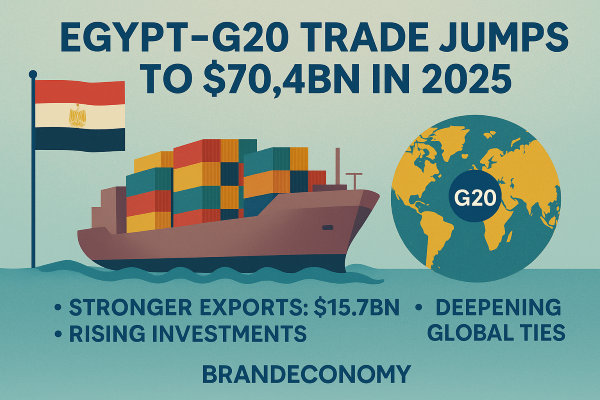
Egypt’s economic integration with the world’s largest economies continues to deepen, as new data shows trade with G20 nations surged to $70.4 billion in the first nine months of 2025 — a robust 14.1% year-on-year growth.
The update comes on the heels of the G20 Leaders’ Summit in Johannesburg, where Egypt’s Prime Minister, Mostafa Madbouly, represented the country in high-level discussions on global resilience, economic stability and sustainable development.



This growth underscores a strategic reality: Egypt is consolidating its position as one of Africa’s most globally-connected emerging markets, leveraging diversified export capacity, infrastructure reforms, and deeper investment alignment with G20 economies.
Exports Surge as Egypt Expands Global Market Footprint
Egyptian exports to G20 partners hit $15.7 billion, a 10.6% rise from 2024 — a signal of strong international demand despite global trade uncertainties.
Top Egyptian Export Categories
- Vegetables & fruits — $2.0bn
- Ready-made garments — $1.9bn
- Mineral fuels — $1.7bn
- Electrical equipment — $1.3bn
- Fertilisers — $1.1bn
- Iron & steel — $954.6m
BRANDECONOMY Insight:
Egypt’s diversified export base shows a maturing, multi-sector economy that is shifting from primary commodities into value-added manufacturing — a trend critical for long-term competitiveness.
Imports Rise as Industrial Demand Strengthens
Egypt imported $54.7 billion worth of goods from G20 economies — up 15.2% from last year — reflecting rising domestic consumption and industrial demand.
China maintained its position as Egypt’s largest trading partner at $13.9 billion.
Top Import Categories
- Electrical & mechanical machinery — $9.1bn
- Grains — $3.5bn
- Vehicles & tractors — $3.4bn
- Plastics — $2.5bn
This import profile reveals a country investing heavily in infrastructure, industrial capacity and food security, areas tightly linked to its Vision 2030 development framework.
Investment Flows Also Strengthening
Beyond trade, G20 investment in Egypt grew to $12.2 billion, up from $11.3 billion a year earlier — a vote of confidence in the country’s macroeconomic reforms and expanding industrial hubs.
At the same time, Egyptian outbound investment into G20 economies rose to $7.5 billion, reflecting the growing global footprint of Egyptian corporates.
Egypt is no longer a passive trade partner; the data shows it is emerging as a regional capital exporter, particularly across Europe, Asia and the Middle East.
What This Means for Africa and the Global Economy
1. Egypt Is Becoming a Strategic Gateway Between Africa and the G20
Its Suez Canal logistics advantage and expanding industrial zones position the country as a continental bridge for trade and investment.
2. The Surge in Machinery Imports Signals Industrial Repositioning
The rise in high-value machinery imports indicates renewed industrial expansion — from energy and logistics to textiles and construction.
3. Export Diversification Is Paying Off
Egypt’s continued push into garments, fertilisers and electrical equipment reduces vulnerability to commodity price shocks.
4. G20 Engagement Strengthens Global Economic Diplomacy
The Johannesburg Summit deepened Egypt’s geopolitical relevance across the G20 — especially within supply chain realignments and food security discussions.
5. Rising Investment Inflows Show Confidence Despite Global Volatility
G20 capital continues to view Egypt as a stable emerging market with long-term growth potential.
Conclusion: Egypt’s G20 Momentum Is a Blueprint for Emerging-Market Integration
With trade, investment and strategic partnerships all rising sharply, Egypt’s economic trajectory shows what is possible when domestic reforms align with global market opportunities.
The road ahead will require:
- sustained political stability,
- deeper private sector reforms,
- export expansion, and
- ongoing engagement with global economic blocs.
But the momentum is unmistakable: Egypt is accelerating into the future as one of Africa’s most globally integrated economies.