

EFCC Arrests Fleeing Ex-Minister Saleh Mamman After 75-Year Sentence Over ₦33.8bn Power Projects Fraud
A landmark moment in the country’s anti-corruption struggle

 The arrest of the convicted former Power Minister is more than a dramatic corruption headline. It is a test of Nigeria’s criminal justice system, its anti-graft resolve, and the cost of public theft in a country still starved of reliable electricity.
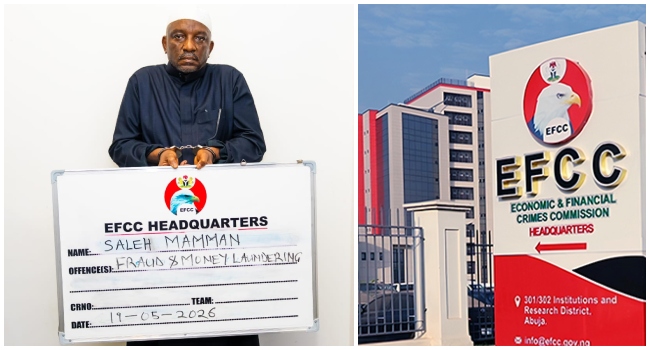 The arrest of the convicted former Power Minister is more than a dramatic corruption headline. It is a test of Nigeria’s criminal justice system, its anti-graft resolve, and the cost of public theft in a country still starved of reliable electricity.
The Economic and Financial Crimes Commission has arrested Saleh Mamman, Nigeria’s former Minister of Power, days after a Federal High Court in Abuja convicted and sentenced him in absentia to a cumulative 75 years’ imprisonment over a ₦33.8 billion money-laundering and fraud case linked to funds meant for the country’s critical Mambilla and Zungeru hydroelectric power projects.




The arrest, confirmed on Tuesday by EFCC Chairman Ola Olukoyede, ends a brief but politically embarrassing period during which Mamman remained at large despite his conviction on 12 counts and a judicial order directing security agencies, including international partners, to apprehend him. Multiple reports now place his arrest in Kaduna State, although some early accounts carried conflicting references to Kano.
Olukoyede said the former minister was taken into custody in the early hours of Tuesday morning, alongside two other individuals suspected of shielding him while he evaded arrest. The EFCC has also opened investigations into the property where Mamman was found, warning that harbouring a convicted person may itself attract legal consequences.
The arrest sharply raises the stakes in one of Nigeria’s most consequential corruption prosecutions in recent years. For the anti-graft agency, it is an opportunity to demonstrate that conviction is not a ceremonial exercise. For the judiciary, it is a test of whether a high-profile sentence can be made to bite. For the public, the case reopens a painful question: how much of Nigeria’s developmental paralysis is the price of public funds diverted from projects that were meant to power the economy?
A Rare Conviction in a Country Familiar with Grand Corruption
Mamman’s case stands out because convictions of former top officeholders in major corruption matters remain uncommon in Nigeria. Reuters described the judgment and subsequent arrest as a rare example of follow-through in the fight against high-level graft.
The Federal High Court, presided over by Justice James Omotosho, found Mamman guilty on all 12 charges brought by the EFCC. Prosecutors alleged that billions of naira earmarked for the Mambilla and Zungeru hydropower projects were laundered through private companies and diverted from their intended public purpose. The court held that the anti-graft agency proved its case beyond reasonable doubt.
Mamman’s sentence was severe. He received:
- Seven years’ imprisonment each on ten counts;
- Three years’ imprisonment on one count, with an option of a ₦10 million fine;
- Two years’ imprisonment on another count, without an option of fine.
Justice Omotosho directed that the prison terms should run consecutively, not concurrently, resulting in a cumulative 75-year sentence.
That judicial choice is central to the case’s significance. Had the terms run concurrently, the effective punishment would have been far lighter. By ordering consecutive sentences, the court signalled that the offences were not to be treated as a single technical breach, but as a sequence of distinct criminal acts with serious public consequences.
Sentenced in Absentia: Why the Court Proceeded Without Him
Mamman was absent when judgment was delivered on May 7, 2026, and remained absent when sentencing followed on May 13. The court concluded that his non-appearance was deliberate and proceeded under the authority of Nigeria’s Administration of Criminal Justice Act, 2015, which is designed, among other goals, to prevent defendants from frustrating criminal proceedings through absence or delay tactics.
Justice Omotosho held that Mamman could not claim a miscarriage of justice merely because he was not present at sentencing, given the procedural history of the matter and the legal framework empowering the court to move forward in appropriate circumstances.
The broader legal point is important. Nigerian criminal trials, especially in politically sensitive corruption matters, have often been weakened by adjournments, absences and procedural obstruction. Mamman’s case suggests a judiciary increasingly willing to rely on statutory tools intended to protect the integrity and speed of criminal justice administration.
That said, sentencing in absentia remains a serious step and one that courts must handle carefully. Its legitimacy depends on demonstrating that the defendant had due notice, adequate opportunity to participate, and no lawful basis for staying away. The reports around the Mamman proceedings indicate that the court was satisfied on those grounds.
From Power Minister to Convicted Fugitive
Saleh Mamman served as Minister of Power under former President Muhammadu Buhari from 2019 until his removal in a cabinet reshuffle in 2021. During that period, he oversaw a sector at the centre of Nigeria’s economic frustration: an electricity system with enormous unmet demand, chronic underperformance and repeated promises of reform.
The corruption case against him was tied to funds connected with two strategic hydropower projects:
- Zungeru, a 700MW hydropower project in Niger State;
- Mambilla, a long-delayed hydropower project in Taraba State planned at roughly 3,050MW.
These projects matter because Nigeria continues to struggle with a severe electricity deficit. In April 2026, the Nigerian Electricity Regulatory Commission reported that average available generation capacity stood at about 4,286MW out of installed capacity of 13,625MW, with average utilised load significantly constrained by system limitations. Reuters separately reported in February that gas shortfalls and sector debts had pushed national generation down to about 4,300MW.
Against that backdrop, the alleged diversion of funds attached to major electricity projects becomes more than a corruption allegation. It becomes a development crime with visible consequences: factories run below potential, households rely on costly alternatives, small businesses lose margins, and the country’s growth ceiling remains artificially low.
The Power Sector Context: Corruption as Economic Sabotage
Nigeria’s power crisis is often explained through technical language — gas constraints, transmission bottlenecks, grid collapses, subsidy shortfalls, tariff disputes, stranded generation. These are real problems. Yet corruption remains one of the most damaging hidden variables in the sector’s failure to deliver.
Public funds diverted from generation and infrastructure do not disappear in abstraction. They reappear as:
- Projects delayed or never completed;
- Contractors underperforming or abandoning work;
- Communities excluded from development;
- Manufacturers paying more for diesel and self-generation;
- Consumers trapped in unreliable supply;
- Investor confidence weakened by policy risk and institutional distrust.
The Mamman case is therefore symbolically heavy. The funds at the centre of the conviction were allegedly associated with projects intended to expand Nigeria’s power capacity in a country that continues to operate far below installed potential.
The public frustration is easy to understand. When power fails, the cost is shared across every layer of society. When money meant to improve that system is unlawfully diverted, the harm is not confined to a treasury ledger. It spreads through households, companies, hospitals, schools and the national economy.
The EFCC’s Message: Conviction Must Lead to Consequence
Olukoyede presented Mamman’s arrest as proof that those convicted of looting public resources will not escape accountability by vanishing after trial. That message is politically and institutionally important for an anti-corruption regime often criticised for securing headlines more easily than durable consequences.
The EFCC’s handling of the case now enters a new phase. With Mamman in custody, the immediate question turns to enforcement of the sentence and any post-conviction legal steps available to him. The trial court had ordered that the prison term begin from the date of his apprehension, meaning the countdown now has real force.
There is also the matter of asset recovery. Reports on the sentencing indicate that the court ordered forfeiture of recovered foreign currencies and properties linked to Mamman, while also directing restitution measures tied to the amount the prosecution established during trial.
For the public, recovery is almost as important as incarceration. Punishment demonstrates consequence; asset recovery demonstrates repair. In corruption cases involving public infrastructure, citizens want to know not only that offenders are jailed, but also that diverted assets are traced, seized and redirected where possible.
Why This Case Matters for the Rule of Law
The Mamman conviction and arrest matter because they sit at the intersection of three fragile Nigerian institutions:
- The judiciary, which must show that politically exposed persons can be tried and sentenced under law;
- The anti-graft system, which must prove it can enforce judgments, not merely announce investigations;
- The development state, which must protect scarce public capital from diversion if infrastructure policy is to have credibility.
The arrest of a convicted former minister does not solve Nigeria’s corruption problem. It does not, by itself, repair Mambilla or deliver power to communities. But it strengthens one principle that often appears weak in public life: office is not immunity, and flight is not acquittal.
That principle deserves institutional reinforcement.
A Wider Signal to Political Elites
Mamman’s conviction is also significant in the context of former public officials facing scrutiny over conduct in office. Nigerian courts and anti-graft agencies have, over the years, struggled to conclude high-profile cases with finality. The conviction of a former cabinet minister on major financial-crime charges sends a warning that the prosecutorial bar may be shifting. Reuters noted that convictions of senior officials remain uncommon, which is precisely why this judgment carries unusual weight.
The message to current and former public officials is unmistakable: stewardship of public funds is not a discretionary privilege. It is a legal duty.
The deeper challenge is consistency. One conviction, however dramatic, cannot carry the entire burden of anti-corruption credibility. Nigerians will judge the system by whether similar cases are investigated with independence, prosecuted competently and resolved within a reasonable time, regardless of political affiliation.
From Mambilla to the Marketplace: The Economic Cost of Stolen Infrastructure Funds
It is tempting to see cases like Mamman’s through the narrow frame of legal drama — arrest, trial, judgment, sentence. But that would understate the economic story.
Hydropower projects are not prestige monuments. They are long-lived national assets meant to lower power costs, support manufacturing, improve grid stability and unlock productivity. The Mambilla project, if completed at its long-proposed scale, would rank among Nigeria’s most consequential power-generation investments. The Zungeru facility, already a major hydropower asset, was similarly central to the country’s power-expansion ambitions.
Every naira misdirected from such projects compounds the development gap. In a country where businesses still shoulder enormous self-generation costs and households routinely endure outages, diversion of infrastructure funds is not merely illicit enrichment. It is a transfer of public hardship into private gain.
That is why this case should resonate far beyond the courthouse.
BRANDECONOMY Insight
The Saleh Mamman Case Is About More Than Corruption — It Is About the Criminalisation of Development Failure
The arrest of Saleh Mamman after his 75-year conviction is one of the most consequential corruption enforcement moments in recent Nigerian memory because it links three issues the country too often treats separately: public theft, infrastructure collapse and everyday economic pain.
The funds at the centre of the case were associated with power projects. That distinction matters. Electricity is not peripheral to growth; it is the base layer of productivity. When a factory cannot run, when a school has no stable power, when small businesses spend excessively on fuel, the economic damage spreads far wider than any single project account.
This is why corruption in power-sector spending should be understood as development sabotage.
The judgment also marks a notable shift in judicial posture. By imposing consecutive sentences and allowing sentencing to proceed in absentia under the law, the court signalled that procedural evasion will not always succeed in frustrating justice. The EFCC’s subsequent arrest of Mamman adds operational force to that signal.
Yet the true measure of progress will be continuity. Nigeria has seen anti-corruption moments before, only for public confidence to recede when cases became selective, stalled or politically compromised. The Mamman matter should therefore become a benchmark, not an exception.
The country needs three things from this point forward:
- Speedier resolution of major corruption cases;
- Aggressive asset recovery tied to public restitution;
- A stronger legal and political culture in which diversion of infrastructure funds attracts severe and predictable consequence.
If Nigeria is serious about development, it must become serious about punishing those who steal development.