
Dangote Refinery’s ₦100bn Suit Against NNPCL, NMDPRA Over Import Licences Resumes November 5

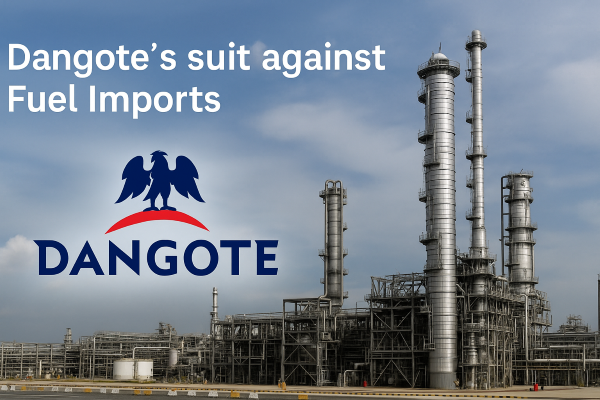
The Federal High Court in Abuja has adjourned to November 5, 2025, the much-watched ₦100 billion lawsuit filed by Dangote Petroleum Refinery and Petrochemicals FZE against the Nigerian National Petroleum Company Limited (NNPCL) and the Nigerian Midstream and Downstream Petroleum Regulatory Authority (NMDPRA). The case, which centers on the issuance of import licences for refined petroleum products, underscores the growing friction between Nigeria’s biggest indigenous refinery and the government’s oil market regulators.
The court, presided over by Justice Mohammed Umar, could not sit due to the judge’s official engagement at the Enugu Division. The matter, previously handled by Justice Inyang Ekwo, was reassigned and is now set for hearing after the parties were directed to regularize their court processes.



The Legal Face-Off: Monopoly vs. Market Competition
At the heart of the Dangote Refinery lawsuit lies Dangote Refinery’s contention that the NMDPRA violated Sections 317(8) and (9) of the Petroleum Industry Act (PIA) by granting multiple oil import licences to NNPCL and select private marketers—including AYM Shafa Limited, A. A. Rano Limited, Matrix Petroleum Services Limited, T. Time Petroleum Limited, and 2015 Petroleum Limited—despite the refinery’s readiness to meet domestic demand.
Dangote is seeking:
- ₦100 billion in damages against NMDPRA;
- A court declaration nullifying all recent import licences issued to NNPCL and the oil marketers; and
- An affirmation that import permits can only be granted when there is a proven product shortfall, as stipulated by the PIA.
Through its counsel, Ogwu Onoja, SAN, the refinery alleges that the continued importation of petroleum products undermines its operations, discourages local refining, and contradicts the government’s self-sufficiency and forex conservation agenda.
NNPCL’s Defence: A Case of “Mistaken Identity”
The NNPCL, in its preliminary objection, described the lawsuit as “incompetent, premature, and misleading.”
Represented by Afe Babalola & Co., the company argued that the plaintiff sued a non-existent entity, “Nigeria National Petroleum Corporation Limited,” which, according to its filing, does not exist in law.
An affidavit deposed by Isiaka Popoola, a clerk in the law firm, noted that a corporate search at the Corporate Affairs Commission (CAC) confirmed there was no entity under that name, urging the court to strike out the case for lack of jurisdiction.
However, Justice Ekwo had earlier dismissed a similar objection, allowing Dangote to amend the suit and correctly reflect Nigerian National Petroleum Company Limited (NNPCL)—confirming the matter’s legal validity before reassignment.
Regulator’s Stand: ‘We’re Preventing Monopoly, Not Violating Law’
The NMDPRA, in its counter-affidavit, defended its actions as necessary and lawful, arguing that Dangote Refinery’s production has not yet met national consumption requirements.
According to Idris Musa, a Senior Regulatory Officer with the authority, the import licences were granted “to bridge supply gaps” and ensure uninterrupted fuel availability nationwide.
He emphasized that under the PIA, the regulator has a dual responsibility to ensure energy security and promote market competition, preventing “unhealthy dominance or monopoly” in the downstream petroleum sector.
“Dangote’s claim of a grand conspiracy is unfounded. Our mandate includes maintaining open competition and protecting consumers from monopolistic pricing,” Musa stated.
Marketers Warn: Blocking Imports Could Cripple the Economy
Independent marketers, including AYM Shafa, A. A. Rano, and Matrix Petroleum, jointly countered Dangote’s suit, warning that granting the refinery’s requests could “spell doom for Nigeria’s oil sector.”
They argued that Dangote’s refinery—while a national asset—has not yet attained full operational capacity to meet the country’s daily fuel consumption.
“Restricting imports now would create artificial scarcity, drive up prices, and jeopardize economic stability,” the marketers said in their filing.
They maintained that multiple import players remain essential until local refining capacity is proven to be both sufficient and consistent.
Legal History: Earlier Dismissal of NNPCL’s Objection
In March 2025, Justice Ekwo had struck out NNPCL’s earlier objection to the Dangote Refinery lawsuit, ruling that the corporation ought to have filed a substantive defence before challenging jurisdiction.
The court also dismissed an attempt by the Federal Competition and Consumer Protection Commission (FCCPC) to join the case, calling the move “a meddlesome interloper,” and reaffirmed the legitimacy of Dangote’s challenge.
BRANDECONOMY Insight: A Defining Moment for Nigeria’s Energy Market
The Dangote–NNPCL legal battle is far more than a courtroom drama—it’s a clash of visions shaping the future of Nigeria’s oil and gas economy.
For Dangote Refinery, which represents a $20 billion investment hailed as Africa’s largest, the case is about protecting domestic production and curbing policy contradictions that allow continuous importation despite self-sufficiency goals.
For regulators and marketers, it’s about market liberalization, fair competition, and preventing a monopoly chokehold on fuel supply and pricing.
The outcome of this case could redefine energy regulation under the PIA, set a precedent for market fairness, and determine how Nigeria balances national interest, industrial protection, and consumer welfare in a post-subsidy environment.
As the court resumes on November 5, 2025, stakeholders across finance, energy, and industry will be watching closely—because this ruling could reshape Nigeria’s oil market for decades.