
Dangote’s $2.5bn Capital Raise: Is Africa Ready for Its Biggest-Ever IPO?

 An extraordinarily successful private placement has demonstrated that global capital believes in African industrial scale. But converting that enthusiasm into a landmark public listing will test Nigeria’s market liquidity, regulatory discipline, corporate transparency—and the credibility of the continent’s investment story.
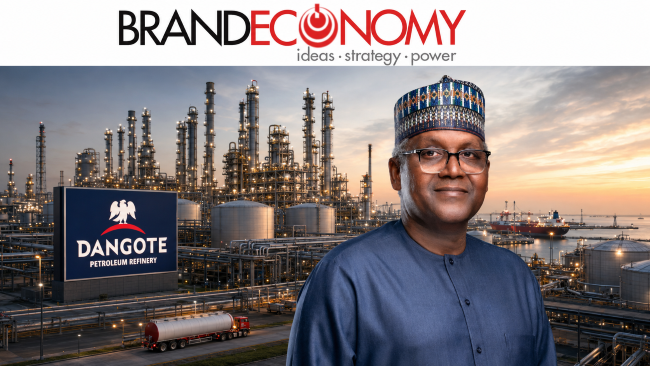 An extraordinarily successful private placement has demonstrated that global capital believes in African industrial scale. But converting that enthusiasm into a landmark public listing will test Nigeria’s market liquidity, regulatory discipline,
 Africa’s biggest refinery has just completed one of the continent’s most consequential capital-raising exercises.
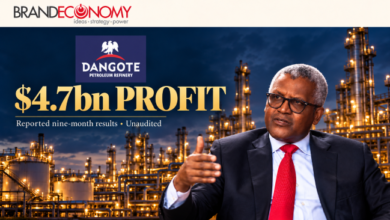
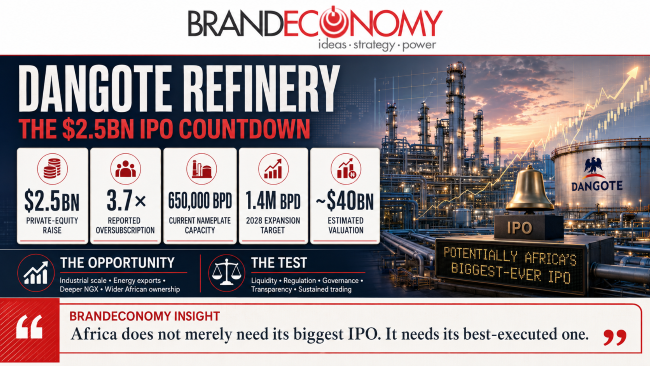
Dangote Petroleum Refinery and Petrochemicals secured $2.5 billion through a private-equity placement reportedly subscribed 3.7 times over its initial target. The transaction brought major African institutional investors—including Africa Finance Corporation and an investment vehicle facilitated by Afreximbank—into the refinery’s ownership structure.




The capital will strengthen the company’s balance sheet and support an expansion intended to raise processing capacity from 650,000 barrels per day to 1.4 million barrels by 2028.
Yet the private placement may be only the opening act.
Dangote is preparing the refinery for a possible public listing at an estimated valuation of approximately $40 billion. Depending on the percentage offered, the transaction could raise several billion dollars and become Africa’s largest-ever initial public offering.
That prospect raises a question extending far beyond one company: Is Africa—and particularly Nigeria’s capital market—ready to host a public offering of such unprecedented scale?
The answer is yes, but not through business as usual.
What the $2.5 Billion Placement Really Proves
 What the $2.5 Billion Placement Really Proves
The oversubscription is a powerful vote of confidence in African industrial assets.
For decades, global investors have frequently approached Africa through sovereign debt, telecommunications, banking, extractive industries and short-term portfolio trades. The Dangote transaction presents something different: privately developed infrastructure of global scale, processing African resources into products with regional and international markets.
Investors are not merely purchasing a refinery. They are buying exposure to Africa’s energy deficit, population growth, industrialisation, import substitution, petrochemicals demand and expanding consumer markets.
The placement also provides Dangote with more than cash. Reputable institutional shareholders can strengthen governance, impose financial discipline and enhance credibility ahead of a public offering.
However, private-placement demand should not be mistaken automatically for successful IPO demand. Private-equity investors can negotiate access to confidential information, lock-up protections, governance rights and preferential terms unavailable to ordinary shareholders.
The public market will require a wider and more demanding proposition.
A $40 Billion Valuation Is Not a $40 Billion IPO
The distinction is essential.
A predicted $40 billion valuation represents the estimated worth of the entire company. It does not mean the refinery will necessarily ask investors to contribute $40 billion.
If, for example, 10 per cent of the business were offered publicly at that valuation, the transaction would be worth approximately $4 billion. Even that would be historic by African standards and transformative for the Nigerian Exchange.
It would also be a considerable liquidity test.
NGX equities ended 2025 with market capitalisation of approximately ₦99.38 trillion, following a powerful 51.19 per cent market rally. Yet total equities turnover for the year was about ₦5.96 trillion.
A hypothetical $4 billion offer—depending on the exchange rate—could approach the value of an entire year’s trading on the exchange.
That does not make the IPO impossible. It demonstrates why the transaction cannot depend on existing Nigerian liquidity alone.
Nigeria Has Capital—but Not All of It Is Available
Nigeria’s pension-fund assets reached approximately ₦31.48 trillion, or $22.8 billion, by July 2026. Insurance companies, asset managers, banks, family offices, sovereign institutions and high-net-worth individuals represent additional pools of domestic capital.
But headline assets are not the same as investible IPO demand.
Pension portfolios must observe regulatory allocation limits and risk controls. A substantial proportion of their assets remains invested in government securities. Fund managers must also avoid excessive exposure to a single company, sector or corporate group.
Retail investors may demonstrate enormous enthusiasm for Dangote’s name and the refinery’s national significance, but their purchasing power has been weakened by inflation, high living costs and constrained household savings.
The transaction must therefore mobilise several layers of demand:
- Nigerian institutional investors;
- African pension and sovereign-wealth funds;
- international emerging-market and energy funds;
- development-finance institutions;
- diaspora investors;
- high-net-worth individuals; and
- Nigerian retail shareholders.
The likely solution is a carefully staged, pan-African and internationally marketed offering—possibly supported by secondary listings, depositary instruments or cross-border trading arrangements.
Africa can absorb the IPO, but it will have to act as an integrated investment market rather than a collection of fragmented national exchanges.
Regulation Must Come Before Excitement
The Securities and Exchange Commission has already demonstrated the appropriate degree of caution.
In June, the SEC ordered an immediate halt to unauthorised promotional and pre-marketing activity surrounding a purported Dangote Refinery IPO. The regulator stated that no application for an IPO or public offer had been filed or approved at that time.
That intervention was not opposition to the listing. It was a defence of market integrity.
A transaction this significant cannot be marketed through rumours, unofficial subscription invitations or valuation speculation. Investors require an approved prospectus, independently audited financial statements, clearly disclosed risks, verified use of proceeds and equal access to material information.
The successful $2.5 billion private placement changes the company’s capital structure, but it does not replace the formal approval process for a public offer.
Nigeria’s credibility will depend as much on how rigorously the IPO is regulated as on how much money it raises.
The Questions Investors Must Ask
The refinery’s size and strategic importance are undeniable. But national pride is not an investment thesis.
Prospective shareholders will need answers to several fundamental questions:
- What are the refinery’s sustainable revenues, margins and free cash flows?
- How much debt remains on the balance sheet, and at what cost?
- What valuation and ownership dilution resulted from the private placement?
- How will the $2.5 billion proceeds be allocated?
- How much additional capital will the expansion require?
- Can Nigeria provide reliable crude supplies on commercially competitive terms?
- What proportion of output will serve Nigeria versus export markets?
- How exposed are earnings to refining-margin cycles, exchange rates and regulation?
- What related-party transactions exist within the Dangote ecosystem?
- How independent and empowered will the post-listing board be?
Investors must also assess operational reliability. Refineries are extraordinarily complex assets exposed to maintenance shutdowns, equipment failures, feedstock constraints, volatile crude prices and fluctuating product margins.
The plan to increase capacity to 1.4 million barrels daily would make the complex one of the world’s largest. It could generate exceptional scale advantages—but it also introduces substantial execution, financing and construction risks.
Market Implications
A successful listing could transform the Nigerian Exchange.
It would deepen the market’s energy representation, attract global investment research, broaden sectoral diversification and create a new benchmark for African infrastructure assets.
The IPO could also encourage other major privately owned Nigerian businesses to list. Nigeria’s exchange has long suffered from the absence of many of the companies dominating telecommunications, energy, technology, consumer services and industrial production.
Dangote Refinery could demonstrate that the public market is not simply an exit route. It can be a platform for financing expansion, widening ownership and institutionalising an enterprise beyond its founder.
However, an oversized offering could also absorb capital that might otherwise support banks, manufacturers and smaller new listings. Careful timing, cornerstone allocations and phased issuance may be necessary to prevent market crowding-out.
The true achievement would not be one spectacular listing followed by silence. It would be an IPO that catalyses a sustained pipeline of credible African companies.
Brand Implications
The refinery has become a symbol of African ambition: audacious, controversial, capital-intensive and impossible to ignore.
A public listing would fundamentally change the obligations attached to that brand.
Dangote Refinery would have to communicate not only as a national industrial champion but as a publicly accountable institution. Production claims, expansion targets, pricing decisions, regulatory disputes, operational interruptions and financial performance would face continuous scrutiny.
The brand must therefore move from personality-led confidence to disclosure-led trust.
The greatest reputational risk would be allowing patriotic excitement to outrun verifiable financial information. The greatest opportunity would be proving that an African industrial giant can combine entrepreneurial boldness with world-class transparency and minority-shareholder protection.
Investor Relevance
The proposed listing offers exposure to a strategically positioned refinery serving one of the world’s fastest-growing regions. It could benefit from Africa’s fuel deficit, export opportunities, petrochemical demand and the commercial advantages of scale.
But investors should separate three ideas too often conflated:
- A transformative national asset is not automatically an attractively priced investment.
- A heavily oversubscribed private placement does not guarantee post-listing liquidity.
- A compelling growth story does not eliminate governance, operational or valuation risk.
The prospectus—when approved and released—must carry more weight than the prestige of the Dangote name.
BRANDECONOMY Insight
Africa is ready for its biggest IPO in ambition. Whether it is ready in market structure remains the defining question.
The $2.5 billion placement shows that international and African institutions will finance industrial assets when scale, strategic relevance and commercial opportunity align. What Nigeria must now demonstrate is that it can convert private enthusiasm into a transparent, liquid and responsibly regulated public market.
A successful Dangote Refinery IPO would do more than raise expansion capital. It could reposition Lagos as a serious global capital-formation centre, connect African savings with African infrastructure and allow ordinary investors to own part of the continent’s industrial future.
But the transaction must not become a referendum on patriotism. It must remain an investment evaluated through earnings, cash flow, governance, price and risk.
Africa does not merely need its biggest IPO.
It needs its best-executed one.